
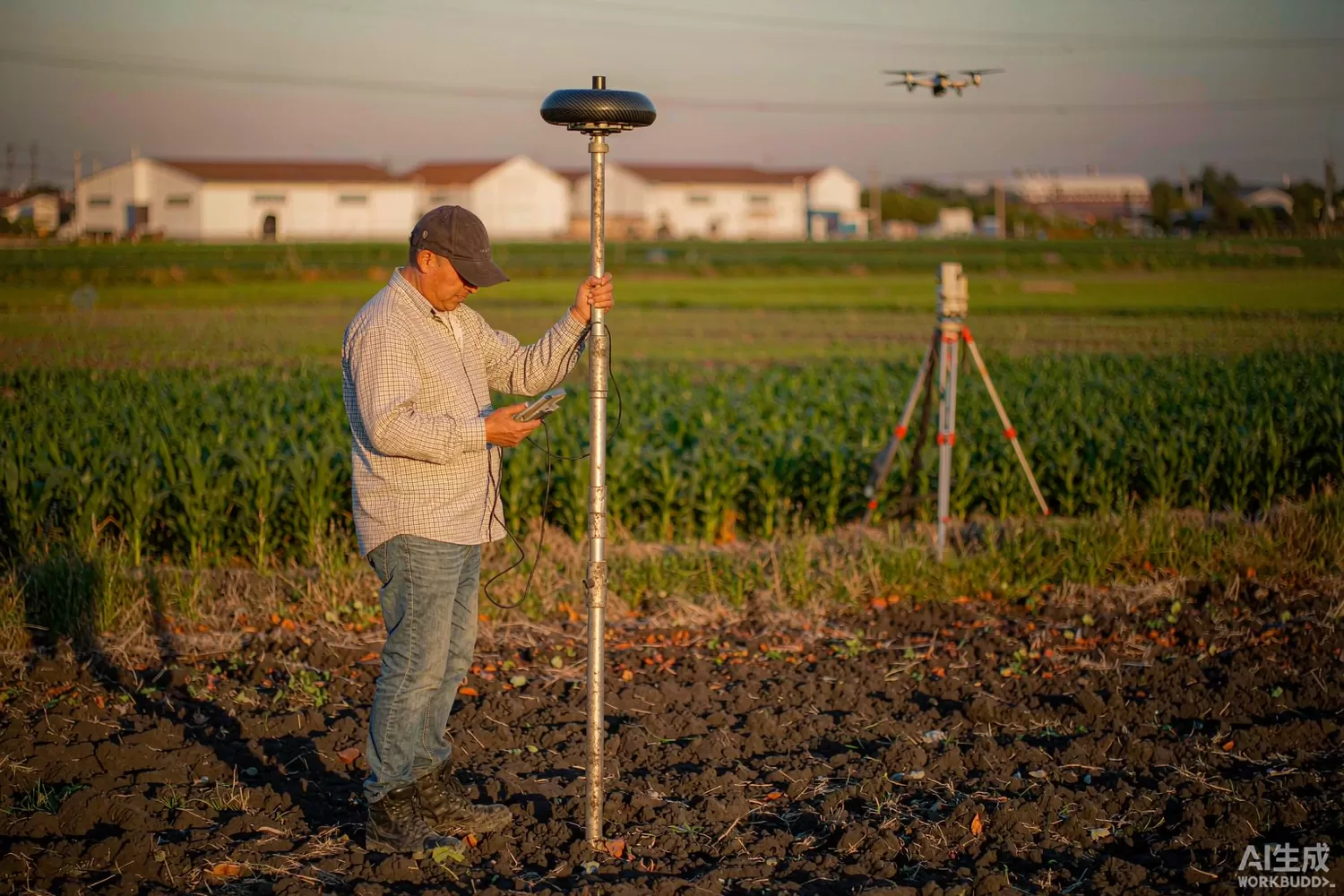
Standard GNSS puts a phone within a few metres of the truth. That is fine for navigation and useless for a survey stake, an autonomous mower or a drone spraying to a 20-centimetre line. The technology that closes the gap — RTK (Real-Time Kinematic) — stops treating satellite signals as codes and starts measuring their carrier phases, which drift only millimetres. This article walks the RTK signal chain from antenna to centimetres, what PPP-RTK services are doing to the infrastructure, and where domestic receivers — already strong in this category — compare with the imported precision boards. For the fundamentals of standard reception, see our GNSS receiver article.

Application logic: from metres to centimetres
- Carrier-phase measurement — the GNSS carrier oscillates 19 cm per cycle at L1; measuring its phase with a fraction of a cycle gives a ranging signal orders finer than the code, but with an unknown integer-cycle ambiguity that the receiver must resolve.
- Ambiguity resolution (the RTK fix) — by comparing measurements from a reference station at a known point, the rover solves the integer ambiguities and locks to a “fixed” solution worth a centimetre or two; before that it floats at sub-metre level, and good receivers report exactly which state they are in.
- Base-rover architecture — a local base transmits corrections over radio to rovers within kilometres, or a network RTK service (virtual reference stations) serves corrections over the internet anywhere inside its anchor grid.
- Multi-frequency, multi-constellation — L1/L2/L5 (and BeiDou B1/B2/B3) signals shorten fix times and survive interference on any single band; dual-frequency is now the entry ticket for serious RTK.
- Antenna quality — at centimetre targets the antenna is part of the measurement: phase-centre stability, multipath rejection and ground-plane behaviour separate a survey antenna from a patch.
- Inertial coupling — a MEMS IMU bridges the gaps: outages under bridges, tilt compensation for the survey pole, and smoothing through foliage flicker; tightly-coupled GNSS/INS is the professional default.
The parameters that decide a real centimetre
- Fix rate and time-to-first-fix — the percentage of epochs holding a fixed solution through trees, fences and urban walls matters more than the theoretical accuracy; look at fix-rate statistics in your real environment.
- Baseline length tolerance — correction quality degrades with distance from base; network services manage this with dense anchors, single-base setups do not.
- Receiver clock and phase noise — the oscillator’s stability feeds directly into phase measurement quality; precision boards specify it, commodity modules do not.
- Multipath rejection — reflected signals corrupt phase measurements subtly; antenna design and receiver-side mitigation decide urban performance.
- Latency of corrections — corrections age fast; a rover hanging on stale base data quietly drifts while still reporting “fixed”.
- Ruggedness of the data link — the corrections channel (radio, 4G, satellite L-band) is a single point of failure; professional setups carry a fallback.
What is changing: PPP-RTK, mass-market chips and the correction-economy
Three currents reshape the field. First, PPP-RTK service layering: regional augmentation services deliver satellite-broadcast or cellular corrections that give centimetre-class results without a local base — agriculture and machine control have adopted this aggressively, and the receiver must now hold multi-service correction stacks. Second, mass-market dual-frequency: smartphone-class chips acquired L5/dual-band capability, collapsing the price of “good enough” sub-metre work and squeezing the middle of the market; the true centimetre tier still needs the professional phase-quality hardware. Third, integration into machines: RTK is becoming a component — inside a mower, a tractor, a crane — where the receiver’s API, its INS coupling and its firmware-update story matter as much as raw accuracy. On the silicon side, the receivers with the deepest phase-measurement heritage keep the top tier, and a capable mid-tier has opened precisely where the domestic vendors now compete.
Domestic alternatives: suppliers and indicative cost
This is the strongest domestic category in the whole satellite chain. Unicore Communications’ UM980/UM982-class receivers — multi-constellation, multi-frequency RTK with integrated INS coupling options — are documented, shipping and widely used domestically; Tersus GNSS and ComNav Technology offer board-level RTK products with published specifications; and the timing-adjacent candidates from our GNSS timing article share the same RF heritage. The imported anchors remain u-blox’s ZED-F9P class at the accessible end and the survey-grade boards from the US and European houses at the top. The honest comparison: at the accessible centimetre tier, domestic boards deliver the headline accuracy at a fraction of the price, with the deltas appearing in edge-case robustness — extreme multipath, long baselines, high-vibration platforms — where the imported phase heritage still shows. For high-volume agricultural and robotics applications, the domestic boards are the default economic choice.
A realistic RTK rover bench: an Unicore-class receiver board as the GNSS core, an Artery AT32F403ARCT7 as the application and logging controller, a Cosine COS29752WU LDO on the RF rail, a GigaDevice GD25Q128ESIG for logs and firmware, a MEMS MPU6050 in development fixtures to prototype the INS-coupling interface, and a PCF8563T RTC for time-stamped logs.
Price figures below are indicative public-market reference ranges for moderate volumes, compiled from publicly observable listings. They fluctuate with the spot market, package option, grade (industrial, automotive, screened) and order quantity, and must not be read as a quotation. Ask us for a firm price on your exact part numbers and quantities.
| Function (imported anchor) | Example import part / class | Indicative import price (USD) | Domestic candidate | Indicative domestic price (USD) |
|---|---|---|---|---|
| Dual-frequency RTK board (accessible tier) | u-blox ZED-F9P class | 180 – 260 | Unicore UM980-class boards | 60 – 120 |
| Survey-grade OEM board (top tier) | US/European survey boards | 600 – 1500 | Tersus / ComNav high-end boards (family level) | 300 – 700 |
| Application / logging controller | STM32-class Cortex-M | 1.5 – 3.5 | AT32F403ARCT7 (Artery) | 0.5 – 1.2 |
| RF rail LDO | Imported low-noise LDO | 0.3 – 0.8 | COS29752WU (Cosine) | 0.07 – 0.20 |
| Log/firmware storage NOR flash | 128 Mbit serial NOR | 0.7 – 1.6 | GD25Q128ESIG (GigaDevice) | 0.22 – 0.55 |
| IMU (INS coupling prototyping) | Tactical-grade IMU | 8.0 – 25.0 | MPU6050 (dev fixture only) | 0.5 – 1.5 |
| RTC for event logs | Imported low-power RTC | 0.35 – 0.9 | PCF8563T | 0.10 – 0.30 |
Read the table as a screening tool, not a quotation. The structural point: RTK pricing broke years ago — the domestic boards moved the accessible centimetre tier from thousands of dollars to hundreds, and the remaining premium buys heritage in edge cases rather than headline accuracy. Procurement advice is to qualify by fix-rate statistics in your real working environment and by the vendor’s correction-service integrations, then let the two-to-fourfold board saving pay for the antenna upgrade that actually improves performance. Where imports still earn their place is survey-grade contracts that name the instrument class, and platforms whose firmware ecosystems are already validated on specific imported boards.
Validation flow before you commit
Log fix statistics where the machine will work: a full day of epochs under the tree line, the warehouse eave and the transmission line that define your site, comparing fixed-rate, float-rate and solution age. Verify correction latency handling by pulling the correction link for seconds at a time and watching the reported state. Run the antenna comparison first — a better antenna on a cheaper board routinely beats a stock antenna on a dearer one. Finally, if the platform moves, drive the vibration profile early: phase loops and oscillator behaviour under real vibration separate the boards from the brochures.
Frequently asked questions
Why not just use the correction service without a local base?
You can — PPP-RTK services remove the base requirement — but fix times are longer and performance depends on the service’s anchor density in your region; local bases still win for fixed sites.
Does dual-frequency really matter?
For reliable fixes in difficult sky views, yes: the second frequency speeds ambiguity resolution and provides a fallback when one band is jammed or blocked.
Why is the antenna half the budget?
At centimetre targets the antenna’s phase-centre stability and multipath behaviour are part of the measurement; a receiver cannot undo what the antenna corrupts.
Are domestic RTK boards export-safe?
For most commercial applications yes, but confirm the end-market’s import rules for GNSS equipment with certain precision classes — some jurisdictions treat high-precision receivers as controlled items.
About us & trademarks: JTDZ Tech (Shenzhen Jingteng Electronics Technology Co., Ltd.) is an independent distributor of electronic components. We are not an authorised distributor or representative of the imported manufacturers named in this article. Manufacturer, brand and part names are used for identification purposes only; all trademarks remain the property of their respective owners. Cross-reference information in this article is based on publicly available sources, is subject to change, and is not a substitute for your own engineering validation. Always verify specifications against the manufacturer's datasheet before design-in or purchase.
