
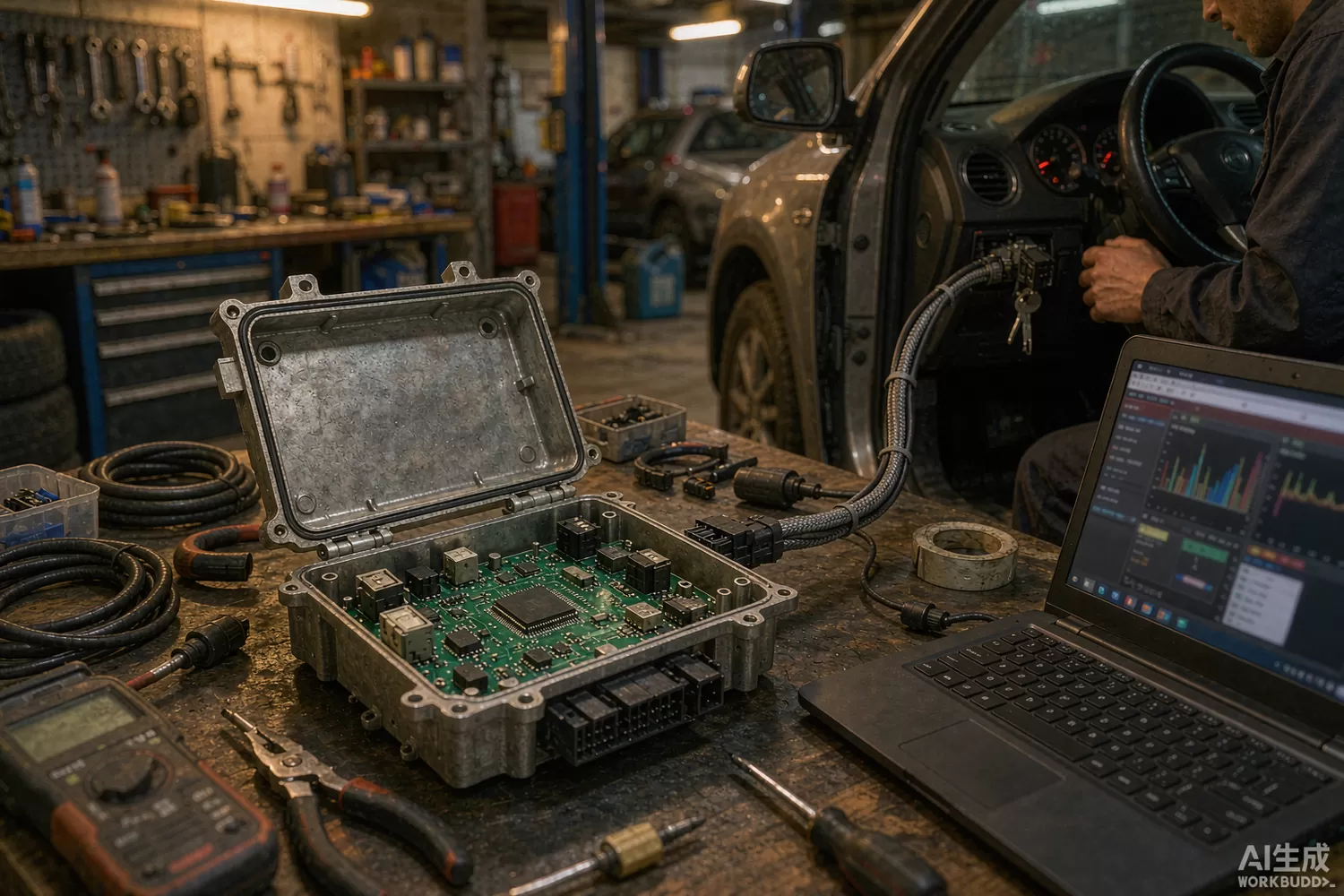
The telematics box (T-Box) is the car’s phone, GPS and alarm dialer fused into one module that must never, ever be off: it answers the manufacturer’s cloud, reports the crash in an emergency call, wakes for an OTA campaign at 3 a.m., and does it all while the car is parked for weeks in a underground garage. That never-off duty cycle, plus automotive qualification on every part, makes the T-Box the most demanding environment in which ordinary IoT silicon is asked to live. This article walks the architecture, the eCall requirements that shape it, and the domestic supply picture across modem, GNSS and controller layers. For the timing-precise side of GNSS, see our GNSS timing article.

Application logic: a terminal that is never allowed to sleep
- Cellular connectivity (Cat.4/Cat.1, 4G today, 5G/RedCap entering) — the module carries telematics data, OTA packages and emergency voice; voice fallback (CSFB or VoLTE) is mandatory because an emergency call cannot ride data-only paths.
- GNSS reception — a multi-constellation receiver (GPS/BeiDou/GLONASS/Galileo) feeds position to emergency services and to the fleet cloud; the cabin is a hostile RF home: glass with metal coatings, roof antennas with long cables, and ignition-noise transients on the power rails.
- eCall / NG-eCall — triggered by airbag events or the SOS button, the terminal must place a 112-class call, push a minimum set of data (position, direction, VIN, timestamp) and open a hands-free voice channel; NG-eCall migrates the emergency data path to packet-based transmission, with new conformance requirements.
- Power-on-CD (crash-durability) architecture — after an accident removes main power, supercapacitors or a reserve cell must keep the modem alive long enough to complete the emergency call; the power tree is designed backwards from that requirement.
- Controller and buses — a qualified MCU bridges the modem and the vehicle: CAN/CAN-FD to the gateway, LIN to comfort functions, and a secure element for certificate-based authentication to the manufacturer cloud.
- Always-on wake logic — parked cars still receive remote commands; the T-Box keeps a low-power receive path or timer discipline that wakes the modem for messages without draining the starter battery over weeks.
The parameters that decide a T-Box that survives
- Modem voice-path conformance — emergency calls are a regulatory matter; the modem’s certification package (and its voice fallback behaviour on every band) is part of the vehicle’s type approval.
- GNSS sensitivity under load — first fix after weeks parked, then tracked accuracy through tunnels and urban canyons; antenna, LNA and receiver quality show up as route continuity, not as a lab number.
- Standby drain — microamps matter: the difference between a 3-week and a 6-week parked-car battery life is a warranty and a tow truck.
- Temperature and qualification grade — AEC-Q grades on every part, from the crystal to the flash; consumer-qualified parts fail exactly in the first summer of a windshield-adjacent install.
- CAN robustness — the vehicle bus is an electrically brutal place; transceiver bus-fault tolerance decides whether a wiring fault takes the telematics down with it.
- Cybersecurity readiness — regulations now require secured OTA and authenticated cloud links; the secure element and its key management are audited, not just installed.
What is changing: NG-eCall, RedCap and the software-defined T-Box
Three shifts are reshaping the box. First, NG-eCall: emergency data moves onto packet-switched infrastructure, which changes modem conformance and pushes the minimum-set-of-data logic into the application processor; every market phase-in adds a conformance wave. Second, 5G RedCap: the mid-tier 5G class targets exactly telematics data rates, promising lower cost and power than full 5G while keeping the network’s future; module roadmaps are converging on RedCap as the next T-Box default. Third, software definition: OEMs consolidate several antenna-connected functions (telematics, V2X, key fob receiver) into shared compute with a service layer, pressuring the T-Box to become a software-upgradable platform rather than a fixed-function modem box — more memory, more secure storage, more processing headroom. On the silicon side, the controller grows a crypto island, and the power architecture adds intelligence to arbitrate wake sources.
Domestic alternatives: suppliers and indicative cost
The imported anchors are the established automotive-grade cellular modules (u-blox, Telit, Quectel’s international lines) and multi-constellation GNSS receivers from the established European vendors. The domestic picture is strong and layered. At module level, domestic Cat.1 and Cat.4 modules built on UNISOC and ASR silicon are the volume default in Chinese fleets, and automotive-qualified lines exist from the leading domestic module houses. At chip level, UNISOC’s 8910DM-class Cat.1 platforms and ASR’s equivalents power the value segment; GNSS chip supply is genuinely domestic — Unicore Communications’ multi-constellation receivers and AT6558R-class parts as covered in our GNSS receiver article) — with automotive qualification to confirm per line. For the controller, Artery’s AT32A automotive-qualified MCU family is the natural bench anchor. Frame modem choices by certification: a modem without the target market’s type-approval history is a schedule risk no price fixes.
A realistic T-Box bench: an Artery AT32A403ACGT7 automotive-qualified controller, Cosine COS1042T and SIT SIT1042AQT CAN transceivers for dual bus channels, a DS3231SN precision RTC as the time base for logged events, a Cosine COS29752WU LDO on the standby rail, a Puya PY25Q128HA for firmware images, and a Titan Micro TS2502PN on the diagnostic and antenna-adjacent ports.
Price figures below are indicative public-market reference ranges for moderate volumes, compiled from publicly observable listings. They fluctuate with the spot market, package option, grade (industrial, automotive, screened) and order quantity, and must not be read as a quotation. Ask us for a firm price on your exact part numbers and quantities.
| Function (imported anchor) | Example import part / class | Indicative import price (USD) | Domestic candidate | Indicative domestic price (USD) |
|---|---|---|---|---|
| Cat.4 telematics module (automotive) | Established automotive Cat.4 module | 14.0 – 26.0 | Domestic automotive Cat.4 module lines (module level) | 7.0 – 15.0 |
| Cat.1 telematics module (value tier) | Imported automotive Cat.1 module | 7.0 – 13.0 | UNISOC 8910DM / ASR-based module lines | 3.5 – 7.5 |
| Multi-constellation GNSS receiver | Imported automotive GNSS module | 4.5 – 9.0 | Unicore receiver families / AT6558R class (qualification per line) | 1.8 – 4.5 |
| Telematics controller MCU (AEC-Q) | Imported automotive Cortex-M | 2.5 – 5.5 | AT32A403ACGT7 (Artery, AT32A family) | 0.9 – 2.2 |
| CAN transceiver (dual channel role) | Automotive CAN transceiver | 0.8 – 1.8 | SIT1042AQT / COS1042T | 0.2 – 0.55 |
| Precision RTC | Imported precision RTC | 1.2 – 2.8 | DS3231SN | 0.5 – 1.2 |
| Standby rail LDO | Imported low-Iq LDO | 0.3 – 0.8 | COS29752WU (Cosine) | 0.07 – 0.20 |
| Firmware storage NOR flash | 128 Mbit serial NOR | 0.7 – 1.6 | PY25Q128HA (Puya) | 0.22 – 0.55 |
Read the table as a screening tool, not a quotation. The structural point: the modem is a certification purchase first and a silicon purchase second, which is why domestic module houses win on service and price where their type-approval dossiers are complete — and why nobody swaps an emergency-call modem purely on unit cost. The controller, RTC, transceiver and flash layers are where domestic substitution is immediate and safe. Where imports still earn their place is export-vehicle programmes requiring the imported modem’s multi-market approval history, and platforms already integrated with a specific OEM’s cloud security scheme.
Validation flow before you commit
Test the power-on-CD path with real supercaps and a real crash-cutoff sequence: the emergency call must complete at end-of-capacitor-life, at temperature extremes, on the worst network. Measure GNSS continuity through the actual antenna installation in urban canyons and multi-level garages, logging first-fix after simulated weeks of parked storage. Run the CAN interfaces against bus-fault injection, and verify standby drain over a 30-day parked simulation with the real duty cycle. Finally, rehearse the emergency-call conformance on every target band — this is the test no one skips twice.
Frequently asked questions
Why does a T-Box still need voice capability?
Emergency calls are voice by regulation; data-only modems cannot satisfy eCall-class requirements, so voice fallback stays in the requirement set.
Is Cat.1 enough for a modern T-Box?
For data telematics yes, and the value fleets run it; the ceiling is OTA speed and future services, which is where RedCap roadmaps aim.
Why an external RTC when the SoC has one?
Precision and autonomy: a temperature-compensated external RTC keeps event timestamps honest across power loss and temperature swings, and auditors like it.
What is the first part to substitute domestically?
The controller and flash — both have automotive-qualified domestic lines — while the modem substitution follows the certification dossier, not the urge.
About us & trademarks: JTDZ Tech (Shenzhen Jingteng Electronics Technology Co., Ltd.) is an independent distributor of electronic components. We are not an authorised distributor or representative of the imported manufacturers named in this article. Manufacturer, brand and part names are used for identification purposes only; all trademarks remain the property of their respective owners. Cross-reference information in this article is based on publicly available sources, is subject to change, and is not a substitute for your own engineering validation. Always verify specifications against the manufacturer's datasheet before design-in or purchase.
