
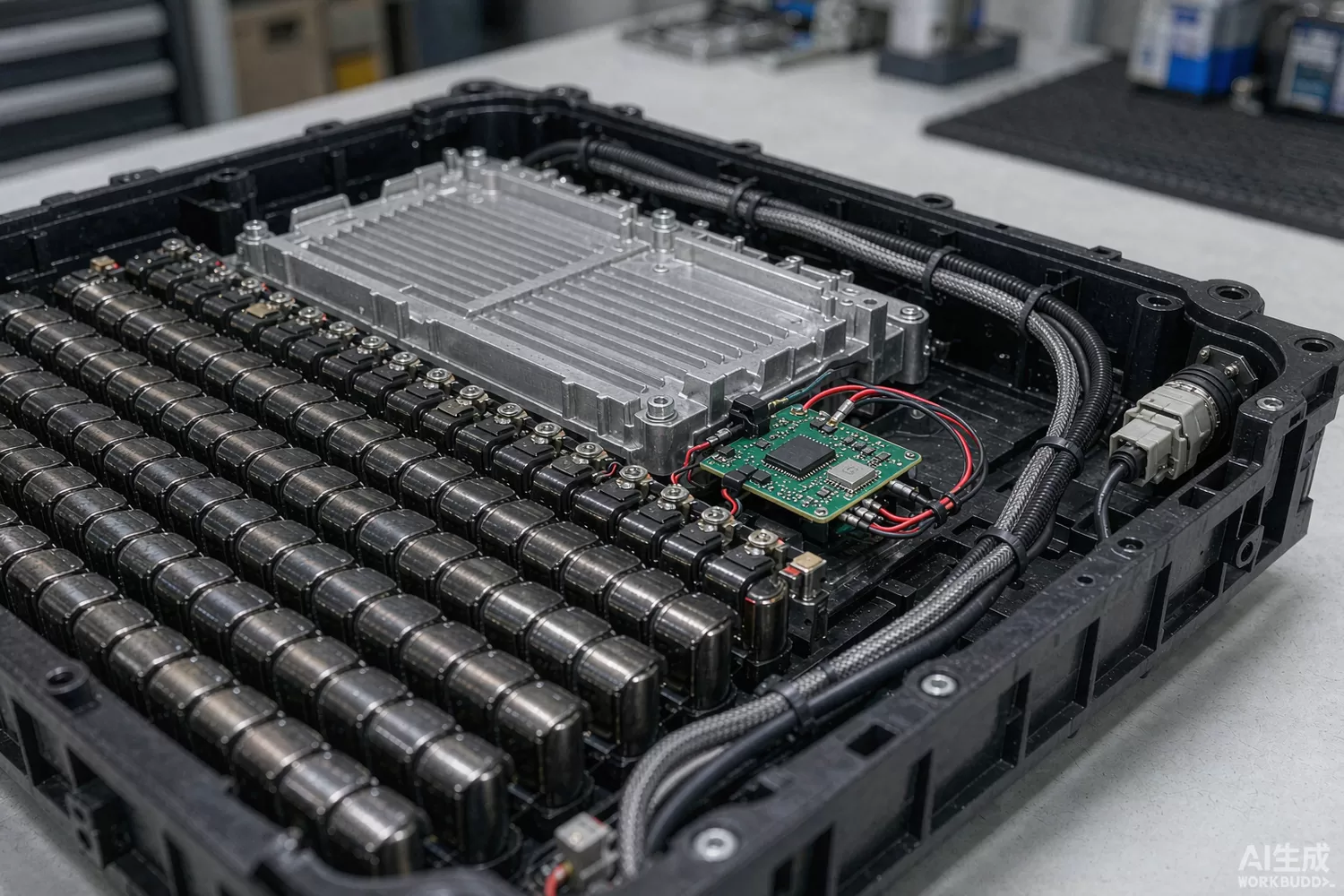
Every lithium pack larger than a power tool has historically been wired like a telephone exchange: a daisy chain of sense lines running from every cell group to a central battery management controller, wrapped in shielding, connectors and labour. The wireless BMS (wBMS) idea — put a small measuring radio next to each cell monitor and delete the harness — reached production credibility first in vehicles, where the harness is metres long, weighs kilograms and costs more than the electronics it serves. This article walks the wBMS architecture, what makes a wireless cell measurement trustworthy, and where domestic supply stands against the imported platforms that proved the concept. For the isolation engineering that remains in the pack, see our digital isolator article.

Application logic: what goes wireless, what stays wired
- Cell-sensing AFE at each monitor node — a compact AFE measures 4–14 cell voltages, one or two temperature channels and balancing current, synchronised to the pack’s measurement cycle; its accuracy and per-node calibration are inherited from the wired-BMS world.
- 2.4 GHz radio per node — each monitor carries a small 802.15.4/BLE-class radio forming a star (or star-of-stars) to the pack controller; the network exists only inside the metal box, which is both an advantage (no interference from outside) and a challenge (multipath inside a battery enclosure).
- Pack controller with gateway role — the controller fuses node data, runs state-of-charge and state-of-health estimation, talks CAN to the vehicle or inverter, and manages joining, key exchange and firmware for every node.
- Time synchronisation — current and voltage must be sampled simultaneously across nodes for credible impedance and balancing decisions; the wireless network carries a sync discipline as strict as the wired daisy chain it replaced.
- Security and pairing — a pack that talks over the air must authenticate its nodes and encrypt its measurements; keys are provisioned at manufacture, and re-pairing after a node replacement is a service procedure.
- What stays wired — power to the nodes, the balancing paths (unless balancing is done at the node), and the safety interlocks; wBMS deletes the sense harness, not the electrical system.
The parameters that decide a trustworthy wireless pack
- Measurement accuracy across the fleet — state-of-charge estimation is only as good as the worst node; per-node calibration data must survive node replacement without re-characterising the pack.
- Sync accuracy — tens of microseconds of skew already distorts impedance estimates; the wireless protocol’s sync quality is a first-order spec, not an implementation detail.
- Link reliability under fading — a battery box is a resonant cavity; retransmission budgets, antenna placement per node and frequency agility decide whether the 99.999% delivery target holds with a full pack.
- Node power budget — each node parasitically drains the cells it monitors; sleep discipline and duty cycling protect pack self-discharge over years of parking.
- Joining and replacement logic — a node swap in the field must rejoin securely without exposing the network; the commissioning story is part of the maintenance contract.
- Functional-safety story — vehicles and grid storage require the measurement chain to meet safety integrity targets; the wireless layer’s diagnostics (heartbeat, plausibility, redundancy) must document equivalently to a wired chain.
What is changing: from automotive novelty to storage economics
Three forces are pulling wBMS beyond its automotive first home. First, harness economics: as cell counts grow in stationary storage, the sense harness becomes the dominant pack labour cost; deleting it changes pack factory economics, not just the BOM. Second, second-life ecosystems: packs that reconfigure — modules added, removed, recombined — benefit from radio nodes that rejoin automatically, which wired harnesses handle poorly. Third, integration trend: the imported first movers shipped AFE-plus-radio as a paired platform; the direction is single-die node electronics, with the balancing switch and the measurement chain integrated, and cheaper star-topology protocols standardised on 802.15.4 and BLE variants. Expect the node BOM to keep falling while the qualification burden — proving wireless equals wired for safety — stays the gate.
Domestic alternatives: suppliers and indicative cost
The imported anchors are Analog Devices’ wireless BMS platform — the proven AFE-plus-radio node pair with automotive qualification — and TI’s SimpleLink wireless-BMS reference architecture pairing its cell monitors with a 2.4 GHz radio SoC. Domestic supply covers the layers around the paired platform: battery AFE families from Sinowealth and the BYD Semiconductor battery-management lines serve the wired and semi-wired pack market at volume; Novosense Microelectronics supplies isolation and communication devices relevant to the pack boundary; and the radio layer can be served by domestic 2.4 GHz SoC families (Telink and peers) whose 802.15.4/BLE credentials are established in other markets. A practical domestic path today is a wired-monitor, wireless-backbone hybrid — keep the proven AFE at the module level, delete the long master harness — which captures most of the labour saving while qualifying only the network layer. Family-level honesty applies: a fully integrated domestic wBMS node equivalent to the imported platforms is not yet a catalogue item, and procurement should treat vendor roadmaps accordingly. The BLE SoC article and the TPMS sensor SoC article cover the adjacent in-pack electronics.
A realistic pack-controller bench: an Artery AT32F426CBT7 as the pack controller core, a Cosine COS1042T CAN transceiver to the vehicle bus, a Cosine COS29302WU LDO on the always-on rail, a GigaDevice GD25Q64CSIG for node tables and logs, and a Titan Micro TS2502PN on the service port.
Price figures below are indicative public-market reference ranges for moderate volumes, compiled from publicly observable listings. They fluctuate with the spot market, package option, grade (industrial, automotive, screened) and order quantity, and must not be read as a quotation. Ask us for a firm price on your exact part numbers and quantities.
| Function (imported anchor) | Example import part / class | Indicative import price (USD) | Domestic candidate | Indicative domestic price (USD) |
|---|---|---|---|---|
| Integrated wBMS node (AFE+radio) | ADI wBMS platform | 6.0 – 12.0 | Not yet a catalogue item; roadmap-dependent | — |
| Cell-sensing AFE (wired role) | Imported 12–16 ch battery monitor | 3.0 – 6.5 | Sinowealth / BYD Semi battery AFE families (family level) | 1.2 – 3.0 |
| 2.4 GHz node radio SoC | TI CC26xx / imported 802.15.4 SoC | 2.0 – 4.5 | Telink-class domestic 2.4 GHz SoC families | 0.7 – 1.8 |
| Pack controller MCU | STM32-class Cortex-M | 1.5 – 3.5 | AT32F426CBT7 (Artery) | 0.5 – 1.2 |
| CAN transceiver (pack boundary) | Fault-tolerant CAN transceiver | 0.6 – 1.4 | COS1042T (Cosine) | 0.15 – 0.45 |
| Always-on rail LDO (3 A) | Imported 3 A LDO | 0.9 – 1.9 | COS29302WU (Cosine) | 0.25 – 0.70 |
| Node/log storage NOR flash | 64 Mbit serial NOR | 0.45 – 1.0 | GD25Q64CSIG (GigaDevice) | 0.14 – 0.40 |
| Service-port ESD | Imported TVS array | 0.12 – 0.40 | TS2502PN (Titan Micro) | 0.03 – 0.10 |
Read the table as a screening tool, not a quotation. The structural point: the imported platforms own the fully wireless node today because the qualification evidence — not the silicon — is the moat; domestic supply wins immediately in the hybrid architecture, where the AFE stays a proven wired part and only the backbone goes radio. The harness deleted is worth more than any single chip saved, which is why the economic comparison should be pack-level, not component-level. Where imports still earn their place is automotive programmes with functional-safety targets and timelines that require a pre-qualified wireless node platform.
Validation flow before you commit
Prove the network inside a real enclosure: measure delivery and sync statistics with a full pack of live cells, including charge/discharge transients, because an empty box lies. Characterise per-node accuracy after thermal cycling and node-swap procedures. Run self-discharge logging across weeks with the network in its duty-cycled state; a node that drains 10 µA extra costs the pack real capacity every year. Then run the safety argument on paper early: map every wired-chain diagnostic to its wireless equivalent and get the assessor to agree before the hardware freeze, because retrofitting diagnostics is how programmes slip.
Frequently asked questions
Is a wireless BMS as reliable as wired?
The imported automotive platforms were qualified to say yes on their own terms; any new network must reproduce the delivery, sync and diagnostic evidence, which is the qualification work, not a datasheet property.
Why not just put BLE on every AFE?
Because pairing, sync and delivery guarantees need a protocol designed for the job; a general BLE stack can be forced into the role but the diagnostics story becomes custom engineering.
What is the cheapest first step toward wireless packs?
The hybrid: keep module-level wired monitoring, delete the long master harness with a wireless backbone, and qualify only the network layer.
Does balancing still need wires?
Unless balancing is integrated at the node, yes — balancing current paths remain wired; wBMS deletes the sense harness, not the power path.
About us & trademarks: JTDZ Tech (Shenzhen Jingteng Electronics Technology Co., Ltd.) is an independent distributor of electronic components. We are not an authorised distributor or representative of the imported manufacturers named in this article. Manufacturer, brand and part names are used for identification purposes only; all trademarks remain the property of their respective owners. Cross-reference information in this article is based on publicly available sources, is subject to change, and is not a substitute for your own engineering validation. Always verify specifications against the manufacturer's datasheet before design-in or purchase.
