
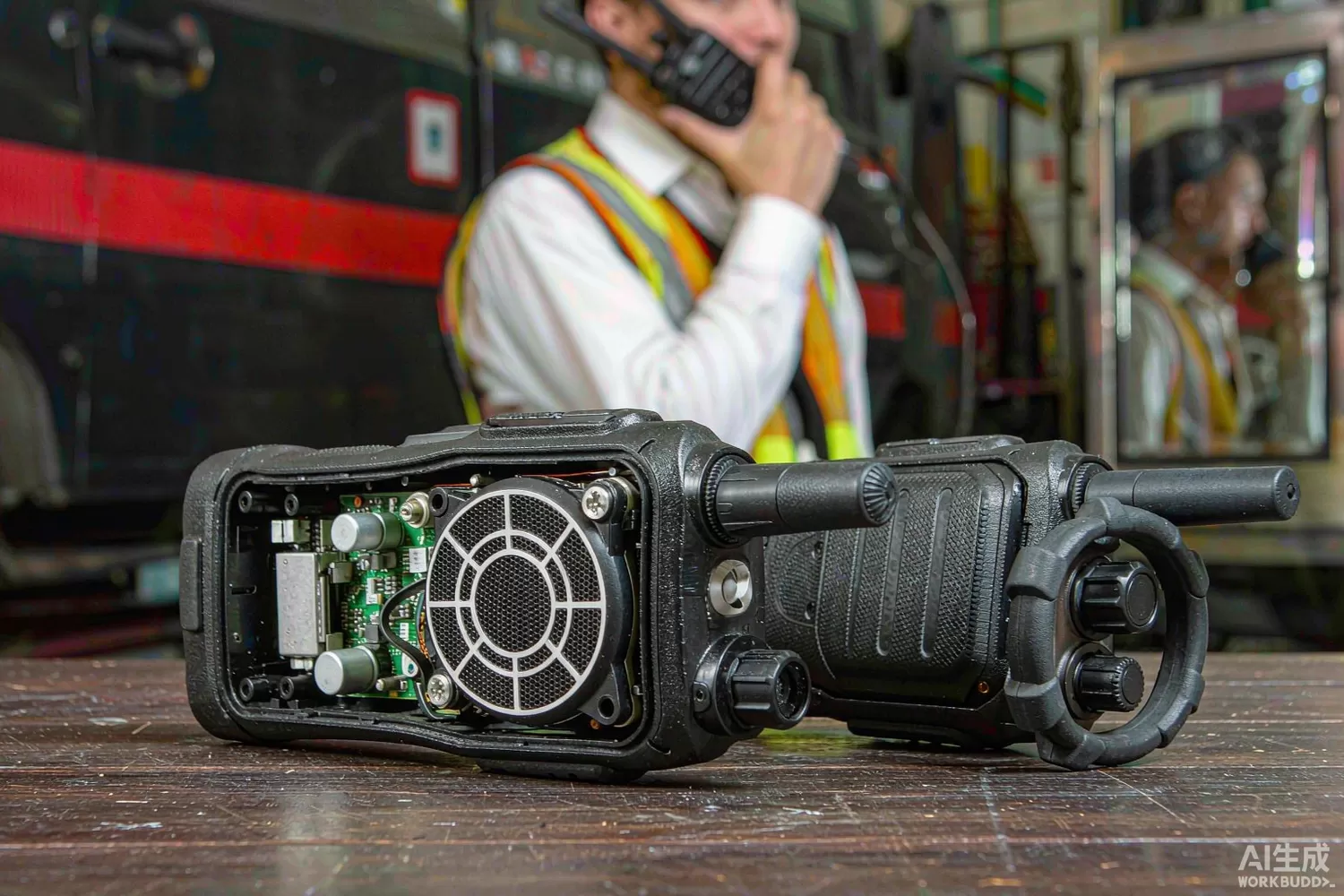
The professional two-way radio looks like a museum piece next to a smartphone, yet it keeps winning jobs where a phone cannot go: oil platforms, hotels, event security, railways — anywhere a push-to-talk call must open in half a second, reach a group, and keep working when the cellular network does not. Under that stubbornness sits a compact RF-and-audio system whose economics have quietly shifted toward domestic silicon. This article walks the DMR/PMR signal chain, what is changing in the digital air interface, and which domestic SoC families can be screened against the imported radio classes that defined the category. For the broadcast-reception side, see our AM/FM receiver article.

Application logic: from push-to-talk to two slots
DMR (Digital Mobile Radio) takes a 12.5 kHz channel and splits it into two independent time slots, doubling capacity over analogue FM; dPMR takes a narrower direct-conversion path, and analogue FM remains in the field for cost reasons. The electronics around that choice:
- RF front end — a narrowband transceiver tuned to the PMR bands (66–960 MHz across regional allocations), with a receive chain whose blocking and intermodulation behaviour matters more than headline sensitivity: a radio that desensitises next to a site transmitter is useless.
- Modem and protocol layer — 4FSK modulation, slot timing, colour codes, and the tier structure (Tier I licence-free, Tier II conventional, Tier III trunked) run on the baseband; Tier III’s call control is where most firmware effort lives.
- Vocoder — DMR uses the AMBE+2 half-rate vocoder, a licensed algorithm; the royalty and the licence logistics are a real line item in every radio BOM, which is why codec choice is a procurement decision, not just an audio one.
- Audio chain — a speaker amplifier sized for 1–2 W into a small transducer at high ambient noise, a microphone path with aggressive noise suppression, and increasingly AI-assisted noise reduction on digital platforms.
- Power and battery — transmit bursts at several watts from a lithium pack, with duty-cycle-aware power management; the radio’s 16/24-hour shift rating is a system figure, not a datasheet footnote.
- Backward compatibility — mixed fleets mean analogue FM and DMR in the same device, so the radio must switch modes transparently; mixed-mode scanning is what sells radios into fleets mid-migration.
The parameters that decide a radio that works on site
- Adjacent-channel and blocking performance — PMR sites stack channels; a receiver with poor blocking loses calls to its neighbours, and the failure is invisible in a two-radio lab test.
- Transmitter spectral mask — narrowband regulation leaves little room for splatter; the PA and its filtering must hold the mask from the first prototype, or certification drags.
- Slot timing accuracy — DMR TDMA lives on 2-slot discipline; clock and synthesiser design decide whether a radio interops with the installed base.
- Vocoder latency and intelligibility — the end-to-end voice delay budget is tight; codec, buffering and audio-chain latency add up to the perceived quality of the push-to-talk experience.
- Battery talk/standby split — the transmit efficiency and the sleep discipline of the transceiver set the shift rating that buyers actually compare.
- Environmental hardening — IP67, drop and thermal ratings are part of the electronics: connectors, PTT switches and antenna joints fail before silicon does.
What is changing: hybrid networks, AI audio and the codec question
Three shifts are reshaping the platform. First, hybrid PTT: radios now pair the PMR air interface with LTE backhaul so a group call spans a site and a city; the device becomes a two-radio system with a roaming decision layer, and the PMR silicon must coexist with a cellular modem inside one can. Second, AI noise suppression: digital platforms ship with neural noise reduction tuned for sirens, engines and crowds, which raises the audio subsystem from an analog afterthought to a differentiator with DSP and memory requirements. Third, the codec and royalty landscape: proprietary vocoder royalties pushed platform vendors to build radios on open codecs where regulation allows, and every royalty avoided is margin at fleet quantities. On the silicon side, integration compresses the board: transceiver plus audio codec plus processing in one SoC, with external PA and filtering, is the direction the whole industry follows.
Domestic alternatives: suppliers and indicative cost
The imported landscape splits into proprietary system vendors that build their own silicon and general transceiver classes — the legacy ADF7021/AX5043-era narrowband parts and TI’s CC112x-class sub-GHz transceivers — that designers paired with separate audio codecs and MCUs. Domestic supply has become strong exactly at the integrated-platform layer: JieLi ships intercom and PMR-oriented SoC families that integrate radio, audio codec and processing, and Actions Semiconductor offers intercom/voice platforms widely used in consumer and light-professional two-way products; both are family-level references whose DMR Tier II/III stack maturity should be confirmed per project, because protocol stacks and vocoder licensing travel separately from silicon. For Tier III trunked systems, the installed imported platforms still dominate. Our Sub-1 GHz transceiver article covers the underlying narrowband-radio component space, and the Bluetooth audio SoC article covers the audio-side domestic candidates.
A realistic DMR-portable bench: an Artery AT32F415RCT7 as the protocol controller, a Cosine COS6112 audio power amplifier driving the speaker, a Cosine COS29752WU LDO on the RF rail, a GigaDevice GD25Q64CSIG for firmware and codeplug storage, and an SiTime-compatible Si5351A reference in development fixtures where a flexible clock source speeds up multi-band bring-up.
Price figures below are indicative public-market reference ranges for moderate volumes, compiled from publicly observable listings. They fluctuate with the spot market, package option, grade (industrial, automotive, screened) and order quantity, and must not be read as a quotation. Ask us for a firm price on your exact part numbers and quantities.
| Function (imported anchor) | Example import part / class | Indicative import price (USD) | Domestic candidate | Indicative domestic price (USD) |
|---|---|---|---|---|
| Integrated PMR SoC (radio+codec+MCU) | Proprietary imported platform (system vendor) | 6.0 – 14.0 | JieLi / Actions intercom SoC families (family level) | 2.0 – 5.0 |
| Narrowband transceiver (discrete design) | TI CC112x / legacy ADF702x class | 2.5 – 5.5 | Domestic sub-GHz transceiver families (family level) | 1.0 – 2.5 |
| Protocol controller MCU | STM32-class Cortex-M | 1.2 – 3.0 | AT32F415RCT7 (Artery) | 0.45 – 1.1 |
| Speaker power amplifier (1–2 W) | Imported Class-D/AB audio amp | 0.4 – 1.0 | COS6112 (Cosine) | 0.10 – 0.30 |
| RF rail LDO | Imported low-noise LDO | 0.3 – 0.8 | COS29752WU (Cosine) | 0.07 – 0.20 |
| Codeplug storage NOR flash | 64 Mbit serial NOR | 0.45 – 1.0 | GD25Q64CSIG (GigaDevice) | 0.14 – 0.40 |
| Reference clock (dev fixture) | Programmable any-frequency clock | 1.2 – 3.0 | Si5351A | 0.5 – 1.2 |
Read the table as a screening tool, not a quotation. The structural point: in two-way radio the expensive parts are certification, vocoder licensing and firmware maturity, and the domestic integrated SoCs attack the largest cost block — the proprietary platform silicon — with reductions of half or more at the component level. Where imports still earn their place is Tier III trunked networks, ATEX-rated professional platforms and fleets locked into a system vendor’s interoperability estate.
Validation flow before you commit
Interop before specifications: put the candidate platform on a channel with the installed fleet’s radios and grade voice intelligibility and slot discipline across a real site, including the basement and the lift lobby. Measure the transmitter spectral mask early, because filtering redesign after certification is the classic schedule killer. Run the audio chain at 95 dBA ambient and judge noise suppression by human listening panels, not waveform plots. Finally, log talk/standby for a full 24-hour shift simulation at both temperature extremes; the battery figure on the quote sheet is a promise, the log is a fact.
Frequently asked questions
Can domestic SoCs run the full DMR Tier II stack?
Some can, but the stack and its interop record are the real product; verify the vendor’s DMR association membership and tested fleet list, not just the silicon features.
Why is the vocoder a licensing issue?
DMR’s AMBE+2 vocoder is proprietary and royalty-bearing; the licence terms affect unit cost and supply chain, which is why open-codec platforms attract attention.
Do analogue radios still make sense?
For licence-free and low-cost fleets, yes; but digital gives two calls per channel, better noise handling and data services, which is why migration continues.
What does hybrid LTE change in the design?
It adds a second radio, an antenna problem and a roaming decision layer — the device becomes a small multi-network gateway with a PTT button.
About us & trademarks: JTDZ Tech (Shenzhen Jingteng Electronics Technology Co., Ltd.) is an independent distributor of electronic components. We are not an authorised distributor or representative of the imported manufacturers named in this article. Manufacturer, brand and part names are used for identification purposes only; all trademarks remain the property of their respective owners. Cross-reference information in this article is based on publicly available sources, is subject to change, and is not a substitute for your own engineering validation. Always verify specifications against the manufacturer's datasheet before design-in or purchase.
