
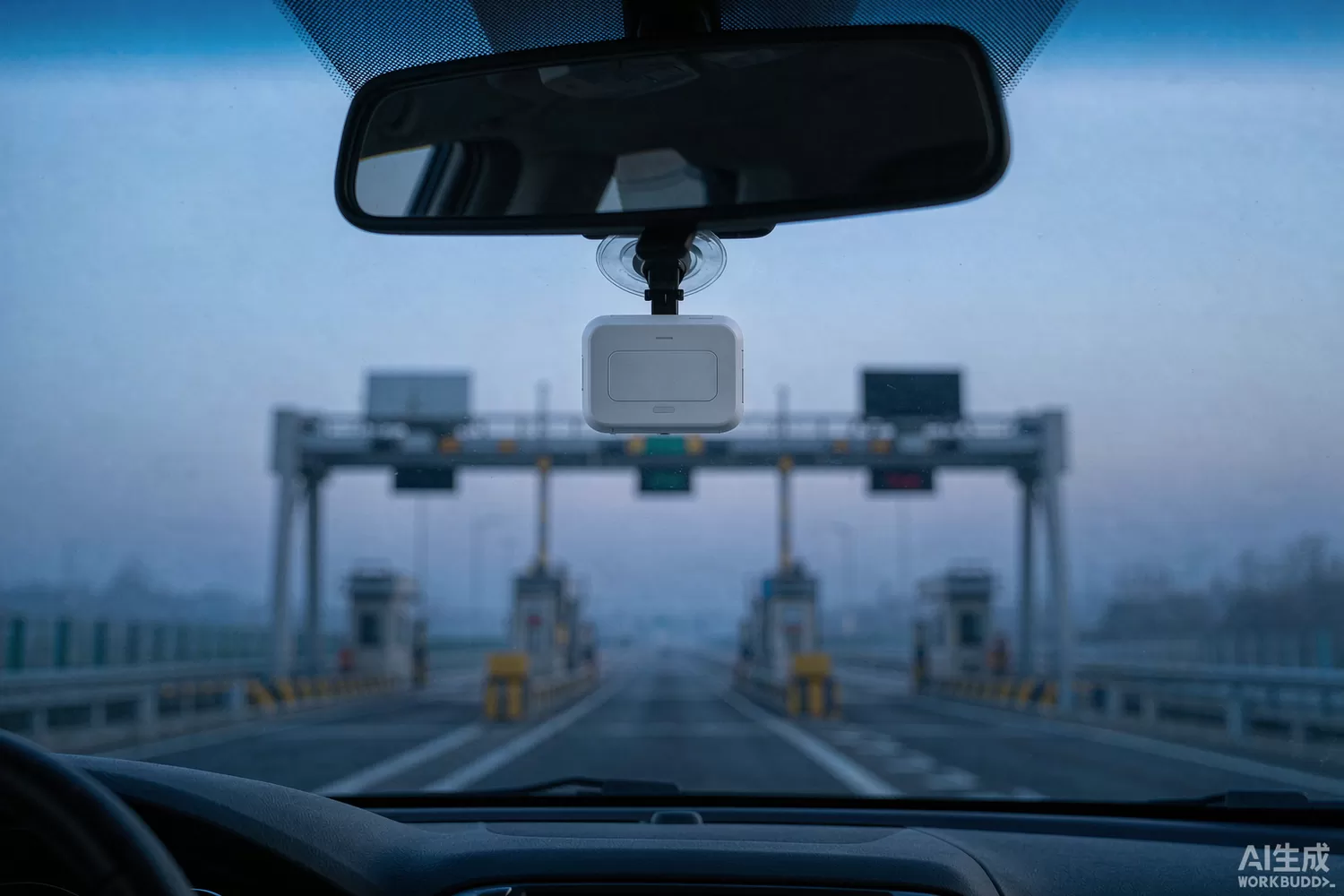
When a car crosses a gantry at speed, a short conversation happens in the air: a roadside unit wakes every passing transponder, each onboard unit (OBU) reports its identity and contract data, the lane system debits an account, and the barrier — or in modern free-flow installations, nothing at all — responds. The whole exchange must complete in milliseconds at vehicle speed, which is why the OBU is one of the most tightly engineered consumer-invisible radios on the road. This article unpacks the 5.8 GHz DSRC chain, the power and security logic around it, and the supplier landscape — a rare category where domestic module-level supply dominates outright, with the interesting cost story at the component bench. For the cellular side of vehicle connectivity, see our C-V2X article.

Application logic: a transaction in three air-interface steps
- Wake-up — the roadside unit transmits a 5.8 GHz ASK wake-up frame; a dedicated, micropower receiver inside the OBU detects it and powers the main radio from a sleeping state, because the OBU cannot afford to listen actively for years on a small cell.
- Transaction — the main transceiver answers with the vehicle and contract data structure, the RSU validates it, and a confirmation frame closes the exchange; the air interface is ASK/FSK DSRC at 5.8 GHz with strict timing budgets so a 120 km/h gantry pass completes before the vehicle leaves the beam.
- Local user interface — a buzzer, a small display and a status LED confirm the transaction; the user layer is deliberately minimal because the OBU sits behind the mirror where nobody can interact with it while driving.
- Power architecture — a primary lithium cell holds years of standby; many units add a small solar panel to keep the charge topped up, with charge management that must tolerate years of float without harming the cell.
- Security — contract data is signed and key-protected against cloning; the OBU is the money, so key storage and anti-replay logic are part of the terminal, not an add-on.
The parameters that decide a gantry pass
- Wake-up sensitivity — the wake receiver must detect the RSU frame at the edge of the lane beam with a cell years into its life; every microamp of standby buys margin at the far lane.
- Transceiver burst behaviour — the main radio must go from sleep to full transaction inside the wake window; synthesiser lock time and packet timing compliance decide whether the exchange fits the beam.
- Antenna and placement tolerance — OBUs are mounted behind windscreens whose metalised films attenuate 5.8 GHz; the link budget is written for the worst legal windscreen, not the best.
- Temperature and lifetime — a windscreen-mounted unit sees extreme soak temperatures; the cell, the crystal and the solar charge management must age together across a decade.
- Anti-collision — gantries pass multiple vehicles per second; the air-interface arbitration must resolve simultaneous transactions deterministically.
- ESD and surge — handling, installation and the solar input expose the electronics to transients; the front ends are cheap insurance in a device nobody services.
What is changing: free-flow, standard evolution and the service layer
Three currents reshape the category. First, free-flow gantries: multiclane free-flow installations remove barriers entirely, which raises the transaction success-rate requirement — there is no barrier to hide behind, and every failed read is a billing exception processed by humans. Second, standard evolution: the 5.8 GHz DSRC air interface coexists now with C-V2X in new-vehicle electronics, and the industry debate is whether the toll function migrates into the car’s connectivity module — for now the OBU remains the installed base and the compliance target. Third, service-layer richness: OBUs increasingly carry parking, refuelling and city-congestion payment functions, which adds secure storage and a management link to the classic toll radio. On the silicon side the OBU stays a two-chip radio story — micropower wake receiver plus main transceiver — with integration pressure from both directions: integrated wake-and-transceive front ends, and SoCs that fold the security controller in.
Domestic alternatives: suppliers and indicative cost
This is the category where the domestic answer is structural: China runs the world’s largest DSRC toll estate, and the module and terminal layer is served by domestic specialists — Genvict, Wanji and their peers supply OBU and RSU electronics in volume to the national programme. Imported presence sits at the component level: general-purpose 5.8 GHz transceiver and wake-receiver classes from the established RF vendors, rather than toll-specific silicon catalogues. A useful framing for procurement is therefore unit-level versus component-level: if your project buys OBUs or RSU modules, the domestic supply chain is the default and the comparison is service, certification and unit price; if you design your own transponder-like device — parking tags, campus tolling, asset gates — then the component bench below is where the cost story lives, and where the domestic RF component families we stock map onto the design. Our RKE remote article covers the closely related micropower wake-up radio problem at 315/433 MHz.
A realistic transponder bench: an Artery AT32F415RCT7 as the transaction controller, a Cosine COS29752WU LDO on the RF rail, a Puya PY25Q128HA for contract-data images, a low-power PCF8563T RTC for time-stamped local logs, and a Titan Micro TS2502PN on the antenna and solar-input ports.
Price figures below are indicative public-market reference ranges for moderate volumes, compiled from publicly observable listings. They fluctuate with the spot market, package option, grade (industrial, automotive, screened) and order quantity, and must not be read as a quotation. Ask us for a firm price on your exact part numbers and quantities.
| Function (imported anchor) | Example import part / class | Indicative import price (USD) | Domestic candidate | Indicative domestic price (USD) |
|---|---|---|---|---|
| Complete OBU module (unit level) | Imported toll-terminal module (rare as catalogue item) | 12.0 – 22.0 | Genvict / Wanji class OBU modules (unit level) | 6.5 – 13.0 |
| 5.8 GHz main transceiver (component level) | General-purpose 5.8 GHz ASK/FSK transceiver class | 1.5 – 3.5 | Domestic RF transceiver families (family level) | 0.6 – 1.6 |
| Wake receiver | Micropower wake-receiver class | 0.8 – 2.0 | Domestic micropower receiver families (family level) | 0.3 – 0.9 |
| Transaction controller MCU | STM32-class Cortex-M | 1.2 – 3.0 | AT32F415RCT7 (Artery) | 0.45 – 1.1 |
| RF rail LDO | Imported low-noise LDO | 0.3 – 0.8 | COS29752WU (Cosine) | 0.07 – 0.20 |
| Contract-data storage | 128 Mbit serial NOR | 0.7 – 1.6 | PY25Q128HA (Puya) | 0.22 – 0.55 |
| RTC for local logs | Imported low-power RTC | 0.35 – 0.9 | PCF8563T | 0.10 – 0.30 |
| Antenna/solar port ESD | Imported surge-rated TVS | 0.15 – 0.45 | TS2502PN (Titan Micro) | 0.03 – 0.12 |
Read the table as a screening tool, not a quotation. The structural point: at unit level the domestic toll supply chain is not an alternative but the incumbent, and the imported comparison mostly exists for export projects tied to non-DSRC standards. At component level, the design-ins that matter are the micropower wake receiver and the transceiver burst timing; those are where imported classes still set the reference and where domestic families must be validated lane by lane. Our Sub-1 GHz transceiver article covers the adjacent micropower-radio design space.
Validation flow before you commit
Bench the wake receiver against cell-age simulation first: measure sensitivity with a cell at end-of-life voltage, because that is the condition the gantry sees in year seven. Run the full air-interface timing suite on the transceiver with a reference RSU, then repeat it through a metalised windscreen at the legal worst case. Soak the power architecture across the temperature range with the solar panel both lit and dark, and watch the cell’s float behaviour over weeks. Finally, anti-collision-test with two, five and ten simultaneous tags in the beam; a lane that passes one tag and fails five will generate exactly the exceptions free-flow was supposed to eliminate.
Frequently asked questions
Why 5.8 GHz for tolling?
The band offers a good balance of antenna size, available bandwidth for fast transactions and regulatory allocation dedicated to transport; the installed RSU base makes migration costly, so it persists.
Is the OBU going away as cars get connected?
Not soon. The toll function may migrate into vehicle modules eventually, but the installed RSU estate and the aftermarket OBU fleet keep the terminal relevant for years.
Can I build a parking or campus tag from toll components?
Functionally yes — wake receiver, transceiver, MCU and cell — but the security architecture must match your billing model, and cloning a signed-contract scheme without the key infrastructure fails exactly where it matters.
What kills OBUs in the field?
Cell ageing and thermal soak. The radio rarely fails; the power budget quietly erodes until the wake receiver stops hearing the edge of the beam.
About us & trademarks: JTDZ Tech (Shenzhen Jingteng Electronics Technology Co., Ltd.) is an independent distributor of electronic components. We are not an authorised distributor or representative of the imported manufacturers named in this article. Manufacturer, brand and part names are used for identification purposes only; all trademarks remain the property of their respective owners. Cross-reference information in this article is based on publicly available sources, is subject to change, and is not a substitute for your own engineering validation. Always verify specifications against the manufacturer's datasheet before design-in or purchase.
