
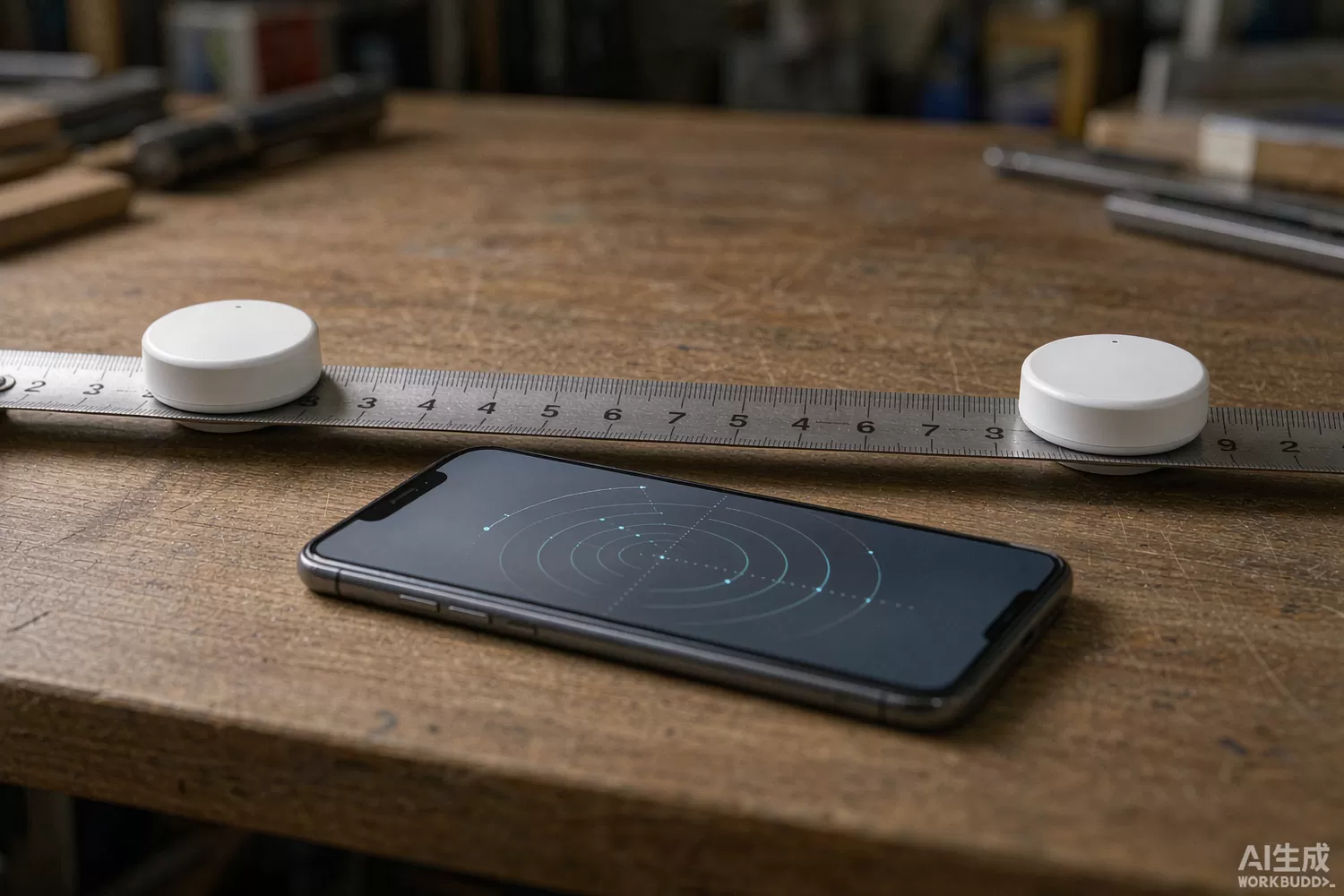
For a decade, “how far away is my device?” in Bluetooth meant reading a signal-strength bar and apologising for it. RSSI-based proximity was always a guess with a plus-or-minus of metres, which is why find-my-phone worked and find-my-keys sort of did. Bluetooth 6.0’s Channel Sounding (CS) replaces that guess with a two-way physical measurement between two radios — phase-based ranging and round-trip time — bringing decimetre-class distance to the same low-energy silicon that already ships in billions of units. This article explains how the measurement works, what it demands from the RF and clock design, and where the domestic SoC landscape stands against the imported first movers. For the ultra-wideband alternative, see our UWB ranging article.

Application logic: two ways to measure distance in a 2.4 GHz radio
Channel Sounding is a procedure, not a new radio: the two devices exchange thousands of tone packets across many of the 2.4 GHz channels and compute distance from what the exchange reveals. Two methods run together:
- Phase-based ranging (PBR) — by stepping a tone across a wide frequency span and measuring the phase rotation at the receiver, the pair estimates distance modulo the span’s unambiguous range, then stitches multiple spans to resolve the ambiguity. PBR delivers high precision but is sensitive to multipath, which is why the procedure hops channels and averages heavily.
- Round-trip time (RTT) — measuring when a packet leaves and its response arrives, minus the known turnaround, yields a time-of-flight estimate. RTT is less precise than PBR but immune to phase wrapping and useful for sanity-checking PBR output.
- Security by symmetry — because both sides transmit and measure, and because the procedure randomises channel and packet sequences, a man-in-the-middle cannot simply replay a stronger signal. This is the property that makes CS interesting for digital keys, where RSSI was trivially spoofable.
- Mode 0 calibration — a calibration exchange at known distance removes per-device offsets; real deployments store this calibration per product, per antenna layout.
- Role and scheduling — one side is the initiator, the other the reflector; the procedure interleaves with normal BLE traffic, so a headset can keep streaming while it ranges.
The parameters that decide measurement quality
- Frequency span and stability — PBR precision scales with the span between the measured tones; a radio whose synthesiser cannot hold phase coherence across that span produces ranging that looks fine in a spreadsheet and fails in a corridor.
- Clock accuracy — RTT converts picoseconds to centimetres; crystal accuracy and the modem’s timestamping resolution set the floor.
- Antenna consistency — CS assumes a single phase centre; handset-scale antennas with multiple feed points need per-antenna calibration tables.
- Multipath handling — indoors, the first arrival is often weaker than a reflection; the reported confidence levels and N-best outputs matter for the fusion layer that actually moves the UI.
- Update rate versus battery — a full CS procedure costs real energy on both ends; ranging cadence is a power-budget decision, and SoCs with dedicated CS accelerators hold sleep current down between sessions.
- Coexistence — CS shares the 2.4 GHz band with Wi-Fi and the rest of BLE; scheduling quality decides how often procedures collide and fall back to fewer channels.
What is changing: from find-my-keys to digital keys
Three forces are moving CS from novelty to BOM line. First, the digital-key ecosystem: car and lock standards bodies have added CS as an approved ranging technology alongside UWB, and phone vendors’ roadmap support turns it into the default distance sensor of the accessory world. Second, geofenced automation: home and industrial devices want an “unlock when I am within two metres” primitive that is robust to Wi-Fi interference, and CS provides it without a second radio. Third, asset-grade accuracy on a tag budget: RTLS niches that could only justify UWB anchors are re-evaluating BLE CS infrastructure because the tags and phones already exist. On the silicon side the split is clear: the first movers shipped CS-capable flagship SoCs with dedicated accelerators, and everyone else — including the domestic vendors — is roadmapping the feature into their next BLE families. Expect CS capability to become a checklist row in every BLE SoC datasheet within a product generation.
Domestic alternatives: suppliers and indicative cost
The imported anchors are Nordic’s nRF54 family, Silicon Labs’ xG24/xG26 class and TI’s newest BLE parts — all shipping CS-capable silicon with SDK support. On the domestic side, Telink’s TLSR9 family and Espressif’s newer BLE SoCs are the families most credibly positioned for CS roadmaps, and both vendors have public BLE-feature histories that make them the natural first screening step; treat CS availability and SDK maturity as items to confirm per part number rather than per family, because roadmap announcements and shipping silicon are different things. For the many CS-adjacent jobs — proximity UI, the ranging-fusion layer, the anchor or tag application core — domestic BLE and MCU silicon is already fully competitive, and that is where the BOM decision actually sits today. Our BLE SoC article and wearable SoC article cover those candidates in depth.
A realistic ranging-node bench: a Cosine COS29752WU LDO for the RF rail, an Artery AT32L021K8U7-4 as the fusion and UI core in anchor nodes, a Puya PY25Q128HA for calibration tables and logs, a Titan Micro TS2502PN on the USB or external antenna port, and an Espressif ESP32-C3FN4 as the connectivity sidecar in reference fixtures for the pre-CS feature set.
Price figures below are indicative public-market reference ranges for moderate volumes, compiled from publicly observable listings. They fluctuate with the spot market, package option, grade (industrial, automotive, screened) and order quantity, and must not be read as a quotation. Ask us for a firm price on your exact part numbers and quantities.
| Function (imported anchor) | Example import part / class | Indicative import price (USD) | Domestic candidate | Indicative domestic price (USD) |
|---|---|---|---|---|
| CS-capable BLE SoC | Nordic nRF54 / SiLabs xG26 class | 2.5 – 5.5 | Telink TLSR9 family (confirm CS per part) | 1.0 – 2.5 |
| Non-CS BLE SoC (proximity, UI) | Established imported BLE SoC | 1.8 – 3.5 | Espressif / Telink BLE families | 0.5 – 1.5 |
| Fusion / application core | STM32L-class low-power MCU | 1.3 – 3.2 | AT32L021K8U7-4 (Artery) | 0.45 – 1.1 |
| RF rail LDO | Imported low-noise LDO | 0.3 – 0.8 | COS29752WU (Cosine) | 0.07 – 0.20 |
| Calibration/log storage | 128 Mbit serial NOR | 0.7 – 1.6 | PY25Q128HA (Puya) | 0.22 – 0.55 |
| Port ESD protection | Imported ultra-low-capacitance TVS | 0.12 – 0.40 | TS2502PN (Titan Micro) | 0.03 – 0.10 |
Read the table as a screening tool, not a quotation. The structural point: for CS-capable silicon the imported parts are a generation ahead and priced like it; the domestic opportunity is in everything around the CS radio — the fusion MCU, storage, power tree and the non-CS tags that outnumber the ranging devices in any deployment. When domestic CS silicon ships, the migration cost will be firmware, not hardware. Where imports still earn their place is any product whose market requires CS conformance today, and phone-side co-design programmes tied to specific imported platform vendors.
Validation flow before you commit
Range in the building you will deploy in, not in a datasheet. Build a fixture with known distances, log the error distribution at 0.5, 2 and 10 metres across walls and bodies, and compute the confidence surface your UX can actually use. Measure the energy cost of your real ranging cadence on coin-cell hardware — procedures per hour is the number that sets battery life. Then attack your own system: replay, relay and jam tests belong in the plan if the feature unlocks anything valuable, because security claims only hold under adversarial testing.
Frequently asked questions
Does Channel Sounding replace UWB?
Not everywhere. UWB holds the accuracy crown in harsh multipath and high-security automotive niches; CS wins on installed base and cost wherever decimetre-class accuracy is enough.
Can existing BLE chips get CS by firmware?
No. The measurement procedure needs radio and timer features that only CS-capable silicon provides; RSSI-only parts cannot be firmware-upgraded into it.
How accurate is it really?
Decimetre-class in good conditions, worse through bodies and near reflective clutter; the confidence metadata exists precisely so the application can downgrade honestly.
What do I design today if my product needs CS next year?
Design the tag or anchor mechanically and electrically around a non-CS domestic BLE part plus the CS-capable imported reference, and keep the ranging layer firmware-isolated so the swap is a module change.
About us & trademarks: JTDZ Tech (Shenzhen Jingteng Electronics Technology Co., Ltd.) is an independent distributor of electronic components. We are not an authorised distributor or representative of the imported manufacturers named in this article. Manufacturer, brand and part names are used for identification purposes only; all trademarks remain the property of their respective owners. Cross-reference information in this article is based on publicly available sources, is subject to change, and is not a substitute for your own engineering validation. Always verify specifications against the manufacturer's datasheet before design-in or purchase.
