
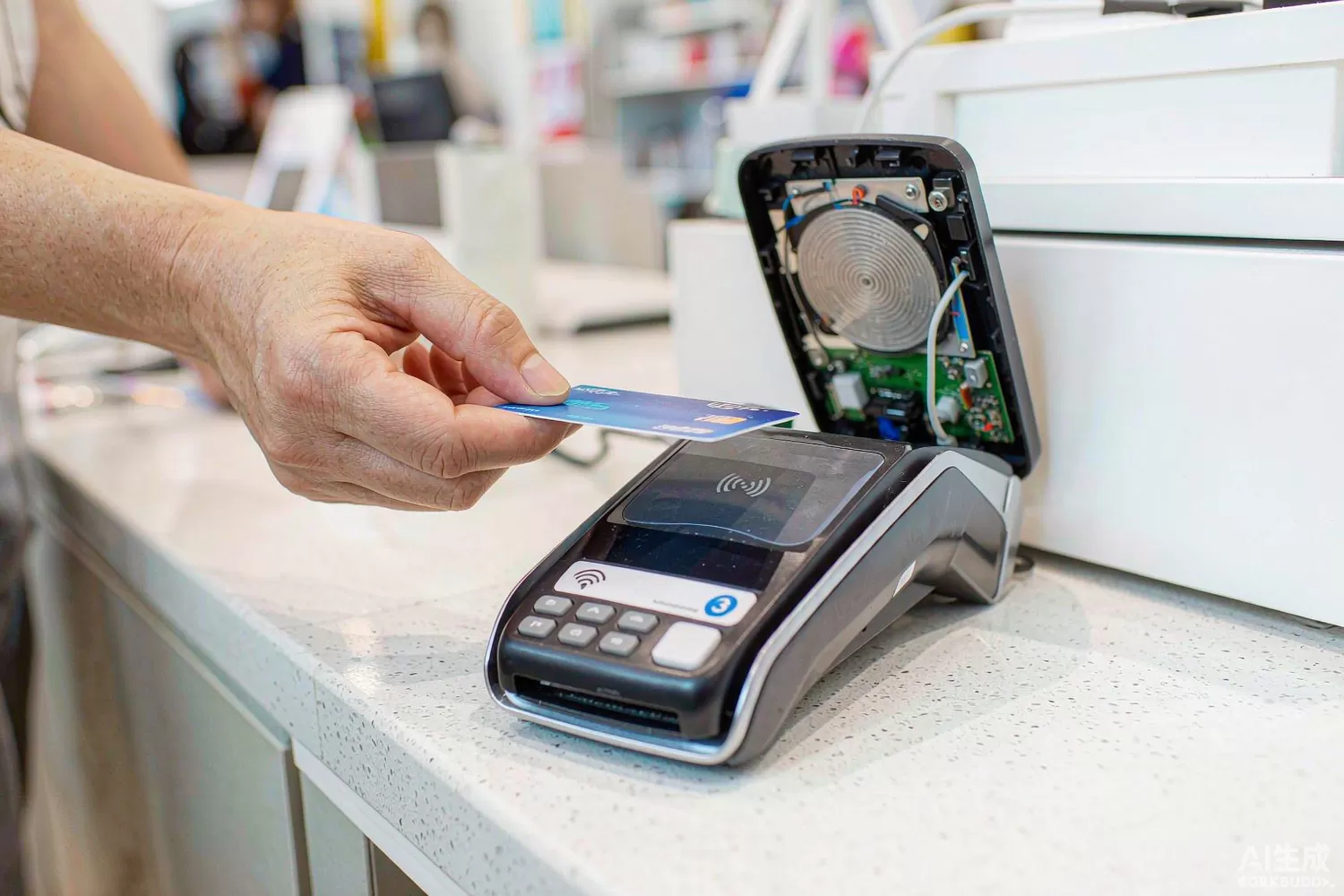
A payment terminal is the one IoT device where a millisecond of latency, a decibel of field strength or a single certification failure is visible to everyone standing in the queue. Its electronics look simple — a screen, a keypad, a card reader, a contactless coil — but the constraint stack is unusually deep: EMV Level 1 timing on the radio, tamper-responsive key storage, protocol certification with every card scheme, and an always-on cellular link that must authorise a transaction in seconds on a congested network. This article walks the terminal’s signal chain, what tap-to-pay volumes are doing to the silicon, and which domestic suppliers can be screened against the imported NFC and secure-element parts that define the category. For the consumer-side lock application, see our smart-lock NFC article.

Application logic: the four-layer terminal stack
- Contactless front end (13.56 MHz) — an analog front end drives the antenna and receives the card’s load modulation; EMV L1 defines the field envelope, the polling cadence and hard response deadlines. The AFE’s receiver sensitivity at the EMV modulation depth decides the tap distance your users complain about.
- Secure element and key storage — terminal keys, the merchant’s certificates and the transaction counters live in a tamper-responsive SE. Payment schemes audit this block separately; its certification (Common Criteria levels and scheme-specific audits) usually takes longer than the rest of the product combined.
- Application SoC — a Cortex-M/A core runs the EMV kernel, the UI and the peripheral stack, with enough flash for multiple scheme kernels and enough RAM to survive concurrent tap, chip and PIN sessions.
- Cellular backhaul (Cat.1/Cat.4) — authorisation round-trips define user-perceived speed; the module must hold a connection through radio re-farming, support TLS with hardware crypto, and fall back gracefully offline, queueing transactions when the network drops.
- Peripherals — smartcard contacts, SAM slots, a printer on countertop units, and increasingly a QR-code camera; each adds a connector, an ESD point and a certification surface.
The parameters that decide a terminal that passes
- AFE receiver dynamic range — EMV specifies both the minimum and maximum field the terminal must accept; an AFE that only reads well at close range fails the L1 test on the upper bound.
- Field envelope control — antenna tuning across a production run drifts; the AFE’s automatic amplitude calibration is what keeps unit 10,000 identical to unit 1.
- Timing margin under load — EMV L1 deadlines are measured from field events; an application SoC busy rendering the UI must still meet them, so interrupt latency and DMA paths matter more than core clock speed.
- SE certification state — an SE without current scheme approvals is a paperweight for payment, regardless of its electrical behaviour; check the certificate, not the datasheet.
- Cellular attach time — the difference between a 2-second and a 6-second authorisation is measurable queue throughput; module attach behaviour on congested cells is a real benchmark, not a datasheet line.
- Tamper responsiveness — mesh sensors, active zeroisation and secure boot all cost board area and battery; the SE’s tamper architecture drives the mechanical design, not just the BOM.
What is changing: tap-first volume, smart terminals and the consolidated backhaul
Three trends are reshaping the category. First, contactless became the default: tap volumes overtook chip-and-PIN in most markets, which raises the EMV L1 bar — more taps per hour, stricter field envelopes, and AFEs that must read both premium dual-interface cards and the cheap ticket tags people hold accidentally. Second, Android terminals commoditised: smart terminals run an Android core with an EMV sidecar, pushing the payment-critical functions into a separate certified chip while the Android core handles UI, video and loyalty — the industry calls this split architecture, and it changes the BOM from one SoC to two-plus-SE. Third, the backhaul consolidated on Cat.1 in Asia and Cat.4-with-Wi-Fi elsewhere; QR and soft-POS flows reduced per-transaction data so aggressively that the fat modem stopped paying for itself. On the silicon side, expect NFC AFEs with integrated SE and faster SAM interfaces, security SoCs with larger certified firmware vaults, and modules with pre-integrated TLS stacks.
Domestic alternatives: suppliers and indicative cost
The imported anchors are NXP’s PN5180/PN7462-class NFC front ends and secure elements from the established European and US vendors. Domestic supply exists at every layer but certification depth varies. Fudan Microelectronics’ FM17xx reader family covers the 13.56 MHz AFE function and is the family we referenced in the door-lock article; its payment-grade qualifications should be confirmed per project. Nationz Technologies historically built security SoCs for banking tokens and financial terminals, and Beijing Huada Electronic Technology supplies SE products with domestic financial certifications. For backhaul, domestic Cat.1 modules on ASR or UNISOC silicon dominate Asian terminal fleets. Frame every cross-reference by certification first: in this category the datasheet is the easy half, and an unqualified SE cannot be substituted by any electrical comparison.
A realistic terminal bench: an Artery AT32F421C8T7 in the peripheral controller, a Cosine COS29752WU LDO on the RF rail, a GigaDevice GD25Q64CSIG for kernel images, a Titan Micro TS2502PN on the card-contact ESD front, and a low-power PCF8563T RTC covering the certified timekeeping role. The 13.56 MHz reader article digs into antenna matching.
Price figures below are indicative public-market reference ranges for moderate volumes, compiled from publicly observable listings. They fluctuate with the spot market, package option, grade (industrial, automotive, screened) and order quantity, and must not be read as a quotation. Ask us for a firm price on your exact part numbers and quantities.
| Function (imported anchor) | Example import part / class | Indicative import price (USD) | Domestic candidate | Indicative domestic price (USD) |
|---|---|---|---|---|
| 13.56 MHz contactless AFE | NXP PN5180 class | 2.5 – 5.0 | Fudan Micro FM17xx family (family level) | 1.0 – 2.4 |
| Secure element (payment) | Certified imported SE | 1.5 – 4.0 | Huada / Nationz SE families (certification-dependent) | 0.6 – 1.8 |
| EMV application SoC | Imported Cortex-M/A payment SoC | 3.0 – 6.5 | Domestic security-SoC families (family level) | 1.5 – 3.5 |
| Peripheral controller MCU | STM32-class Cortex-M | 1.2 – 3.0 | AT32F421C8T7 (Artery) | 0.4 – 1.0 |
| Cat.1 backhaul module | Imported LTE Cat.1 module | 4.5 – 8.0 | Domestic Cat.1 bis module (ASR/UNISOC based) | 2.2 – 4.2 |
| Kernel storage NOR flash | 64 Mbit serial NOR | 0.45 – 1.0 | GD25Q64CSIG (GigaDevice) | 0.14 – 0.40 |
| RF rail LDO | Imported low-noise LDO | 0.3 – 0.8 | COS29752WU (Cosine) | 0.07 – 0.20 |
| Card-contact ESD | Imported low-capacitance TVS | 0.12 – 0.40 | TS2502PN (Titan Micro) | 0.03 – 0.10 |
Read the table as a screening tool, not a quotation. The structural point: in terminals the certification chain — EMV L1 on the AFE, scheme audits on the SE, network approvals on the module — costs more than the silicon, and domestic parts compete hardest where you can reuse an already-certified terminal platform and swap only the non-certified blocks. The contactless AFE is the most electrically substitutable layer; the SE is the least. Where imports still earn their place is schemes and markets whose certification lists do not yet include the domestic SE, and split-architecture designs already qualified against a specific imported front end.
Validation flow before you commit
Test the AFE the way EMV does: the full L1 analogue test suite across the field envelope, with production antennas and production tuning, not a lab coil. Hammer the backhaul in the worst cell environment your fleet will see and measure attach and authorisation percentiles, not averages. Treat the SE as paperwork first: verify the current certificates and the audit scope before touching the electrical comparison. Then run a 10,000-tap endurance soak with mixed card generations — the failures that surface at tap 7,000 are the ones that generate merchant complaints.
Frequently asked questions
Can a domestic NFC front end pass EMV L1?
The FM17xx-class parts have the analogue ingredients, but L1 conformance is measured with your antenna, your tuning and your kernel; budget for the full test-house cycle either way.
Why is a split Android architecture common now?
UI expectations grew faster than payment certification cycles, so the Android core handles the experience and a certified sidecar keeps the payment path auditable.
Is QR payment replacing the hardware?
Not for card programmes; QR and soft-POS grow alongside, but acceptance of physical cards keeps the NFC front end in the BOM.
What is the fastest cost win in a terminal BOM?
The cellular module and the flash; both have mature domestic supply, while the SE must be chosen for certification, not price.
About us & trademarks: JTDZ Tech (Shenzhen Jingteng Electronics Technology Co., Ltd.) is an independent distributor of electronic components. We are not an authorised distributor or representative of the imported manufacturers named in this article. Manufacturer, brand and part names are used for identification purposes only; all trademarks remain the property of their respective owners. Cross-reference information in this article is based on publicly available sources, is subject to change, and is not a substitute for your own engineering validation. Always verify specifications against the manufacturer's datasheet before design-in or purchase.
