
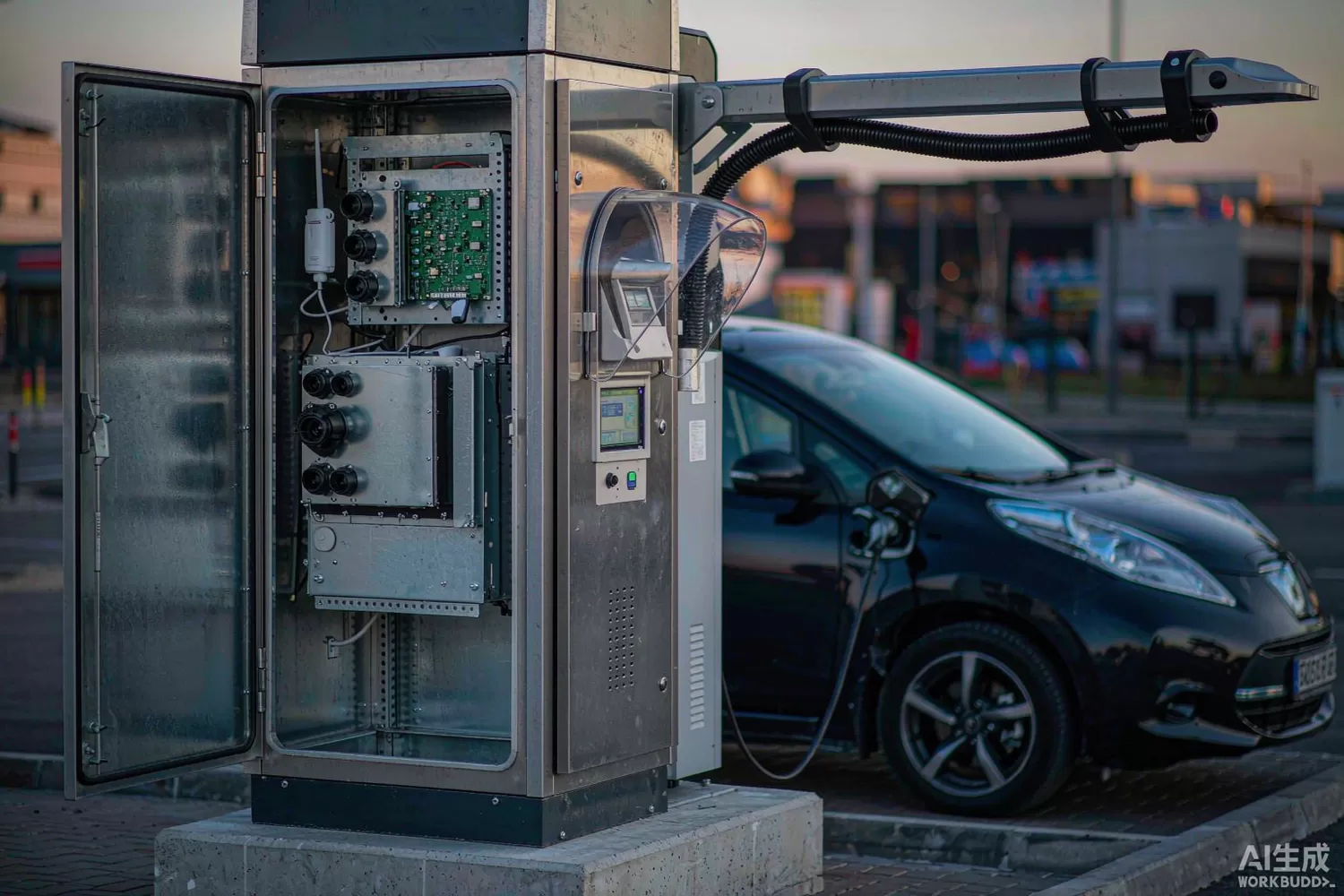
The charging cable between a car and a pile carries far more than current. Before energy flows, the two ends must identify each other, agree on a current limit, negotiate cable capacity, and — in the newest stations — exchange billing credentials, all over the same pair of conductors that later delivers kilowatts. That conversation is the control pilot and power-line signalling layer, and it is the single most common reason a charger that measures perfectly on the bench still fails in the field. This article walks through the communication architecture of an AC and DC charging station, what the newest standards are pushing onto the silicon, and which domestic suppliers can be screened against the imported HomePlug Green-PHY and cellular parts that dominate today's designs. For the grid-side dual-mode metering case, see our smart-meter dual-mode article.

Application logic: three links, one station
A charging station is really three radio-and-wire systems stacked on top of a power stage, each with a different failure profile:
- Vehicle link (PLC over the pilot) — ISO 15118 defines high-level communication between car and charger over HomePlug Green-PHY, a narrow-band OFDM carrier riding the control-pilot line inside the same cable that carries power. The modem must coexist with the PWM pilot signal, tolerate the cable being coiled around steel, and start communicating within strict timing windows during plug-in.
- Backhaul link (Cat.1 LTE or Ethernet) — the pile reports session records, state-of-charge telemetry and payment authorisations to the operator cloud. In China this is overwhelmingly Cat.1 bis cellular with a SIM per pile; abroad it is often Ethernet with 4G fallback. The modem must survive a metal cabinet, a roof-mounted antenna run of many metres, and operator re-farming.
- Local commissioning and user link (BLE / Wi-Fi hotspot) — installers configure pile parameters over BLE with a phone app; some stations run a local hotspot for QR-code session handover. This link is short-range and latency-tolerant, but it is also an attack surface that must be segmented from the payment path.
- Interlocking and safety signalling — the DC fast-charger adds a CAN or RS-485 link between the pile controller and the power-module stack, carrying real-time current demands and fault codes every few milliseconds; this link is deterministic and safety-relevant, and its transceivers are as critical as the radio ones.
- Firmware and metering integrity — billing depends on a separate DC meter whose data the controller must read and forward without being able to alter it; signed firmware updates over the backhaul are now expected on public networks.
The parameters that decide a working station
- Green-PHY link robustness — the carrier channel sees a different attenuation every time a different car plugs in, because the vehicle-side modem is inside the car. Receiver sensitivity and the modem’s adaptive bit-loading behaviour at low SNR decide whether the session opens at all.
- Pilot coexistence — the 1 kHz PWM pilot and the carrier band share the same conductor; the analogue front end must notch the pilot cleanly or the PLC PHY never synchronises.
- Session timing compliance — ISO 15118 defines message timeouts in the hundreds of milliseconds; a modem or SoC that adds firmware latency fails conformance even with a perfect RF link.
- Cat.1 sensitivity in a metal cabinet — the backhaul antenna is usually remote; what matters is the module’s behaviour with a long lossy cable and its ability to re-attach after blackouts.
- Surge and isolation survival — the pilot line is exposed to the outside world; ESD, surge and isolation ratings on the carrier interface belong in the BOM, not in an appendix.
- CAN transceiver robustness — the pile-to-power-module bus sits next to a 100 kW switching stage; bus-fault tolerance and common-mode transient immunity are what separate transceivers that pass certification from those that pass the bench.
What is changing: plug and charge, V2G and the signed station
Three shifts are reshaping the communication stack. First, plug and charge: ISO 15118-20 pushes certificate-based authentication into the PLC link, which means the station needs secure storage, a real-time clock and crypto acceleration alongside the carrier modem — a single-carrier PHY chip is no longer enough, and integrated Green-PHY SoCs with an embedded secure element are the direction. Second, vehicle-to-grid: bidirectional sessions carry more frequent, more time-critical set-points, pushing the PLC layer toward newer MAC/PHY profiles and forcing the CAN backbone to carry energy-schedule changes without dropping session state. Third, the operator side consolidated: stations are now fleet nodes, so OTA update reliability, remote diagnostics and roaming-platform interconnect all flow through the Cat.1 link, and a pile that cannot be updated in the field is a warranty liability. On the silicon side that pushes toward fewer, more integrated chips: carrier PHY plus AFE in one die, an MCU with crypto on the controller board, and a certified cellular module rather than a bare chipset.
Domestic alternatives: suppliers and indicative cost
The imported anchors are Qualcomm’s QCA7005/7000 Green-PHY family and ST’s ST2100-class carrier SoC, with Cat.1 backhaul from established cellular modules. Domestic supply has two live fronts. Wango (Hangzhou) supplies PLC modem chips and modules aimed specifically at charging-pile and energy applications, and appears in domestic pile-controller reference designs. Leaguer Microelectronics, whose metering-carrier engines we covered in the metering article, has extended its PLC portfolio toward charging and distribution-side applications. For the backhaul, domestic Cat.1 modules built on ASR or UNISOC silicon are the volume default. For the local BLE commissioning link, Espressif’s ESP32 family is the de-facto reference. Treat every carrier cross-reference as a screening step: ISO 15118 conformance lives as much in the protocol stack and its certification as in the silicon, and a modem that is electrically compatible can still fail the plug-and-charge handshake if the stack is unlicensed or incomplete.
A realistic pile-controller bench looks like this: an Artery AT32F425C8T7 as the session controller, a Cosine COS1042T CAN transceiver for the power-module bus, a Cosine COS21844S gate driver in the auxiliary power stage, a Cosine COS29302WU 3 A LDO for the always-on rail, a Puya PY25Q128HA for firmware and session logs, and a Titan Micro TS2502PN on the pilot-facing port. Add our eFuse protection article when you design the auxiliary power path.
Price figures below are indicative public-market reference ranges for moderate volumes, compiled from publicly observable listings. They fluctuate with the spot market, package option, grade (industrial, automotive, screened) and order quantity, and must not be read as a quotation. Ask us for a firm price on your exact part numbers and quantities.
| Function (imported anchor) | Example import part / class | Indicative import price (USD) | Domestic candidate | Indicative domestic price (USD) |
|---|---|---|---|---|
| HomePlug Green-PHY modem | Qualcomm QCA7005 class | 3.5 – 7.0 | Wango PLC modem families (family level) | 1.5 – 3.2 |
| Green-PHY carrier SoC with MCU | ST ST2100 class | 4.5 – 8.5 | Leaguer / Wango carrier+MCU families (family level) | 2.0 – 4.0 |
| Cat.1 backhaul module | Established imported LTE Cat.1 module | 4.5 – 8.0 | Domestic Cat.1 bis module (ASR/UNISOC based) | 2.2 – 4.2 |
| Session controller MCU | STM32-class Cortex-M | 1.5 – 3.5 | AT32F425C8T7 (Artery) | 0.5 – 1.2 |
| CAN transceiver (power-module bus) | Standard fault-tolerant CAN transceiver | 0.6 – 1.4 | COS1042T (Cosine) | 0.15 – 0.45 |
| BLE commissioning radio | Established imported BLE SoC | 1.8 – 3.5 | Espressif ESP32 family (module level) | 0.9 – 2.0 |
| 3 A LDO for always-on rail | Imported 3 A LDO | 0.9 – 1.9 | COS29302WU (Cosine) | 0.25 – 0.70 |
| Pilot-port ESD protection | Imported surge-rated TVS array | 0.15 – 0.45 | TS2502PN (Titan Micro) | 0.03 – 0.12 |
Read the table as a screening tool, not a quotation. The structural point: the carrier modem is where imported silicon earns its certification premium, because ISO 15118 conformance is certified as a stack-plus-chip package and imported Green-PHY parts come with the reference stacks and test reports. Domestic PLC parts undercut the imported modem by roughly half, and where the application is pile-to-cloud telemetry rather than plug-and-charge billing, that premium buys nothing. Where imports still earn their place is export programmes certified against ISO 15118-20 plug and charge, and fleets whose roaming platforms already qualify specific imported module SKUs. Our digital isolator article covers the isolation between pilot, CAN and backhaul domains.
Validation flow before you commit
Conformance first: run the candidate carrier modem through the ISO 15118 session-timing test suite with your own stack before comparing prices, because a modem that misses the timing windows cannot be rescued by a better price. Then field-test the backhaul the way the pile will live: metal cabinet closed, antenna 10 m away on lossy cable, and a re-attach timer set to the operator’s requirements. Stress the pilot interface with the surge and ESD levels of a public parking environment, not a lab. Finally, run a 48-hour CAN bus soak next to a live power stage and look for transient-induced errors, because that bus is the link no marketing page talks about and the one that strands cars.
Frequently asked questions
Is the vehicle link really power-line communication, like metering?
It is the same family of technology — OFDM carriers over existing conductors — but on a different standard (HomePlug Green-PHY under ISO 15118) with different bands, timing requirements and certification. A metering carrier chip will not simply move into a charging pile.
Do I need plug and charge on a domestic-only project?
Not always. Many domestic networks still run account or QR-code authorisation; plug and charge matters mainly for export programmes and platforms that have enabled certificate billing.
Why Cat.1 and not 4G Cat.4 for backhaul?
A pile sends kilobytes per minute. Cat.1 halves module cost and power for the same coverage; Cat.4 earns its premium only where station-level video or aggregated site telemetry rides the same link.
What fails first in the field?
Statistically, connectors and surge-exposed interfaces. The pilot line is handled by the public every day, which is why ESD and surge parts on that port are cheap insurance.
About us & trademarks: JTDZ Tech (Shenzhen Jingteng Electronics Technology Co., Ltd.) is an independent distributor of electronic components. We are not an authorised distributor or representative of the imported manufacturers named in this article. Manufacturer, brand and part names are used for identification purposes only; all trademarks remain the property of their respective owners. Cross-reference information in this article is based on publicly available sources, is subject to change, and is not a substitute for your own engineering validation. Always verify specifications against the manufacturer's datasheet before design-in or purchase.
