
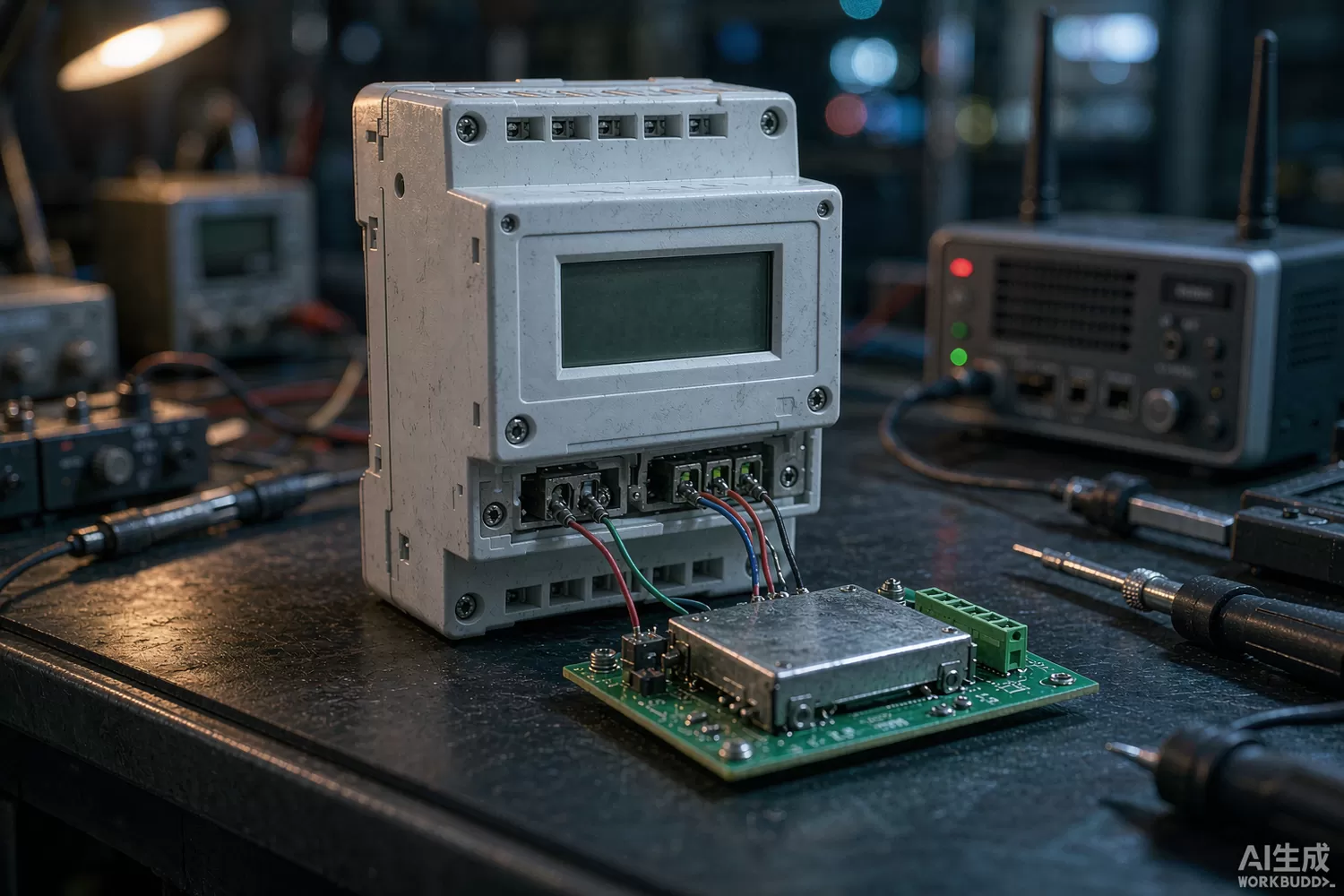
Ask a utility engineer what limits automatic meter reading and the answer is never the meter's metrology. It is the communications module bolted to the front of it, which has to push a few hundred bytes through a transformer district full of switching noise, at a success rate above 99 per cent, for fifteen years. The industry's answer has converged on dual-mode modules: a power-line carrier (PLC) engine and a 470 MHz mesh radio in the same can, under one routing layer that picks a channel per frame. This article explains how those modules are engineered, what the new requirements are doing to the silicon, and which domestic suppliers can be compared with imported G3-PLC and Sub-GHz parts. For the radio-only case, our Sub-1 GHz transceiver article covers the non-metering side.

Application logic: two channels, one routing decision
A low-voltage transformer district serves anywhere from 50 to 500 meters over a wiring topology nobody drew on purpose. The PLC channel rides that same wiring, which makes it free of antennas but hostage to load-dependent attenuation, capacitor-bank resonances and inverter noise from rooftop PV. The radio channel is immune to the wiring but must survive reinforced-concrete basements and the 470 MHz micro-power emission limit. Neither channel wins everywhere, which is exactly why the module carries both:
- Frame-level channel selection — the module keeps a per-meter link-quality table for both media and sends each reading down whichever channel has a better recent success record; a fallback frame goes out on the other channel before the read is declared a failure.
- Mesh routing over the radio side — meters that cannot reach the concentrator directly relay for neighbours, so the radio layer is a routing protocol (parent selection, hop limits, route repair) rather than a point-to-point link, and the node must be able to forward while remaining a meter.
- PLC as the backbone — the carrier channel carries most traffic because it costs no spectrum and has no duty-cycle constraint; HPLC engines spread OFDM carriers across roughly 2–12 MHz and deliver hundreds of kilobits per second of goodput on a clean run.
- Protocol framing — metering payloads follow DL/T 645 or the object-oriented DL/T 698.45 model, and the module is expected to translate between the local meter port and the upstream concentrator without the meter's own MCU caring which channel was used.
- Event reporting — open-cover, magnetic tamper, reverse current and power-fail events are pushed immediately and must survive the moment the mains disappears, which is why the module carries a supercapacitor or a small cell.
- Clock and schedule discipline — the concentrator schedules reads in 15-minute windows and expects time-stamped data; a module whose real-time clock drifts across a temperature swing corrupts the load profile the utility bills against.
The parameters that decide a reading success rate
- Receiver sensitivity at the real data rate — look for the figure at the modulation and bit rate you will actually run, not the datasheet headline; a 470 MHz mesh at 10 kbps with narrow deviation behaves very differently from the 50 kbps number on the front page.
- Carrier output level and receive threshold — the PLC driver must be strong enough to cross a long service drop yet quiet enough not to desensitise its own receiver; the transmit/receive isolation inside the module decides this.
- Adjacent-channel and blocking immunity — a district full of switch-mode inverters puts energy exactly where the carrier band sits; blocking performance shows up as a success-rate collapse during daylight hours once PV is on the roof.
- Routing table depth and memory — forwarding for neighbours costs RAM and firmware complexity; modules that only support a handful of routes fail at the far end of a long chain.
- Sleep and quiescent current — a meter has mains power, but the module's standby budget still matters because the utility sums it across millions of units and because power-fail reporting runs on stored energy.
- Temperature range and long-term drift — outdoor cabinets see −25 °C to +70 °C; a carrier front end whose filter drifts out of band by year five is a field recall, not a specification argument.
- Isolation and surge survival — the carrier interface is galvanically tied to the mains side, so isolation, creepage and surge clamping belong in the module datasheet, not in an application note.
What is changing: high-speed carrier, topology awareness and the new grid
Three shifts are reshaping the module. First, the carrier layer moved from narrowband to OFDM: high-speed carrier chipsets replaced single-carrier modems and pushed per-district throughput up by an order of magnitude, which is what made fifteen-minute full-district reads possible. Second, topology awareness: modules now inject and measure characteristic signals so the concentrator can infer which meter hangs off which branch — the district wiring diagram that never existed is being reconstructed from link statistics, and that inference is what turns a mesh into a manageable network. Third, the meter became a grid sensor: distributed PV, storage and EV chargers mean the module is expected to carry minute-level voltage and power-quality samples upstream, and to support firmware updates over the air across a district without truck rolls. On the silicon side that pushes toward an integrated SoC — carrier PHY and analogue front end, radio transceiver, mesh-capable MAC, metering UARTs and a capable application core on one die — with security (signed firmware, key storage) inside the same boundary.
Domestic alternatives: suppliers and indicative cost
This is one of the few categories where domestic silicon leads rather than follows, because the world's largest metering deployment is domestic and the specifications are written locally. Leaguer Microelectronics (Shenzhen, listed) supplies power-line carrier modem and dual-mode communication families for metering and distribution automation; Neusoft Carrier (Qingdao) has a long carrier-communication history in the same market; SmartChip Microelectronics, the State Grid-affiliated design house, defines much of the dual-mode reference design; Dingxin Technology builds carrier and dual-mode modules at volume. Imported anchors remain ST's ST8500 G3-PLC family and its ST7580 predecessor, Maxim/Analog Devices G3-PLC modems, and TI's CC13xx Sub-GHz transceiver families. Treat every cross-reference as a screening step: carrier modulation, frame format and the concentrator's protocol stack must all match, and a module that is electrically compatible can still be protocol-incompatible. Our mesh radio SoC article covers the routing-firmware side in more depth.
A realistic bench for module development looks like this: an Artery AT32L021K8U7-4 as the application and protocol core, a Cosine COS29752WU regulator for the analogue rail, a Puya PY25Q128HA for firmware images and load-profile buffering, a Tai-Saw TB0614A SAW filter to define the radio receive channel, and a Titan Micro TS2502PN on the antenna port. Add our isolation article when you design the carrier interface.
Price figures below are indicative public-market reference ranges for moderate volumes, compiled from publicly observable listings. They fluctuate with the spot market, package option, grade (industrial, automotive, screened) and order quantity, and must not be read as a quotation. Ask us for a firm price on your exact part numbers and quantities.
| Function (imported anchor) | Example import part / class | Indicative import price (USD) | Domestic candidate | Indicative domestic price (USD) |
|---|---|---|---|---|
| G3-PLC / HPLC modem SoC | ST ST8500, ST7580 class | 2.8 – 6.5 | Leaguer Microelectronics carrier modem families (family level) | 1.2 – 2.8 |
| Dual-mode communication SoC | Imported PLC SoC plus discrete Sub-GHz radio | 4.0 – 8.0 | SmartChip / Neusoft Carrier dual-mode families (family level) | 1.8 – 3.6 |
| 470 MHz mesh transceiver | TI CC1310 / CC1352 class | 1.6 – 4.2 | Domestic Sub-GHz mesh radio families | 0.6 – 1.6 |
| Metering application MCU | STM32L-class low-power Cortex-M | 1.3 – 3.2 | AT32L021K8U7-4 (Artery) | 0.45 – 1.1 |
| Firmware and profile storage | Serial NOR 128 Mbit class | 0.7 – 1.6 | PY25Q128HA (Puya) | 0.22 – 0.55 |
| Receive channel SAW filter | Imported 470 MHz SAW | 0.20 – 0.70 | TB0614A (Tai-Saw) | 0.07 – 0.25 |
| Rail regulator for analogue blocks | General-purpose LDO, 300 mA class | 0.25 – 0.65 | COS29752WU (Cosine) | 0.07 – 0.20 |
| Antenna-port ESD protection | Imported ultra-low-capacitance TVS | 0.12 – 0.40 | TS2502PN (Titan Micro) | 0.03 – 0.10 |
Read the table as a screening tool, not a quotation. The structural point is that the carrier engine is the expensive, hard-to-second-source block: domestic dual-mode SoCs undercut imported G3-PLC silicon by roughly half, and the delta grows once you include the modem firmware licence and the local protocol stack that imported parts expect you to bring yourself. Where imported silicon still earns its place is in export programmes to utilities that specify G3-PLC or PRIME by name, and in designs already certified against a particular concentrator vendor's interoperability list.
Validation flow before you commit
Build a district, not a link. A bench with two modules and an attenuator proves nothing about a 300-meter mesh. Set up at least twenty nodes on real low-voltage wiring with a switched load bank and an inverter running, then log daily success rate per node for a week rather than a minute. Inject the failure modes that actually happen: a capacitor bank switching, a PV inverter at full output, a node powered down for a day, a concentrator clock jump. Measure the time to recover route and channel after each event, because recovery time is what the utility's service-level metric measures. Check power-fail reporting by pulling mains at −20 °C with a partly discharged supercapacitor. Finally, verify firmware update behaviour across the whole district: a half-updated district is the failure mode that gets a supplier removed from an approved list.
Frequently asked questions
Why not just use the radio channel and skip the carrier engine?
Because the radio band is power-limited and blocked by building structures, while the carrier channel is unlimited in spectrum but noisy and load-dependent. Districts that rely on one medium alone typically report success rates several points lower, and the gap widens in dense urban basements.
Is the domestic dual-mode silicon protocol-compatible with imported concentrators?
Electrical compatibility is common; protocol compatibility must be verified per project. Frame formats, routing behaviour and the concentrator's interoperability list are project-specific, so request an interoperability test rather than a datasheet comparison.
What sets the fifteen-minute read cycle?
Not the radio data rate but the district-wide scheduling and the carrier layer's aggregate throughput. High-speed OFDM carrier engines raised per-district capacity enough that full reads fit inside a fifteen-minute window.
Do these modules need isolation?
Yes. The carrier interface is tied to the mains side, so isolation, creepage and surge clamping are mandatory design elements, and the module's certification usually depends on them.
About us & trademarks: JTDZ Tech (Shenzhen Jingteng Electronics Technology Co., Ltd.) is an independent distributor of electronic components. We are not an authorised distributor or representative of the imported manufacturers named in this article. Manufacturer, brand and part names are used for identification purposes only; all trademarks remain the property of their respective owners. Cross-reference information in this article is based on publicly available sources, is subject to change, and is not a substitute for your own engineering validation. Always verify specifications against the manufacturer's datasheet before design-in or purchase.
