
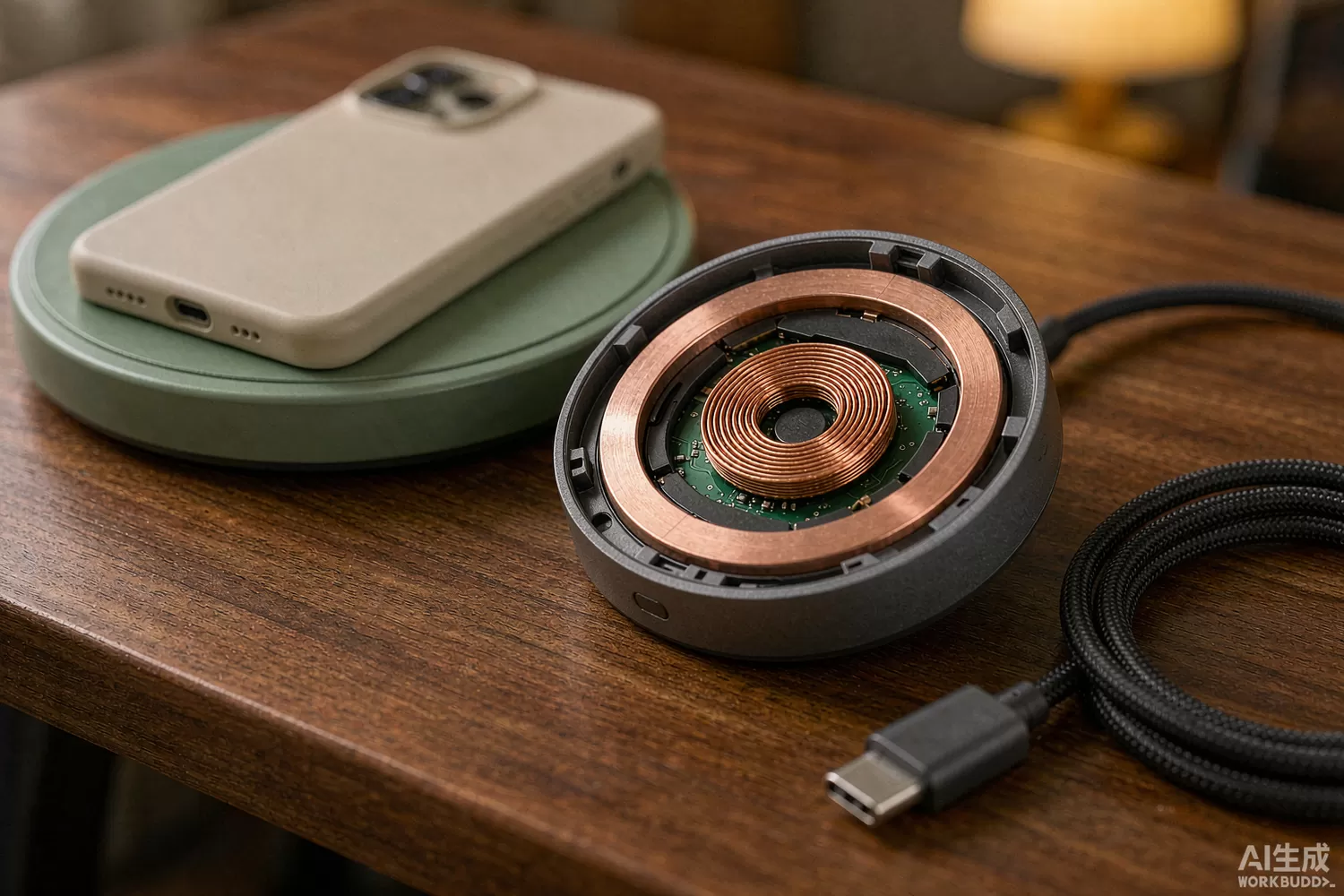
Wireless charging looks like a coil and a battery with nothing in between, and that impression is wrong in an instructive way. Between the coil and the battery sit an inverter, a resonant network, a rectifier, a charger and a control loop that has to keep a loosely coupled transformer — coupling factor typically 0.3 to 0.6 — running at 70 to 80 per cent end-to-end while staying inside a skin-temperature limit it cannot measure directly. The Qi2 magnetic profile added a magnet array that fixes the coil alignment and, with it, the coupling, which is why the standard could raise its ceiling to 25 W. This article covers the conversion logic, the parameters that decide whether a design passes certification, what is new in the power stage, and the domestic suppliers worth comparing with imported Qi2 controllers. This is a near-field inductive link rather than a far-field radio, but it shares the matching, thermal and EMC discipline of the RF work covered in our low-noise supply article.

Application logic: a transformer you cannot wind tightly
Power transfer is inductive, but every design decision is driven by the fact that the "transformer" has an air gap you cannot control to better than a millimetre and a coupling factor that changes when a phone case or a camera bump enters the gap:
- Inverter and resonant tank — the transmitter drives a half or full bridge into a series-resonant network at 87–205 kHz; the tank's quality factor sets circulating current, and therefore loss, for a given delivered power.
- Rectifier and post-regulation — the receiver's synchronous rectifier converts the coupled AC to a DC rail, then a charger or charge pump feeds the battery; each stage trades efficiency against die area, and the rectifier's body-diode behaviour dominates light-load loss.
- In-band communication — the receiver talks back by modulating the load (amplitude shift keying), the transmitter talks forward by shifting frequency; every control decision, including power contracts and fault reporting, travels over this link rather than a separate radio.
- Foreign-object detection — before and during transfer the transmitter measures quality factor and power-loss balance; a coin or a key fob on the pad absorbs watts that never reach the receiver, and the detection threshold must sit above legitimate misalignment loss and below the temperature rise that damages furniture.
- Authentication — Qi2 defines certificate-based authentication so a pad can refuse an unverified receiver; the secure element and its provisioning become part of the BOM, not an afterthought.
- Thermal budgeting — the receiver sits against a battery in a sealed phone; the design must derate power as the case temperature rises, which is a firmware policy expressed as a look-up table against measured NTC readings.
- Standby discipline — a pad on a bedside table draws quiescent power for years; standby budgets below 100 mW are now a procurement requirement in several markets, and they are set by the ping schedule and the analogue front end's bias current.
Parameters that decide certification, not just function
- End-to-end efficiency at rated power — measured coil to battery, not inverter to rectifier; a two-point improvement is worth several degrees of case temperature and is usually cheaper than a bigger coil.
- Misalignment tolerance — with Qi2 magnets the reference position is defined, but case thickness, camera rings and magnetic accessories still shift coupling; characterise efficiency and FOD false-trip rate across the specified offset envelope.
- Foreign-object detection margin — test with the objects that actually cause incidents: coins, keys, foil-wrapped gum, NFC cards, and a second phone's camera bump.
- EMC and conducted emissions — the inverter's switching edges and the resonant tank's circulating currents are the dominant radiator; the coil is an antenna whether you intended one or not.
- Receiver thermal path — die-to-case thermal resistance and copper spreading under the coil decide whether 25 W is sustained or throttled after four minutes.
- Authentication provisioning — certificate injection, key storage and the manufacturing flow that keeps keys out of firmware dumps; an unprovisioned batch cannot ship.
- Protection behaviour — over-voltage, over-current, over-temperature and metal-detection responses must latch or retry per the specification, and the retry policy is visible to the user as “my phone keeps stopping”.
What is changing in the power stage
Three things. First, the magnet array changed the economics of alignment: because Qi2 fixes the coil position, designers can raise coupling and shrink the coil, and the freed board area goes to a larger battery or a camera module. Second, the power ceiling moved twice — 5 W baseline to 15 W extended, and the newest profiles to 25 W — which pushed transmitters toward gallium-nitride switches and receivers toward charge-pump-based fast charging rather than linear post-regulation. Third, multi-device pads: a single pad now allocates power across a phone, a watch and earbuds, which turns the controller into a small power manager with per-coil foreign-object detection and a shared thermal budget. Underneath all three sits integration: the receiver controller, rectifier, charger and authentication block are collapsing into one die, and the survivors are the vendors who also own the firmware stack that passes certification.
Domestic alternatives: suppliers and indicative cost
Domestic coverage here is strong at the controller and power-stage level and thinner at the authentication-provisioning level. ConvenientPower Semiconductor (CPS) and NuVolta Technologies both ship wireless-charging receiver and transmitter controllers in high volume for phones and accessories; Southchip Semiconductor (listed) covers the charging and power-path side with wireless-charging front ends in its portfolio; Injoinic Technology (listed) supplies transmitter controllers such as the IP6808 family for pads and car mounts. Imported anchors are TI's BQ51013B receiver and BQ50002A/BQ500511 transmitter chipset, NXP's MWCT2xxx transmitter controllers, ST's STWLC receiver family and Renesas P9242-R. Verify certification status explicitly: a part can be electrically excellent and still lack the Qi2 authentication path your customer's product needs.
For a bench prototype, the supporting parts are ordinary: an Artery AT32F4212C8T7 to run the pad's UI and power policy, a Cosine COS29302WU for the housekeeping rail, an AO3401A P-channel MOSFET for input path switching, an INA226AIDGSR to log input power during efficiency sweeps, and a Titan Micro TS2502PN on the coil-side interface. If your pad doubles as an NFC reader for pairing, the coexistence notes in our NFC reader article apply directly.
Price figures below are indicative public-market reference ranges for moderate volumes, compiled from publicly observable listings. They fluctuate with the spot market, package option, grade (industrial, automotive, screened) and order quantity, and must not be read as a quotation. Ask us for a firm price on your exact part numbers and quantities.
| Function (imported anchor) | Example import part / class | Indicative import price (USD) | Domestic candidate | Indicative domestic price (USD) |
|---|---|---|---|---|
| Receiver controller with rectifier | TI BQ51013B, ST STWLC68 class | 0.85 – 2.10 | CPS and NuVolta receiver controller families (family level) | 0.35 – 0.95 |
| Transmitter controller | TI BQ50002A + BQ500511, NXP MWCT2xxx | 1.60 – 4.50 | Injoinic IP6808 family; other domestic TX controllers | 0.55 – 1.60 |
| Certification / authentication element | Imported secure element with Qi2 credentials | 0.40 – 1.20 | Domestic secure elements, provisioning support varies (family level) | 0.15 – 0.55 |
| Synchronous rectifier MOSFETs | Imported 30 V trench MOSFETs | 0.10 – 0.30 each | AO3401A and domestic equivalents | 0.02 – 0.08 each |
| Charger / power-path IC | Imported buck charger, 3 A class | 0.70 – 1.90 | Southchip and Injoinic charger families (family level) | 0.25 – 0.70 |
| Input current sensing | Imported INA-class monitor | 0.70 – 2.20 | INA226AIDGSR and domestic monitors | 0.30 – 0.90 |
| Housekeeping LDO | General-purpose 300 mA LDO | 0.25 – 0.65 | COS29302WU (Cosine) | 0.07 – 0.20 |
| Pad control MCU | STM32F0-class Cortex-M0 | 0.80 – 1.80 | AT32F4212C8T7 (Artery) | 0.30 – 0.70 |
Interpret the table as a cost-structure sketch. The receiver controller is where domestic pricing is most aggressive, and where the functional gap is smallest once certification is handled. The transmitter side still shows a wider spread because imported controllers carry mature multi-coil firmware and an interoperability test history; a domestic transmitter controller saves real money but you inherit more of the coil-characterisation work. Note also that the cheapest bill of materials in this category is not the one with the lowest silicon cost: thermal derating, FOD false trips and certification retries cost far more than a few cents of controller.
Validation flow before you commit
Characterise efficiency as a surface, not a point: sweep output power against coil offset and case thickness, and plot case temperature on the same axes. Then run the artefacts that cause field failures — a coin at the coil edge, a key fob under the phone, an NFC card between pad and phone, a camera bump that lifts the receiver by three millimetres — and record both the detection decision and the time to decision. Test the thermal policy by charging from empty in a 35 °C chamber with the phone in a case, and confirm the derating curve matches the published power contract. Measure standby input power over 24 hours, including the ping cadence, because a pad that pings too eagerly fails procurement even when everything else is fine. Finally, run EMC pre-compliance early: re-spinning a coil and shield stack is the most expensive mistake in this category.
Frequently asked questions
Is Qi2 the same as the older Qi 15 W extended profile?
No. Qi2 introduced a magnetic power profile with a defined magnet array and alignment, plus certificate-based authentication. The magnet array raises achievable coupling, which is what allows higher power levels without exceeding thermal limits.
Can a domestic receiver controller pass Qi2 certification?
In principle yes, but certification depends on the controller, the authentication path and the firmware stack together. Ask for evidence of a certified reference design rather than a silicon capability statement.
Why does my charger stop when I put a coin on it?
That is foreign-object detection working. A metal object absorbs power without delivering it, so the transmitter sees a power-loss imbalance and halts. False trips come from miscalibrated thresholds, usually after a coil or shield change.
Does wireless charging interfere with NFC?
Both use magnetic fields at the same coil, so coexistence needs time-multiplexing or frequency planning. Test card reads while charging rather than assuming the isolation is adequate.
About us & trademarks: JTDZ Tech (Shenzhen Jingteng Electronics Technology Co., Ltd.) is an independent distributor of electronic components. We are not an authorised distributor or representative of the imported manufacturers named in this article. Manufacturer, brand and part names are used for identification purposes only; all trademarks remain the property of their respective owners. Cross-reference information in this article is based on publicly available sources, is subject to change, and is not a substitute for your own engineering validation. Always verify specifications against the manufacturer's datasheet before design-in or purchase.
