
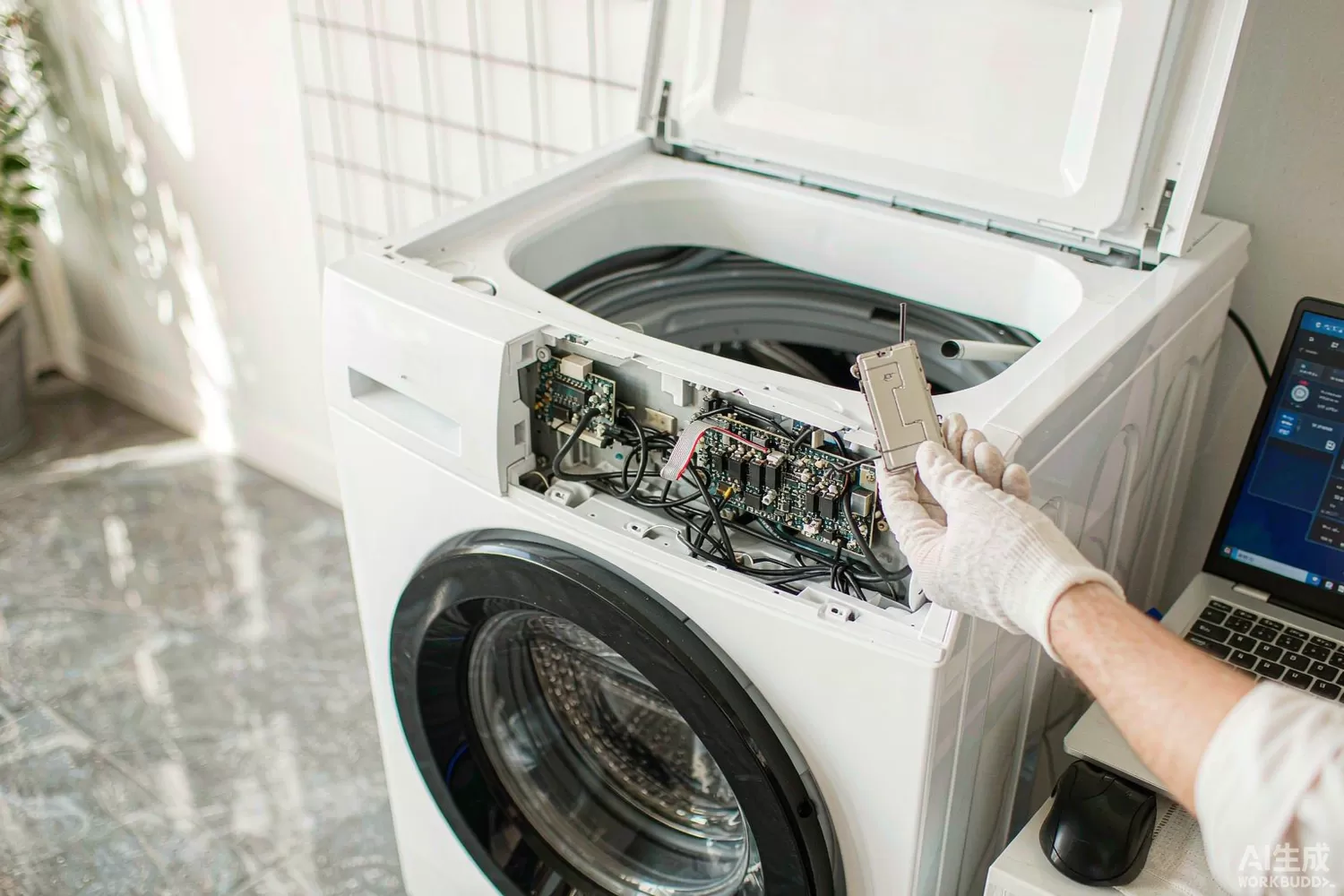
A washing machine that reports its own faults needs two radios for one job. Wi-Fi carries the cloud traffic — firmware images, telemetry, occasionally a video doorbell's worth of throughput — while Bluetooth carries the thirty seconds of provisioning that happens once in the product's life, plus local control when the router is down. Putting both on one die with one crystal and one antenna is the standard answer, and it turns a radio problem into a coexistence problem. This article explains the integration logic, the arbitration parameters that decide whether a device stays connected, what Wi-Fi 6 changed for battery-powered products, and the domestic combo SoCs worth comparing with imported connectivity silicon. For the front-end module that often sits beside them, see our Wi-Fi FEM article.

Application logic: two radios, one antenna, one clock
- Provisioning path — the phone hands over SSID and credentials over a BLE link, then the device joins the network and the BLE link either idles or becomes a local control channel; Matter commissioning works exactly this way, with BLE as the out-of-band carrier.
- Traffic asymmetry — cloud traffic is bursty and mostly upstream-small; a dishwasher sends kilobytes a day, so average power is set by how often the radio wakes to check for downlink, not by throughput.
- Antenna sharing — a single 2.4 GHz antenna with a switch, or a diplexed front end; either way the two radios cannot transmit simultaneously without arbitration, and the switch's insertion loss is paid twice.
- Coexistence arbitration — time-domain arbitration (Wi-Fi announces its slot, BLE defers) or packet-traffic arbitration over a hardware handshake; done badly, a BLE connection drops every time the device uploads a telemetry burst.
- Clock sharing — one crystal feeds both PHYs, which saves cost but couples frequency error; the BLE sleep-clock accuracy then depends on the Wi-Fi sleep strategy and the calibration schedule.
- Security boundary — secure boot, encrypted keys and a hardware root of trust now sit in the same die as the radio; an appliance that can be re-flashed over the air needs the key store to be non-extractable.
Parameters that decide whether the product stays online
- Receive sensitivity at the modes you will use — the 1 Mbps figure is not the number that matters if your traffic runs at MCS7; compare like for like, and check sensitivity with the BLE radio active.
- Transmit power and EVM — 20 dBm at the antenna port with adequate EVM beats 22 dBm that distorts; the appliance is usually behind a metal panel, so link margin is worth more than peak power.
- Deep-sleep and DTIM behaviour — the product's battery or standby rating is set by the sleep current plus the wake cadence; a part that wakes for every beacon cannot meet an always-on specification.
- Coexistence performance under load — measure BLE connection interval jitter while the Wi-Fi link is at full upstream throughput; this is where cheap arbitration shows up.
- Provisioning robustness — how the device behaves when the phone walks away mid-handover, or when the router uses WPA3 and the phone does not; recovery paths are firmware, but they depend on the radio's state machine.
- Regulatory and certification headroom — the module or SoC must have margin against spurious limits; a combo radio that barely passes leaves no room for the enclosure and cable changes of production.
What is changing: Wi-Fi 6, Matter and the end of the always-on radio
Wi-Fi 6's target wake time is the most consequential change for appliances in a decade. The access point and the device negotiate when the device will be awake, so the radio can sleep for seconds instead of listening to every beacon; for a battery-powered sensor this converts Wi-Fi from a mains-only technology into a plausible one. Matter standardised the commissioning flow and the data model on top of Wi-Fi and Thread, which pushed combo SoCs to add an 802.15.4 radio — a tri-radio part is now the default for a smart-home hub, and our 802.15.4 SoC article covers that side. The third shift is integration of the front end: PA, LNA, switch and sometimes the harmonic filter moved on-die, so the bill of materials for a connected appliance now contains one radio SoC, one antenna matching network and very little else — which is precisely why module-level certification and antenna design became the differentiators rather than radio performance.
Domestic alternatives: suppliers and indicative cost
Domestic combo SoCs are competitive at the silicon level and ahead on ecosystem tooling for cost-sensitive appliances. Espressif Systems (listed) ships the ESP32-C6, a Wi-Fi 6 plus BLE 5 plus 802.15.4 part on a RISC-V core, and the ESP32-C3 for Wi-Fi 4 plus BLE designs; both are supported by a mature open toolchain that shortens bring-up considerably. Beken (Bomtong Integrated, listed) supplies Wi-Fi 6 plus BLE combo SoCs with audio paths, aimed at appliances and cameras; Winner Micro's W800 pairs Wi-Fi with BLE on a RISC-V core for metering and white goods. Imported anchors are Infineon's CYW43439 (the part behind several popular development boards), NXP's IW612 tri-radio, and TI's CC33xx companion family. Cross-reference at the feature level rather than the pin level: antenna count, coexistence handshake, host interface and the certification the module already holds all matter more than a pin map.
Bring-up hardware for a first prototype is straightforward: pick the combo SoC module that already holds the certification you need, then add an Artery AT32L021C8T7 if your appliance needs a separate real-time control core, a Cosine COS29502WU for the 3.3 V rail, a Qorvo RFFM8209TR when you need an external front end for range, a Tai-Saw TA0224A for the receive filter in a shared-antenna design, and a Titan Micro TS2502PN at the antenna port. Flash for OTA staging is covered in our SPI NOR sourcing guide.
Price figures below are indicative public-market reference ranges for moderate volumes, compiled from publicly observable listings. They fluctuate with the spot market, package option, grade (industrial, automotive, screened) and order quantity, and must not be read as a quotation. Ask us for a firm price on your exact part numbers and quantities.
| Function (imported anchor) | Example import part / class | Indicative import price (USD) | Domestic candidate | Indicative domestic price (USD) |
|---|---|---|---|---|
| Wi-Fi 4 + BLE combo SoC | Infineon CYW43439 class | 2.20 – 4.80 | Espressif ESP32-C3 family; Winner Micro W800 | 0.90 – 2.10 |
| Wi-Fi 6 + BLE combo SoC | NXP IW612 tri-radio class | 3.50 – 7.50 | Espressif ESP32-C6; Beken Wi-Fi 6 combo families | 1.60 – 3.60 |
| Certified module (antenna included) | Imported pre-certified module | 5.00 – 12.00 | Domestic pre-certified modules (family level) | 2.20 – 5.50 |
| External 2.4 GHz front end | Qorvo / Skyworks FEM class | 0.60 – 1.80 | RFFM8209TR as reference; domestic FEM families | 0.25 – 0.80 |
| Application control MCU | STM32L0-class Cortex-M0+ | 0.90 – 2.20 | AT32L021C8T7 (Artery) | 0.30 – 0.80 |
| OTA staging flash, 128 Mbit | Winbond W25Q128 class | 0.70 – 1.60 | Puya / XTX / GigaDevice 128 Mbit equivalents | 0.22 – 0.55 |
| 3.3 V rail regulator | General-purpose LDO, 300 mA | 0.25 – 0.65 | COS29502WU (Cosine) | 0.07 – 0.20 |
| Antenna-port ESD protection | Imported low-capacitance TVS | 0.12 – 0.40 | TS2502PN (Titan Micro) | 0.03 – 0.10 |
The table describes structure, not quotations. Domestic combo SoCs land at roughly half the imported price at equivalent feature levels, and the gap widens once you count the toolchain: an imported combo part often arrives with a proprietary SDK and a support contract, while the domestic ecosystem assumes you will read the source. What imported silicon still sells is a long interoperability history with access-point vendors and a certification file that a conservative appliance brand can hand to a notified body without argument.
Validation flow before you commit
Test the product, not the radio. Put the board inside the actual metal or plastic enclosure, behind the actual door, and measure throughput and reconnect time at the distances your customers will use — a washing machine in a utility room is a worse RF environment than any lab. Then run the coexistence matrix: BLE connected at 30 ms interval while Wi-Fi uploads at full rate; BLE provisioning while the Wi-Fi stack scans; both radios active while the motor inverter runs. Log disconnection causes, because "it reconnects" hides a user-visible delay. Add a router diversity check: at least one consumer mesh system, one ISP-supplied gateway and one enterprise access point with band steering, since band steering is the single most common cause of provisioning failures in the field. Finally, measure sleep current with the radio associated but idle, since that number, not the datasheet's deep-sleep figure, decides your standby rating.
Frequently asked questions
Do I need Bluetooth at all if the device has Wi-Fi?
In practice yes. Provisioning over a soft access point is slower and less reliable on modern phones, and BLE gives you a local control path when the router or the cloud is unavailable. Matter commissioning assumes it.
Why does the BLE connection drop during firmware upload?
Antenna sharing plus weak time-domain arbitration. The Wi-Fi burst holds the front end long enough to miss BLE connection events. Look for a hardware coexistence handshake and verify the arbitration policy in the SDK.
Is Wi-Fi 6 worth it for a low-power appliance?
Yes when the application can use target wake time. Without TWT, Wi-Fi 6 mainly buys spectral efficiency in dense environments; with TWT, it changes the battery arithmetic.
Can I use a domestic combo SoC for a product sold in Europe?
Yes, provided the module or the design holds the relevant radio certification and you can produce the test reports. Certification is a property of the module and antenna arrangement, not of the die.
About us & trademarks: JTDZ Tech (Shenzhen Jingteng Electronics Technology Co., Ltd.) is an independent distributor of electronic components. We are not an authorised distributor or representative of the imported manufacturers named in this article. Manufacturer, brand and part names are used for identification purposes only; all trademarks remain the property of their respective owners. Cross-reference information in this article is based on publicly available sources, is subject to change, and is not a substitute for your own engineering validation. Always verify specifications against the manufacturer's datasheet before design-in or purchase.
