
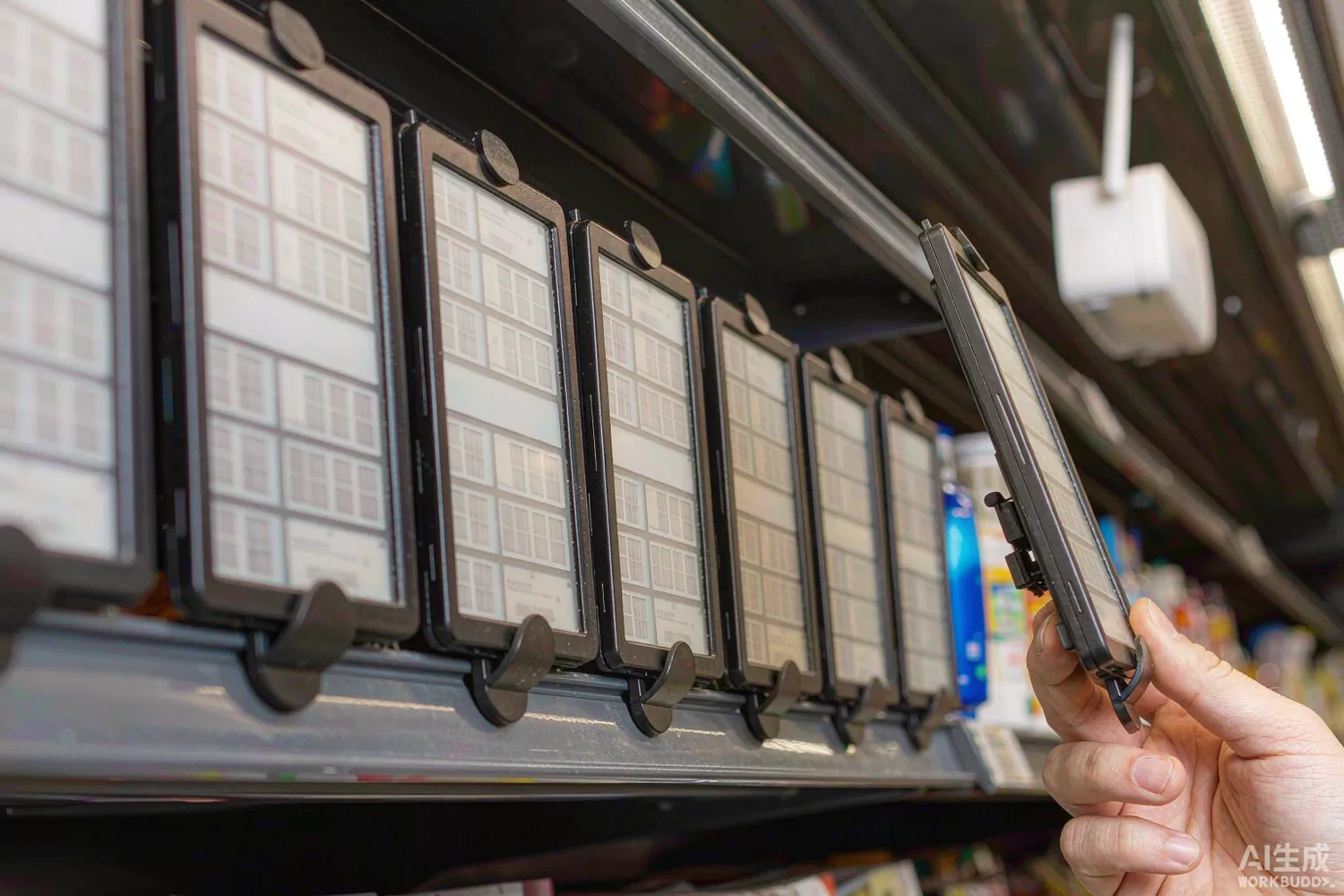
A supermarket shelf label is a computer with one job, powered by a coin cell, expected to run for five years, and priced so that a store can deploy twenty thousand of them. That combination produces an unusual chip specification: the radio spends almost all its life asleep, the display consumes more energy in one refresh than the radio does in a month, and the bill of materials is dominated by things that are not the SoC. This article covers the update logic, the energy budget that actually governs the design, the display technology shift now underway, and the domestic label SoCs worth comparing with imported Bluetooth parts. For the store-side infrastructure, our indoor positioning article covers the complementary problem of knowing where the shelf is.

Application logic: broadcast, wake briefly, refresh rarely
- Gateway fan-out — a store gateway on Ethernet or Wi-Fi drives shelves of labels over 2.4 GHz; the protocol is usually a proprietary broadcast scheme with time-slotted acknowledgements rather than connection-oriented Bluetooth, because connecting twenty thousand labels individually would never finish.
- Group addressing — labels are addressed by shelf, aisle or product group so a price change updates a whole category in one broadcast; the SoC must filter addresses in hardware while asleep, otherwise the application core wakes for traffic that is not its own.
- Image diffing — the label does not repaint the whole screen for a digit change; the host sends a partial image or a delta, and the SoC's display driver refreshes only the affected region, which is where most of the energy saving in the product actually comes from.
- E-paper drive — electrophoretic panels need 12–15 V rails generated on label from a 3 V cell; the boost converter's efficiency and inrush behaviour decide the refresh energy and the cell's useful life.
- Identity and binding — each label carries a unique ID bound to a planogram position; losing that binding during a firmware update means a person walks the aisle with a scanner, so the binding must survive power loss and update failure.
- Optional sensing — temperature, tamper and, in some formats, a pick-to-light LED; each addition costs sleep current, and sleep current is the specification that decides whether the product ships.
The energy budget that governs everything
- Sleep current — sub-microamp sleep with address filtering active is the target; a part that sleeps at 3 µA instead of 0.7 µA loses roughly two years of life on a CR2450 at one refresh a day.
- Receive current and duty cycle — labels wake on a schedule to catch broadcasts; the product of receive current, wake duration and wake frequency usually exceeds the display's annual energy in high-churn stores.
- Refresh energy per update — measured in millijoules for a partial update and tens of millijoules for a full three-colour repaint; the number depends on panel size, waveform and boost efficiency, and must be measured, not estimated.
- Peak current during refresh — a coin cell's internal resistance turns a 40 mA peak into a voltage sag that resets the SoC; bulk capacitance and a soft-start boost are not optional.
- Update latency — a store expects a price change to be visible within minutes; latency is set by broadcast scheduling and by how many labels answer in the acknowledgement window.
- Retention and temperature — cold stores and freezer aisles are the hard case: e-paper response slows and cell capacity collapses at −25 °C, so the waveform and the cell chemistry both change.
What is changing: colour, wireless power and store-scale software
Panel technology is moving faster than the radio. Multi-colour electrophoretic panels — black, white, red, yellow, and now four-colour and spectral formats — let retailers show promotional colour without a second display technology, at the cost of longer waveforms and more refresh energy; the SoC's display driver and waveform storage have become the differentiator. Battery-free and energy-harvesting labels are appearing in pilot volumes, using NFC field power or indoor light, which removes the coin cell's replacement cost but constrains refresh frequency. On the infrastructure side, label data became a retail system: dynamic pricing, pick-to-light and out-of-stock detection run over the same radio, so the gateway protocol now carries latency-sensitive messages alongside bulk price updates, and the label SoC is expected to support scheduled wake windows rather than fixed polling. Integration follows: radio, display driver, boost converter and a small application core in one die, with the waveform tables in on-die or external flash.
Domestic alternatives: suppliers and indicative cost
Domestic silicon is well positioned here because electronic shelf labels are manufactured in volume domestically. Telink Semiconductor (listed) supplies Bluetooth Low Energy SoCs — the TLSR8258 family in particular — that are widely used in label designs, with the low sleep current and hardware address filtering this application demands; its newer multi-protocol families extend the same architecture. Hanshow Technology is the largest domestic label system supplier and defines much of the reference architecture, while BOE supplies the electrophoretic panels that sit behind it. Imported anchors are TI's CC2640R2F, Nordic's nRF52832, Silicon Labs' EFR32MG22 and NXP's JN5189/QN9090 families. Compare at the level of sleep current with filtering enabled, boost-converter integration, waveform storage and how much of the display driver is on-die; a cheaper SoC that needs an external boost and an external driver rarely wins on total cost.
Prototyping hardware is modest: an Artery AT32L021K8U7-4 if you want a separate application core for a multi-label gateway, a Cosine COS29302WU for the label's housekeeping rail, an XTX XT25F128B to hold image buffers and waveform tables, a Tai-Saw TA0224A to define the gateway's receive channel, and a Titan Micro TS2502PN on the antenna. For the gateway's own power tree, our eFuse and hot-swap article covers protection.
Price figures below are indicative public-market reference ranges for moderate volumes, compiled from publicly observable listings. They fluctuate with the spot market, package option, grade (industrial, automotive, screened) and order quantity, and must not be read as a quotation. Ask us for a firm price on your exact part numbers and quantities.
| Function (imported anchor) | Example import part / class | Indicative import price (USD) | Domestic candidate | Indicative domestic price (USD) |
|---|---|---|---|---|
| BLE label SoC with display driver | TI CC2640R2F, Nordic nRF52832 class | 1.10 – 2.60 | Telink TLSR8258 family (family level) | 0.45 – 1.05 |
| Multi-protocol label SoC | Silicon Labs EFR32MG22 class | 1.60 – 3.40 | Telink multi-protocol families (family level) | 0.70 – 1.70 |
| E-paper panel, 2.9 inch three-colour | Imported panel with driver board | 3.50 – 7.00 | BOE and other domestic panel suppliers | 1.60 – 3.60 |
| Boost converter for panel rails | Imported low-power boost, 15 V | 0.25 – 0.70 | Domestic boost families; integrated in newer label SoCs | 0.08 – 0.28 |
| Waveform / image flash | Serial NOR 128 Mbit class | 0.70 – 1.60 | XT25F128B (XTX) | 0.22 – 0.55 |
| Gateway receive filter | Imported 2.4 GHz SAW / LTCC filter | 0.15 – 0.60 | TA0224A (Tai-Saw) | 0.06 – 0.22 |
| Housekeeping LDO | General-purpose 300 mA LDO | 0.25 – 0.65 | COS29302WU (Cosine) | 0.07 – 0.20 |
| Antenna ESD protection | Imported low-capacitance TVS | 0.12 – 0.40 | TS2502PN (Titan Micro) | 0.03 – 0.10 |
Treat the numbers as a shape, not a quote. Two facts dominate the economics: the panel and the cell together cost more than the SoC, and the SoC's sleep current determines how much cell you must buy. That is why domestic label SoCs win on total cost even when their silicon price advantage looks modest — the integration of boost and driver removes two components and a calibration step from every label. Imported parts retain ground in labels that must interoperate with an existing estate, where the protocol and the binding database are already invested.
Validation flow before you commit
Measure life, do not calculate it. Run a rack of twenty labels at your real update cadence for at least a month with periodic cell-voltage logging, in a chamber that cycles between 5 °C and 30 °C, and extrapolate from measured coulombs rather than from a datasheet sleep figure. Then test the ugly cases: a broadcast storm during a promotion reset, a firmware update interrupted at 50 per cent, a label whose address is corrupted, and a freezer aisle at −25 °C where the panel's waveform must slow down. Verify the boost converter's behaviour at end-of-life cell voltage, because that is when resets happen and when a label shows a blank screen to a customer. Finally, measure the gateway's completion time for a full-estate update; if it exceeds the store's maintenance window, no amount of per-label optimisation will save the deployment.
Frequently asked questions
Why do labels use proprietary protocols instead of Bluetooth?
Because a store updates thousands of labels at once. Broadcast with time-slotted acknowledgements scales better than connection-oriented links, and hardware address filtering lets the SoC stay asleep for traffic that is not addressed to it.
How long does a coin cell really last?
It depends almost entirely on update frequency and sleep current. One refresh a day with sub-microamp sleep can reach five years on a CR2450; hourly full-colour repaints will not, regardless of the radio.
Are battery-free labels practical?
For low-churn categories, yes. Harvested power from NFC fields or indoor light limits refresh frequency and usually forces a smaller panel, so they complement rather than replace battery labels.
Can I mix label vendors in one store?
Only with a shared protocol and binding database. Mixing hardware without a common gateway protocol means two estates and two update paths.
About us & trademarks: JTDZ Tech (Shenzhen Jingteng Electronics Technology Co., Ltd.) is an independent distributor of electronic components. We are not an authorised distributor or representative of the imported manufacturers named in this article. Manufacturer, brand and part names are used for identification purposes only; all trademarks remain the property of their respective owners. Cross-reference information in this article is based on publicly available sources, is subject to change, and is not a substitute for your own engineering validation. Always verify specifications against the manufacturer's datasheet before design-in or purchase.
