
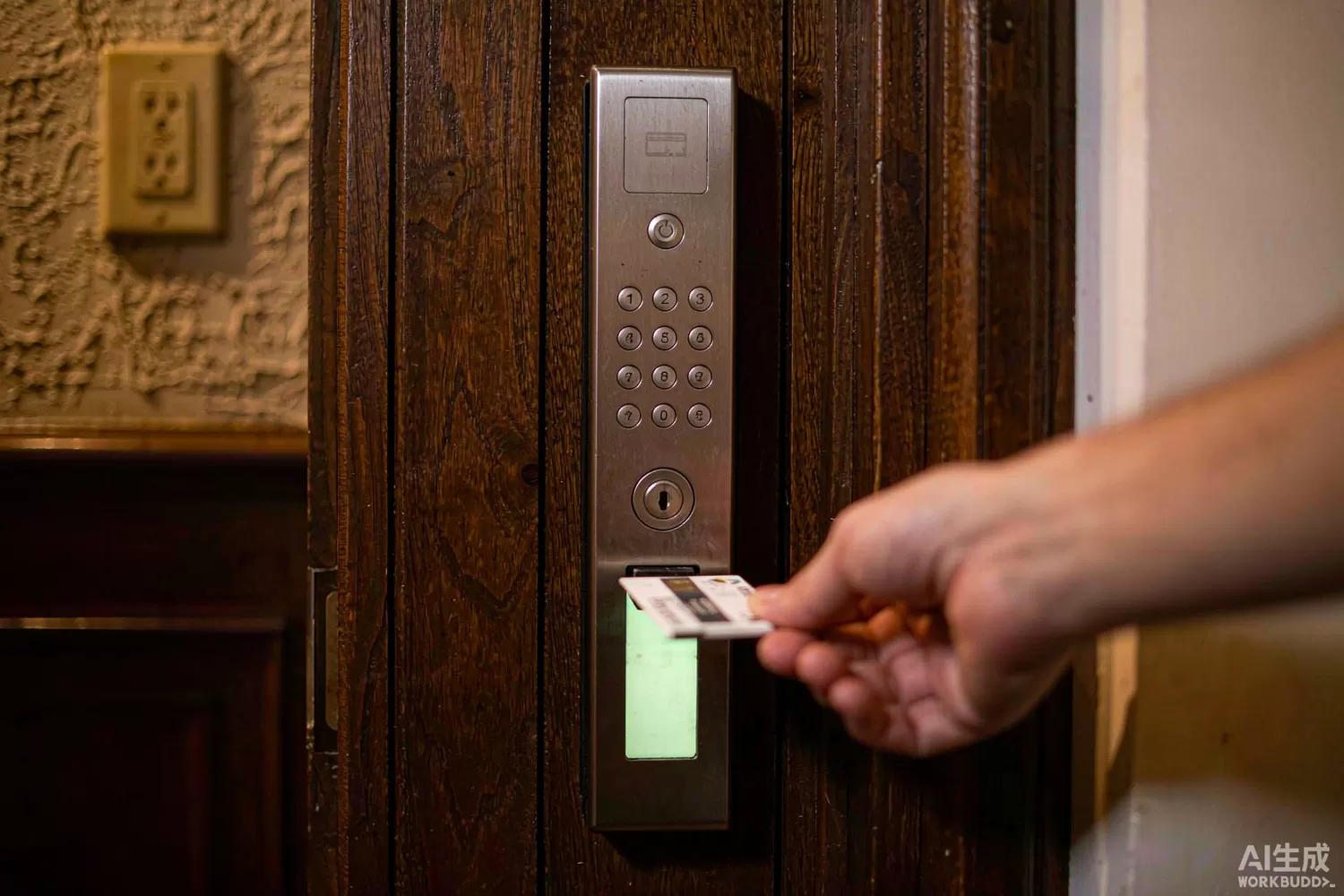
A door lock is a security product pretending to be a consumer gadget. It runs from four AA cells, must open on the first press in the rain at −10 °C, must refuse a cloned card, must survive a magnetic attack from a handheld coil, and must not brick itself when the battery dies. Every one of those requirements lands on a different chip: a 13.56 MHz reader front end, a Bluetooth SoC for phone keys, a secure element or protected flash for key material, a motor driver with a boost stage, and a power tree that spends microamps as if they were currency. This article walks that chain, the parameters that decide whether a lock passes a security review, and the domestic parts worth comparing with imported reader and radio silicon. Card-side chips are covered in our NFC tag IC article, and the radio front end comparison lives in the reader chip article.

Application logic: wake, verify, actuate, sleep
- Wake sources — a capacitive keypad, a card approaching the reader's field, a BLE connection request, or a mechanical handle sensor; each wake path has its own quiescent cost, and the sum of them is the lock's standby current.
- Credential verification — cards are read over ISO/IEC 14443 A/B or ISO/IEC 15693, phone keys arrive over BLE with a challenge-response, and both resolve to a key slot in protected storage; the decision logic must run in a trusted path, not in the same flash page as the user interface code.
- Actuation — a gear motor or a solenoid, driven through an H-bridge or a motor driver, often from a boosted rail because a solenoid needs 6–12 V while the cells deliver 6 V and sag under load.
- Fail-safe state — the lock must know its position (open, closed, deadbolted), report jam conditions, and never half-retract; position sensing and current monitoring are how a lock distinguishes "the door is pushing back" from "the battery is flat".
- Audit trail — the last few hundred events (which credential, which time, which result) live in non-volatile memory with wear management; this is the feature that makes a lock a building product rather than a gadget.
- Tamper and attack response — cover switches, field-strength monitoring against magnetic attacks, and a policy that locks out repeated failures without locking out the owner.
Parameters a security review will ask about
- Standby current of the whole chain — not just the MCU; the reader's field-detect oscillator, the BLE advertisement interval and the LDO's quiescent current all contribute, and the target is a few tens of microamps for a six-to-twelve-month battery life.
- Card read distance and consistency — 2–5 cm is comfortable and also a security boundary; a reader that reaches 15 cm invites relay and skimming attacks and wastes field power.
- Key storage — whether key material can be extracted through a debug port, a firmware dump or a glitch; parts with locked flash, dedicated key slots and true random number generation survive a teardown, parts with plain flash do not.
- Motor inrush and brown-out behaviour — the cells' internal resistance plus a cold morning decides whether the MCU resets mid-actuation; bulk capacitance, soft start and a brown-out detector with a defined recovery path are all required.
- ESD on a metal front panel — the panel is the antenna for every discharge in the hallway; the reader's antenna pins and the keypad lines need protection that does not detune the coil, which is the same trade-off discussed in our antenna-port ESD article.
- Temperature range — a north-facing door in winter is a −25 °C design case; the cell, the display and the motor all derate, and the firmware must know.
- Firmware update path — OTA over BLE with signed images and rollback; a lock that fails an update is a lock that must be physically serviced.
What is changing: passive entry, biometrics and Matter
Three currents are visible in current designs. First, the phone key became the default credential, first through vendor-specific BLE protocols and now through standardised access credentials carried over BLE and UWB; the lock's radio is increasingly a multi-role device that advertises, connects and, in premium models, ranges. Second, biometrics moved onto the lock — fingerprint sensors with on-die template matching mean the lock no longer stores a reusable secret, only a template that cannot be reversed into a finger, which changes the security architecture as much as the bill of materials. Third, Matter over Thread turned the lock into a fabric node that must interoperate with hubs it has never met, which pushes memory, certificate storage and commissioning logic up a tier — and pushes the radio toward the multi-protocol SoCs described in our 802.15.4 radio article. Underneath all three, the power budget has not moved: a lock still has to last a year on four cells while doing more radios and more cryptography per press.
Domestic alternatives: suppliers and indicative cost
Domestic coverage of the reader and secure-element layer is mature because the access-control market is large. Fudan Microelectronics (listed) supplies 13.56 MHz reader front ends and secure microcontroller families used widely in locks and readers, with card-side and reader-side parts in the same portfolio; Telink supplies the BLE SoC with the low-duty-cycle advertising behaviour a lock needs; Goodix (listed) covers fingerprint sensing with on-die matching; Nationz Technologies covers security controllers. Imported anchors are NXP's PN5180 and PN7462 reader families, ST's ST25R3916, TI's CC2640R2 and Nordic's nRF52840 for the radio. Cross-reference at the credential level: card protocol support, secure-element certification and the BLE stack's pairing model decide whether a substitution is viable, and none of them can be inferred from a pin map.
For a development bench, the supporting parts are familiar: an Artery AT32F403ACGT7 as the application and actuation controller, a Nordic-class nRF52832-QFAA-R as the BLE reference, a Cosine COS29302WU for the always-on rail, an SI2301 P-channel MOSFET for rail gating, an INA226AIDGSR to log actuation current profiles, and a Titan Micro TS2502PN on the reader antenna pins.
Price figures below are indicative public-market reference ranges for moderate volumes, compiled from publicly observable listings. They fluctuate with the spot market, package option, grade (industrial, automotive, screened) and order quantity, and must not be read as a quotation. Ask us for a firm price on your exact part numbers and quantities.
| Function (imported anchor) | Example import part / class | Indicative import price (USD) | Domestic candidate | Indicative domestic price (USD) |
|---|---|---|---|---|
| 13.56 MHz reader front end | NXP PN5180, ST ST25R3916 class | 1.60 – 3.80 | Fudan Microelectronics reader families (family level) | 0.55 – 1.50 |
| Reader plus MCU integration | NXP PN7462 class | 3.00 – 6.50 | Fudan Microelectronics reader-MCU families (family level) | 1.20 – 2.90 |
| BLE SoC for phone keys | Nordic nRF52832 / nRF52840 class | 1.80 – 4.20 | Telink BLE families (family level) | 0.60 – 1.50 |
| Secure element / protected key store | Imported secure element, CC EAL4+ class | 0.60 – 1.80 | Nationz and other domestic secure controllers (family level) | 0.25 – 0.80 |
| Fingerprint sensor with on-die matching | Imported capacitive sensor module | 1.80 – 4.50 | Goodix sensor families (family level) | 0.80 – 2.10 |
| Motor / solenoid driver | Imported H-bridge or stepper driver | 0.80 – 2.20 | DRV8825PWPR as reference; domestic drivers | 0.30 – 0.90 |
| Boost for solenoid rail | Imported low-power boost converter | 0.40 – 1.10 | TPS61080DRCR reference; domestic equivalents | 0.15 – 0.45 |
| Antenna-side ESD protection | Imported low-capacitance TVS | 0.12 – 0.40 | TS2502PN (Titan Micro) | 0.03 – 0.10 |
Treat these as ranges to screen with. The reader front end is the part where domestic and imported silicon are closest on function and furthest apart on price, so it is usually the first block to localise. The secure element is the opposite: certification evidence, not price, decides, and a lock sold into a building project may be contractually tied to a certified device. Budget for the security review as a line item, because it will consume more engineering hours than the radio.
Validation flow before you commit
Start with the credential layer. Enumerate the cards you must support, then attack your own reader: clone a card, replay a BLE handshake, remove the cover mid-authentication, and apply a magnetic field to the panel. Log the lock's response and the time it takes to return to a safe state. Then measure the battery honestly: a full year's cadence compressed into a few weeks by raising the wake rate, with cell voltage logged and the motor exercised at −10 °C. Actuation deserves its own campaign — run five thousand open-close cycles with a door-closing force applied and watch the current signature for jams. Check the firmware update path by interrupting an update at every stage and confirming the lock still opens with the old image. Finally, verify the mechanical fail-safe: with a dead cell, the key override must work without the electronics.
Frequently asked questions
Can a domestic reader chip handle the same cards as an imported one?
Protocol support is usually equivalent for ISO/IEC 14443 A/B and 15693, but card-specific extensions and the secure-element pairing model vary. Validate against the exact card population the project must support.
Is BLE secure enough for a door lock?
BLE itself is not the security boundary; the pairing model and key storage are. Use a challenge-response scheme with keys in a protected element, and treat the radio as an untrusted transport.
Why does a lock reset when the motor starts?
The cell's internal resistance plus motor inrush pulls the rail below the brown-out threshold. Bulk capacitance, a soft-start driver or a boosted rail fixes it; firmware alone cannot.
Do I need a secure element if the MCU has protected flash?
For consumer locks, protected flash with locked debug and a hardware random number generator is often enough. For building projects and audit requirements, a certified secure element simplifies the argument.
About us & trademarks: JTDZ Tech (Shenzhen Jingteng Electronics Technology Co., Ltd.) is an independent distributor of electronic components. We are not an authorised distributor or representative of the imported manufacturers named in this article. Manufacturer, brand and part names are used for identification purposes only; all trademarks remain the property of their respective owners. Cross-reference information in this article is based on publicly available sources, is subject to change, and is not a substitute for your own engineering validation. Always verify specifications against the manufacturer's datasheet before design-in or purchase.
