
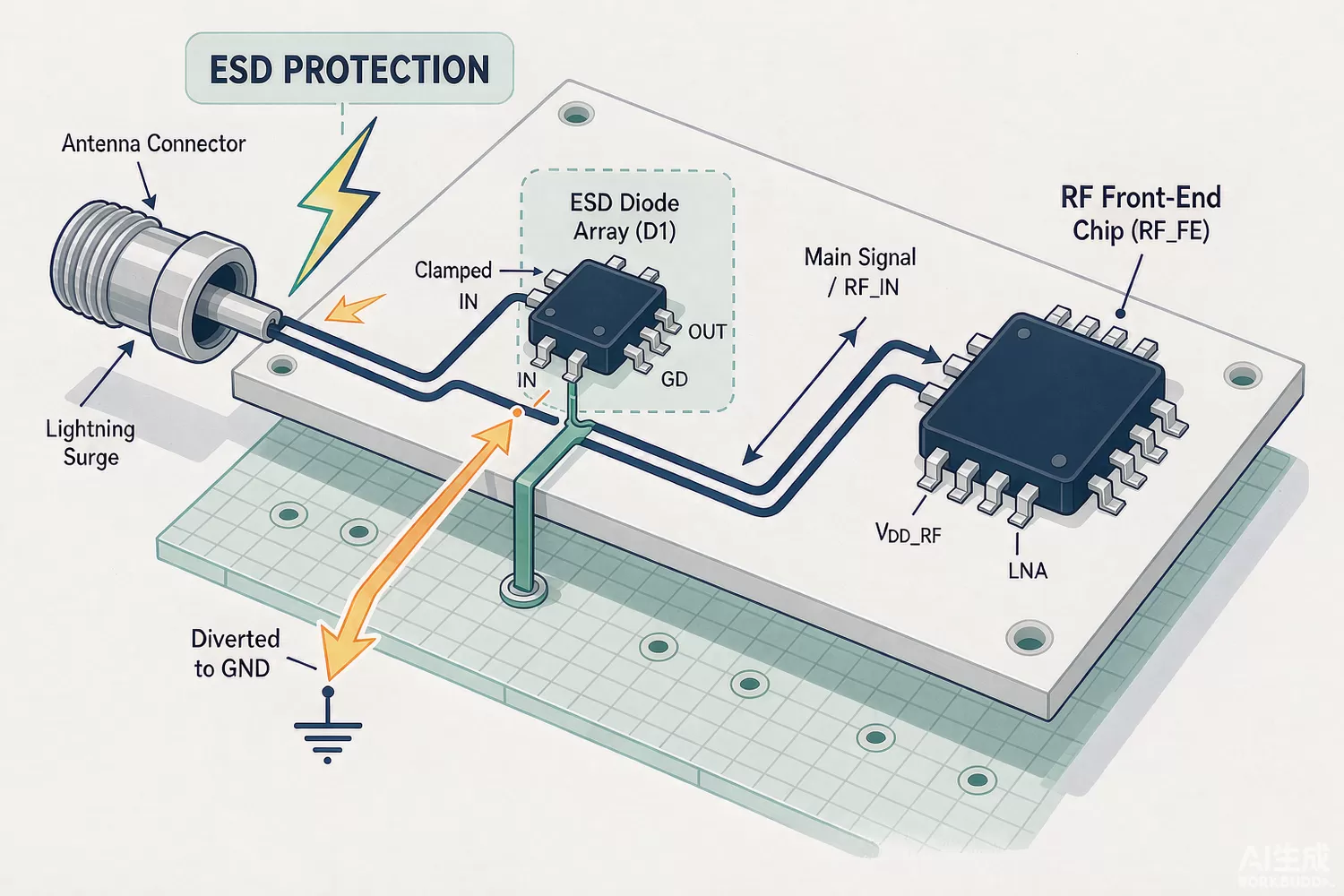
Every radio that touches an external antenna, a connector or a human hand inherits the electrostatic-discharge problem. A person walking across carpet can present 8 kV; the IEC 61000-4-2 contact-discharge test formalises 4–8 kV at the connector; and an RF front end built on gallium arsenide or SOI dies at a fraction of that energy. Protection at the antenna port is therefore not an accessory — it is part of the receiver's gain budget and the product's warranty exposure. This article covers the selection logic for ESD and surge protection on RF lines, what is new in the device technology, and the domestic supply picture.

Application logic: the capacitance-versus-protection trade
The core trade is brutal: a protection structure is a diode network, and every diode adds capacitance. On a 2.4 GHz antenna line, even 0.5 pF of shunt capacitance moves the match and eats insertion loss; on a 433 MHz telemetry input or an RS-adjacent IO line, 1–3 pF is affordable. So the selection logic runs by line class:
- Antenna lines above 1 GHz: ultra-low-capacity ESD arrays (0.15–0.5 pF), often combined with the intrinsic robustness of the front-end IC itself; every 0.1 pF is negotiated.
- Sub-GHz antenna and telemetry lines: 1–3 pF arrays with higher surge ratings, because the match is wider and lightning-adjacent cable events matter.
- External-connector IO (USB, SIM, button lines near the radio): 5–15 pF is acceptable; protection depth and clamping voltage dominate.
- Between protection and the limiter: on power-amplifier-adjacent receive chains, a PIN limiter diode handles the high-energy case and the ESD array handles the fast human-body pulse — the two stages are complementary, as covered in the PIN limiter article.
Placement discipline matters as much as the part: the protection device sits at the connector side of any series inductance, with a short, low-inductance ground return; otherwise the very inductance you route to isolate the RF path turns the fast pulse into a voltage spike that bypasses the diode. Ground vias are part of the protection, not an afterthought.
Reading the datasheet: the numbers that matter
- Line capacitance at your bias and frequency — quoted at 0 V or 1 MHz in some datasheets and at operating bias in others; read the condition, not the headline.
- Clamping voltage at the IEC 61000-4-2 pulse current (typically at 8 kV contact, ~16 A class) and dynamic resistance during the pulse.
- ESD robustness rating by model: HBM (human body), MM (machine), IEC 61000-4-2 air and contact — a part rated 8 kV IEC may be modest in machine-model terms and vice versa.
- Insertion loss or return-loss plot across your band with the device mounted in a 50-ohm fixture.
- Leakage and breakdown: leakage below a microamp keeps battery products honest; the reverse standoff must exceed your DC bias on bias lines.
- Surge rating (8/20 µs or 2/10 µs impulse) for outdoor-connected ports.
New technology in port protection
The visible trends: sub-0.3 pF arrays in flip-chip and flow-through packages that let the RF trace pass straight through the protection footprint; lower dynamic clamping, where newer device physics hold the residual voltage during the 1-ns edge of a real ESD event below what older arrays allowed, protecting sensitive transceiver inputs; integration into front-end modules, where switch and LNA vendors ship modules with the ESD structure already inside, moving the discrete array's job to the connector side; and flow-through land patterns that remove the stub geometry which used to spoil the match. On high-power transmit chains the ESD array works alongside gas-discharge tubes and PIN limiters in a staged defence, each stage absorbing the energy class it handles best.
Domestic alternatives: families and indicative cost
Domestic capability here is strong and verifiable at product level. Titan Micro (Tianwei) publishes the TS-series ESD protection diodes — our stock includes the TS2502PN ESD protection diode in DFN-8L, a working example of the class. Geewood (Geewood, stock code 688230) documents ESD/TVS array families across sub-picofarad RF grades and general-purpose port grades. Jiejie Microelectronics (JieJie) publishes TVS and ESD families in the discrete and array formats the industry standardises on. Import anchors remain Littelfuse SP/CAN families, Infineon ESD8xxx-class arrays and onsemi's NUF/ESD lines — same physics, longer brand premium.
Price figures below are indicative public-market reference ranges for moderate volumes, compiled from publicly observable listings. They fluctuate with the spot market, package option, grade (industrial, automotive, screened) and order quantity, and must not be read as a quotation. Ask us for a firm price on your exact part numbers and quantities.
| Function (imported anchor) | Example import part / class | Indicative import price (USD) | Domestic candidate | Indicative domestic price (USD) |
|---|---|---|---|---|
| 0.15-0.5 pF RF ESD array (Wi-Fi / BLE antenna lines) | Import ultra-low-capacity arrays | 0.08 – 0.30 | Geewood sub-picofarad ESD family (family level) | 0.02 – 0.10 |
| General-purpose port ESD array (IO, SIM, buttons) | Littelfuse SP-class arrays | 0.05 – 0.20 | TS2502PN-class Titan Micro parts; Jiejie TVS family | 0.01 – 0.06 |
| Surge-rated TVS for outdoor antenna feed | Import 8/20 µs TVS classes | 0.10 – 0.40 | Jiejie Microelectronics surge TVS family (family level) | 0.03 – 0.12 |
| Front-end switch with intrinsic ESD headroom | MACOM SW-456TR switch | 0.80 – 2.50 | SKY2595L front-end module-class parts | 0.30 – 1.20 |
| Clean bias rail feeding the front end | TPS73601DBVR (TI) | 0.60 – 1.20 | COS2991S LDO (COSINE) | 0.15 – 0.50 |
Validation is everything in this category: datasheet capacitance and clamp figures interact with your specific layout. A domestic array that measures equal on the VNA and on the ESD gun is equal — and at five-to-ten-times lower unit cost the economics usually close themselves.
Qualification flow
Mount the candidate on your real board, sweep insertion loss and return loss across band on a VNA, then run IEC 61000-4-2 at your target level with at least ten discharges per point and count hard failures and soft degradation (sensitivity shift). Repeat after temperature cycling. Where cable-surge exposure exists, add the impulse test your industry requires. Our article on SOI RF switches discusses the front-end robustness that complements the external array, and the PIN limiter article covers the high-energy tier.
Frequently asked questions
Why did my Wi-Fi range drop after adding ESD protection?
Capacitance. Even 0.5-1 pF detunes a 2.4 GHz match. Use a sub-0.3 pF array, keep the stub geometry zero with a flow-through package, and re-tune the match after fitting the part.
Can one ESD array protect both the antenna and the power pin?
Different jobs. Antenna lines need low capacitance; power pins need energy absorption and standoff. Split the protection by line class instead of sharing one part.
Is a higher IEC rating always better?
Only with clamping and capacitance held constant. A part that passes 15 kV but clamps high can still kill a sensitive LNA input; read clamping voltage at the pulse current, not just the pass level.
Do domestic ESD arrays match import performance?
Public families from Titan Micro, Geewood and Jiejie document matching capacitance and clamp classes. Verify on your board with a VNA plus IEC gun, since layout dominates the measured result.
About us & trademarks: JTDZ Tech (Shenzhen Jingteng Electronics Technology Co., Ltd.) is an independent distributor of electronic components. We are not an authorised distributor or representative of the imported manufacturers named in this article. Manufacturer, brand and part names are used for identification purposes only; all trademarks remain the property of their respective owners. Cross-reference information in this article is based on publicly available sources, is subject to change, and is not a substitute for your own engineering validation. Always verify specifications against the manufacturer's datasheet before design-in or purchase.
