
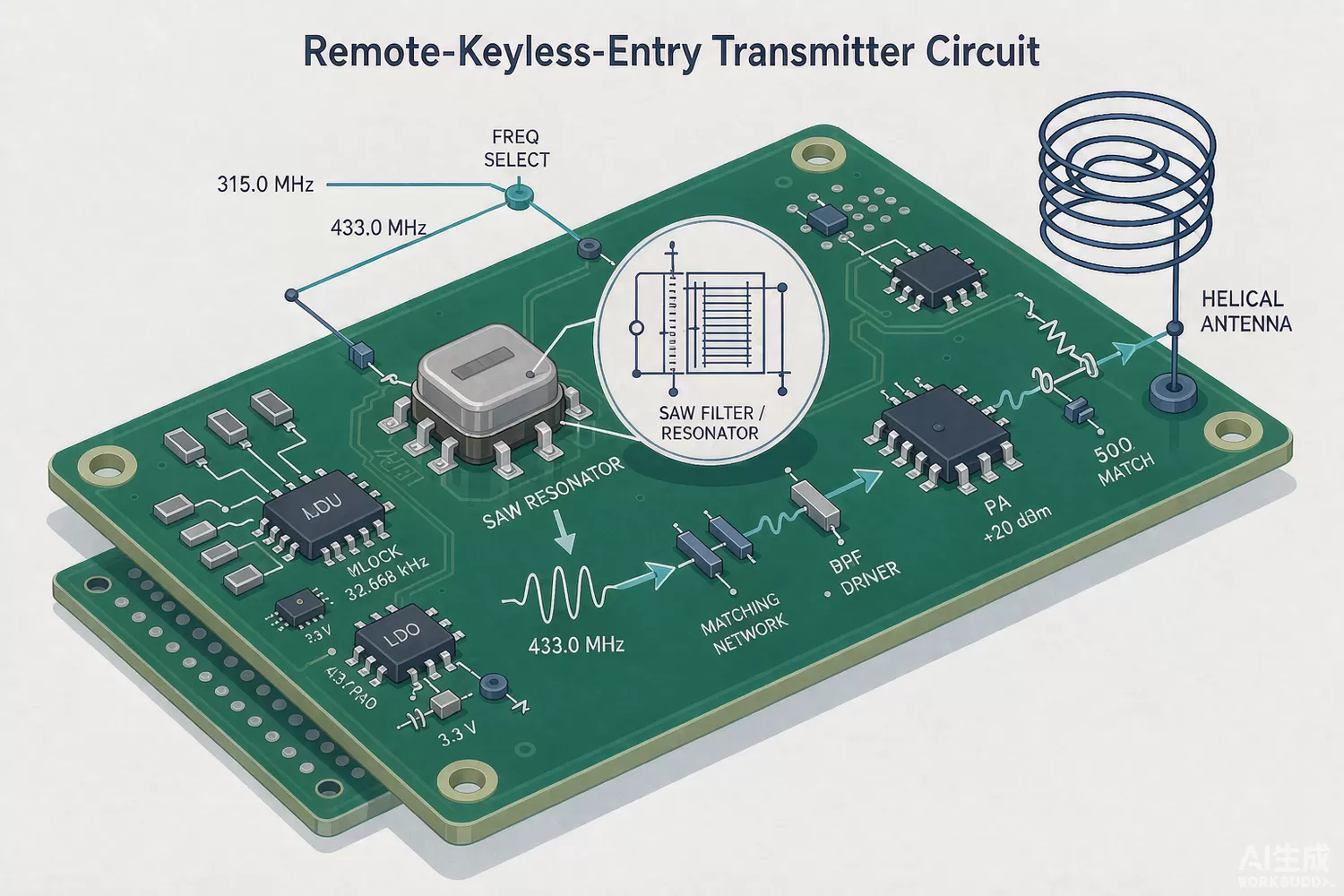
A surface-acoustic-wave resonator is a one-port or two-port acoustic device that behaves, electrically, like a very high-Q series resonant circuit. Where an LC tank drifts with every degree and every capacitor tolerance, a SAW resonator holds a fixed carrier — typically 315 MHz or 433.92 MHz for unlicensed telemetry — to a few tens of kilohertz across the full industrial temperature range. That single property is why it remains the default frequency-determining element in remote keyless entry, garage and gate controls, alarm sensors, wireless call bells, PTZ controller links and low-cost telemetry transmitters.

This article is about the resonator as an oscillator element, which is a different job from the acoustic filter: a SAW/BAW filter article on this site covers channel selection in receivers, while a reference-oscillator article covers the TCXO/OCXO tier. Here the focus is the fixed-source tier between them.
Application logic: where a SAW resonator earns its place
The decision logic is simple and three-sided. A crystal oscillator gives you precision but, above roughly 30–50 MHz fundamental, forces a PLL multiplier with its cost and spurious considerations. An LC or PCB structurally-controlled oscillator costs almost nothing but drifts tens of megahertz across temperature — enough to walk a narrow-band receiver out of range and fail regulatory occupied-bandwidth checks. The SAW resonator sits in between: fundamental frequency in the several-hundred-megahertz range, Q in the thousands, and frequency stability around ±30 to ±75 kHz over −40 to +85 °C — comfortably inside the hundreds-of-kHz receive bandwidth of a superheterodyne receiver such as the classic 3315-class link budget.
Three architectures dominate in practice. In a SAW-stabilized Colpitts oscillator, the one-port resonator replaces the inductor-capacitor tank of a discrete transistor oscillator; the negative-resistance seen by the resonator must exceed its equivalent series resistance with margin, otherwise the unit oscillates cold but fails at temperature extremes. In a PLL-referenced architecture, the SAW resonator locks a fractional divider; this buys channel agility at the cost of a synthesizer IC. And in a loop-keyed transmitter, the resonator doubles as the antenna coupling element. Whatever the topology, the receiver side needs matching selectivity — typically a companion SAW filter such as the TB0614A SAW filter — so the transmitter's drift stays inside the receiver passband over life.
Datasheet parameters that decide success
- Nominal frequency and its tolerance at 25 °C (typically ±50 to ±150 kHz) — the anchor of your link budget.
- Frequency drift over temperature; a ±75 kHz part plus ±50 kHz ageing over five years must still fit the receiver bandwidth.
- Equivalent series resistance and Q: lower Rm means easier oscillation start-up and better phase noise close to carrier.
- Load conditions and the recommended negative-resistance target (design for at least 3–5× the resonator's Rm).
- Drive level limit, typically below a few milliwatts; overdriving ages the acoustic film and shifts frequency.
- Package hermeticity — metal-can parts tolerate humidity and thermal shock far better than bare SMD styles in outdoor alarm sensors.
New technology around the fixed-frequency source
Three movements are visible. First, package shrink and reflow compatibility: classic 3×3 mm metal cans are being pushed down to 2.5×2.0 mm and chip-scale styles for key fobs where every cubic millimetre is costed, while reflow-profile robustness improves so the same part survives lead-free assembly. Second, higher-power and harsh-environment grades: tyre-pressure and industrial telemetry variants specify extended drive levels and screening to survive under-hood and outdoor service. Third, hybrid architectures: low-cost MCU transmitters — for example the widely cross-referenced CH32F103C8T6-class MCU in domestic designs — now often pair a SAW resonator transmitter with a digitally corrected receiver, pushing the frequency-accuracy burden to whichever side is cheaper to trim in production.
Domestic alternatives: families and indicative cost
Domestic SAW capability is real and documented at product level. Wentai (Wuxi Hoda) publishes SAW resonator and filter families covering the 315/433 MHz telemetry bands, alongside its better-known filter lines. Maijie Technology (Shenzhen, stock code 300319) documents SAW device capability including resonator-style parts in its RF device portfolio. And at the research-institute tier, CETC's 26th Institute (Sichuan) has published SAW resonator and oscillator device families for decades. On the import side the anchors remain Murata, Epson and EPCOS/TDK-class Japanese parts, plus North-American catalogue brands, with the same electrical behaviour and a price premium that mostly reflects brand and availability rather than physics.
For sourcing context, our own stock includes 315 MHz-class resonator and SAW parts — for example the RF3315TR13 315 MHz-class resonator and the ESHS-C085TK SAW device — and a receiver comparator such as the LM393DR completes the classic superheterodyne decoder front end.
Price figures below are indicative public-market reference ranges for moderate volumes, compiled from publicly observable listings. They fluctuate with the spot market, package option, grade (industrial, automotive, screened) and order quantity, and must not be read as a quotation. Ask us for a firm price on your exact part numbers and quantities.
| Function (imported anchor) | Example import part / class | Indicative import price (USD) | Domestic candidate | Indicative domestic price (USD) |
|---|---|---|---|---|
| 315 / 433 MHz one-port SAW resonator, metal can | Murata / Epson-class resonator families | 0.12 – 0.45 | Wentai (Hoda) resonator family; Maijie RF portfolio | 0.04 – 0.15 |
| 433.92 MHz two-port resonator for PLL reference | EPCOS/TDK-class two-port parts | 0.25 – 0.70 | Wentai two-port family (family level) | 0.08 – 0.25 |
| Companion receiver SAW filter | Import 315/433 filter families | 0.10 – 0.35 | TB0614A SAW filter-class parts | 0.05 – 0.18 |
| MCU for encoder / decoder side | STM32F103-class MCU | 1.20 – 3.50 | CH32F103C8T6 cross-referenced MCU | 0.35 – 0.90 |
| Receiver decoder comparator | LM393DR (TI) | 0.05 – 0.15 | LM393SR (COSINE) | 0.02 – 0.08 |
The honest engineering statement: at 315/433 MHz the acoustic physics is mature and domestic parts compete on tolerance, size and reliability; the residual differences show up in consistency of ageing data and screening depth, which only your own burn-in can measure. Compare on a drift-versus-time plot, not on the datasheet headline.
Qualification flow
Build three oscillator boards, measure frequency at −30, +25 and +70 °C against a calibrated counter, and compute the negative-resistance margin across the same temperatures by the injection-locking or netmethod measurement. Run a 168-hour high-temperature operating life check and re-measure drift; then transmit into a reference superheterodyne receiver across the full temperature sweep to confirm the link never leaves the passband. If your design instead needs a programmable or multi-channel source, compare against the TCXO/OCXO reference-oscillator tier and the any-frequency clock generator before committing to a fixed resonator.
Frequently asked questions
Can I replace a SAW resonator with a crystal and a PLL?
Electrically yes, but you take on synthesizer cost, current and spurious management for a link that only ever needs one frequency. For single-channel RKE and alarm transmitters the resonator remains the cheaper and more robust choice.
Why does my transmitter drift after a year outdoors?
Ageing plus moisture ingress. Cheap open packages shift tens of kilohertz after humidity cycling; specify hermetic metal-can construction and budget ageing of 30-50 kHz over five years.
What negative resistance should my oscillator show?
Design for at least three to five times the resonator's specified equivalent series resistance at the temperature extremes, or start-up will be marginal in cold conditions.
Do domestic SAW resonators match Japanese reliability?
Public datasheets from Wentai, Maijie and CETC 26th Institute families show matching tolerance and temperature behaviour. Validate with your own temperature sweep and life test, since screening depth is where brands differ most.
About us & trademarks: JTDZ Tech (Shenzhen Jingteng Electronics Technology Co., Ltd.) is an independent distributor of electronic components. We are not an authorised distributor or representative of the imported manufacturers named in this article. Manufacturer, brand and part names are used for identification purposes only; all trademarks remain the property of their respective owners. Cross-reference information in this article is based on publicly available sources, is subject to change, and is not a substitute for your own engineering validation. Always verify specifications against the manufacturer's datasheet before design-in or purchase.
