
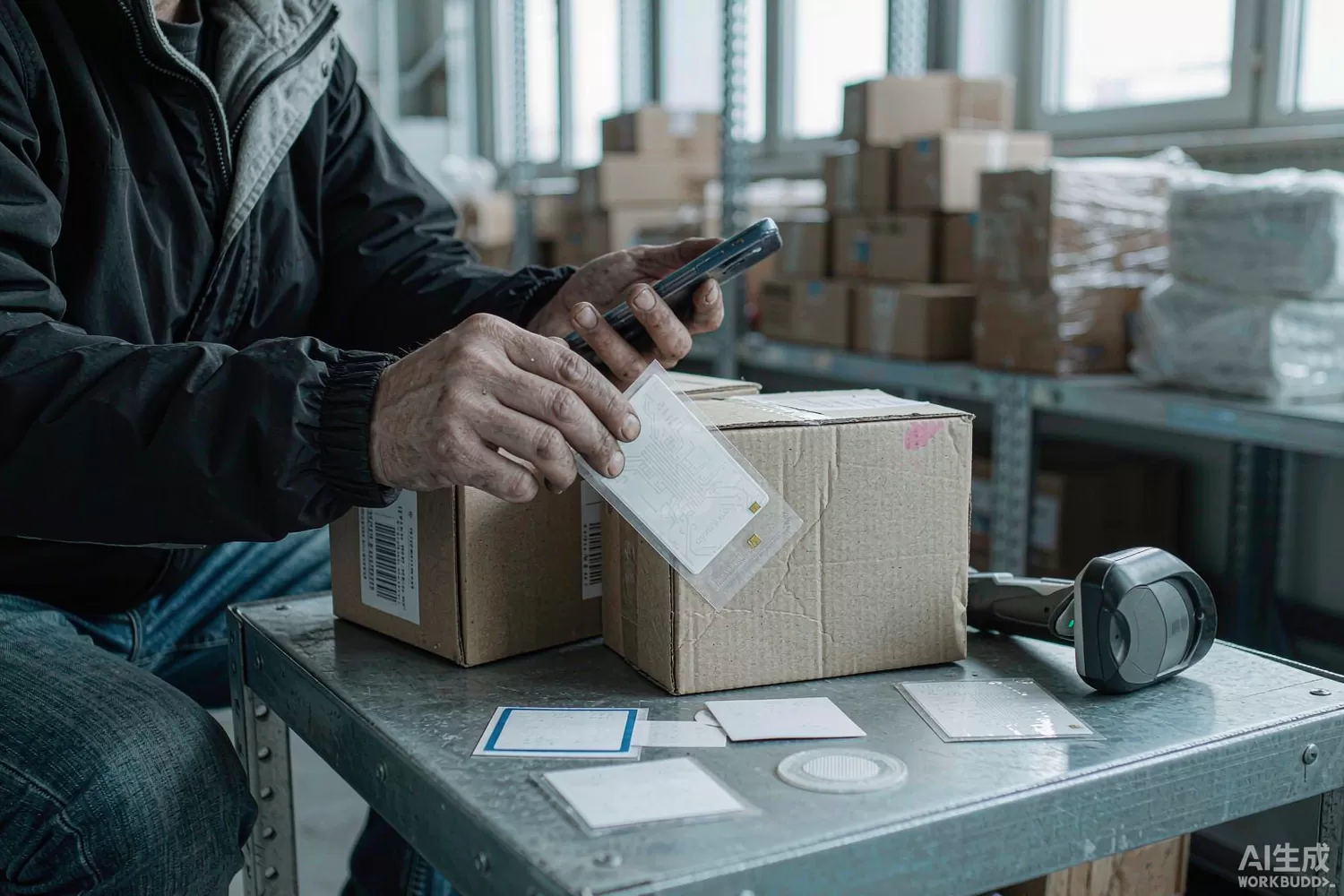
An NFC tag is the cheapest radio in the industry: no battery, no transmitter, a chip that powers itself entirely from the reader's field. That constraint is also its value — a tag cannot lie about being scanned because it cannot even exist without a scanner nearby. Over the last few years the NFC tag has moved from asset label to security element: brand protection for medicine and spirits, parts traceability in aerospace and automotive supply chains, tap-to-pair in consumer devices, and cold-chain evidence that survives the freezer. This article looks at the tag IC as a component choice: application logic by use case, the memory and security features that separate a 5-cent label from a 50-cent one, what is new in the silicon, and the domestic supply picture. For the other half of the link — the reader side — our NFC reader chip article covers front ends and power in depth.

Application logic: four tiers of tag, four different specifications
The choice logic starts from what the tag must withstand, not from what it must store. Four tiers cover most designs:
- Plain read-only identification — asset tracking, tap-to-pair, event ticketing: the tag only needs a unique ID and a few hundred bytes; the security question is irrelevant because the UID is public by design.
- Writable with one-way control — product serialisation and coupons: the tag needs a password-protected or counter-locked write path so field updates cannot overwrite factory data.
- Authenticated — brand protection and spare-parts verification: the tag holds a cryptographic secret and proves it with a challenge–response (CMAC or elliptic-curve based); a cloned tag may copy the label but not the secret.
- Tamper-evident — pharmaceutical closure seals and high-value goods: the tag additionally detects that its antenna loop has been cut or bridged after personalisation, and reports the tamper state permanently.
Frequency and protocol follow the tier. ISO/IEC 14443-A (the NTAG-class world) dominates consumer interaction because phones speak it natively; ISO/IEC 15693 reaches further (tens of centimetres to about a metre with a large antenna) and suits item-level inventory; ISO/IEC 14443-B and FeliCa-style families exist for closed transit and banking ecosystems. The engineering trap is assuming protocol equivalence: a tag that works perfectly with a phone may be unreadable by an industrial fixed reader whose field strength and modulation depth were tuned for a different tag class — always qualify the tag and the reader as a pair.
Parameters that decide which tag survives your process
- Memory map and access rights — usable NDEF capacity, configuration pages, and whether access conditions are settable per page or only globally.
- UID originality — whether the unique identifier is factory-set, read-only, and (in newer parts) paired with a cryptographic key so the UID itself cannot be spoofed.
- Security model — password protection, CMAC authentication (AES-128), or full asymmetric (ECC) with a unique secret per tag; each tier costs silicon and cents, so buy what the threat model needs.
- Tamper detection — a second antenna loop that reports continuity state; only meaningful if the label construction physically breaks the loop on opening.
- RFC field tolerance — minimum operating field (typically 1.5–2.5 A/m) decides whether the tag reads through a metal-backed label or inside a foil-laminated carton.
- Form factor and antenna match — the chip's input capacitance must match the label antenna; a mismatched inlay loses half its read range before any parameter dispute begins.
- Data retention and endurance — 10-year retention and 100k write cycles are typical; cold-chain and long-lifecycle industrial uses should ask for the test data, not the summary line.
- Package and assembly — die-in-label, bare die for embedding in moulded parts, or module-in-package for soldering onto a PCB; each has its own pick-and-place and conversion economics.
What is new in tag silicon
Three shifts matter. First, asymmetric cryptography on passive tags: elliptic-curve signature verification (ECDSA-class) has moved from active cards into tag ICs, letting any phone verify a part without network access — the basis of the offline anti-counterfeit schemes now appearing in luxury goods and pharmaceuticals. Second, energy harvesting and ambient sensing: newer tag families rectify surplus field energy to power a sensor or an MCU wake-up pin, turning the tag into a battery-less sensor node; combined with NFC's native interface to phones this has created the “tap to check temperature history” cold-chain label. Third, UID integrity features: originality signatures that tie the public UID to a factory certificate close the oldest NFC attack — cloning an ID string — and are now the deciding feature for authentication-tier designs. On the label side, printed-antenna and metal-mount constructions keep improving, but the chip-to-antenna match discipline remains the difference between a label that reads everywhere and one that works only in the demo kit.
Domestic alternatives: families and indicative cost
Domestic coverage of the tag tier is genuine. Fudan Microelectronics (Fudan Microelectronics, stock code 688385) has shipped 14443-A-compatible contactless tag and card families for many years, with security-elevated variants carrying domestic cryptographic certifications; Huada Electronics (Huada Electronics) offers NFC/RFID tag families including secure and tamper-detect classes; and additional listed suppliers cover the transit and ID-card segments. Imported anchors are the NXP NTAG 21x family (the de-facto consumer standard), the MIFARE Classic/DESFire lineage for closed-loop ticketing, ST's ST25 series (which includes originality-signature and tamper-detect variants), and Infineon's SECiD-class tags. The practical division: for plain read/write consumer tags, domestic families are fully competitive on price and phone interoperability; for crypto-tier and tamper-evident designs, both imported and domestic parts are credible, and the choice usually comes down to which certification file your customer's auditor wants to see.
For a pilot line, the surrounding parts are ordinary catalogue stock: a COSINE precision op-amp class part for the analogue front end of a custom reader, an Artery AT32F403ACGT7 MCU as the reader controller, a DS3231SN real-time clock for tamper-evident audit timestamps, and a Boya BY25Q80ESTIG SPI NOR flash to hold the tag key database and audit log. The reader front end itself is covered in the NFC reader article.
Price figures below are indicative public-market reference ranges for moderate volumes, compiled from publicly observable listings. They fluctuate with the spot market, package option, grade (industrial, automotive, screened) and order quantity, and must not be read as a quotation. Ask us for a firm price on your exact part numbers and quantities.
| Function (imported anchor) | Example import part / class | Indicative import price (USD) | Domestic candidate | Indicative domestic price (USD) |
|---|---|---|---|---|
| Plain read/write tag IC, 14443-A, ~500 byte NDEF | NXP NTAG 213/215/216 class | 0.04 – 0.12 | Fudan Micro 14443-A tag family (family level) | 0.015 – 0.05 |
| Authentication tag with CMAC (AES-128) | NXP NTAG 424 DNA class; ST25 TV-A/B | 0.25 – 0.60 | Fudan / Huada secure tag families (family level) | 0.12 – 0.35 |
| Originality-signature tag (ECC) | ST25 TV series with originality signature | 0.30 – 0.70 | Huada secure tag family (family level) | 0.15 – 0.40 |
| Tamper-detect tag for closure seals | ST25 TV-class tamper variants | 0.40 – 0.90 | Huada / Fudan tamper-detect classes (family level) | 0.20 – 0.50 |
| 15693 long-range tag for inventory | NXP ICODE SLIX class | 0.08 – 0.20 | Fudan 15693-compatible family (family level) | 0.03 – 0.10 |
| Reader-side controller for the pilot line | PN53x-class reader IC | 1.5 – 4.0 | Fudan / Huada reader families; see our NFC reader article | 0.6 – 2.0 |
| Key-database and audit flash | Winbond W25Q-class SPI NOR | 0.2 – 0.6 | BY25Q80ESTIG (Boya) | 0.08 – 0.2 |
Read the table as a screening tool, not a quotation. Two procurement warnings earned from the field. First, inlays are only as good as their conversion: the same die in a well-made label reads twice as far as in a rushed one, so qualify the converter, not just the chip. Second, the cryptography is only as strong as its key management: a perfect ECC tag whose factory keys are printed in a shared spreadsheet is a plain tag with better marketing. Ask suppliers where keys are generated and how they reach your personalisation line.
Validation flow before you commit
Qualify tag and reader as one system. Measure read range through your real packaging — foil liners, metal shelves, dense stacks — not in free space, because field coupling changes everything. Test the write path with interrupted field (the phone always leaves early) and confirm the access-control logic prevented the half-written state. For authentication tags, run the challenge–response through a hundred thousand iterations on the final personalisation line and audit that no key ever appeared in a file a line operator could reach. For tamper variants, build the actual closure: break ten seals and confirm the state reports correctly, then ship one through a courier and check it again — tamper features that cannot survive logistics are decoration.
Frequently asked questions
Is a phone enough to verify an authentication tag?
Yes for CMAC and ECC schemes: modern phones carry the AES and elliptic-curve primitives, and offline verification is exactly the use case for originality-signature tags. The phone checks the signature against a public certificate; no network round-trip is required.
NTAG-class and MIFARE-class tags — which for brand protection?
NTAG-class parts are optimised for phone interaction and open ecosystems; MIFARE DESFire-class parts carry stronger closed-loop security at higher cost. For consumer-facing authentication, an originality-signature NTAG-class part is the mainstream answer.
Are domestic tag ICs accepted by phone NFC stacks?
For 14443-A compatible families from Fudan Micro and Huada, interoperability with mainstream phones is routine and proven in transit and identity projects. Still, run your own tap-test matrix across the phone models your users carry.
What is the usual way an NFC authentication scheme fails?
Key management, not silicon: keys printed on shared files or hard-coded in firmware defeat the tag. Design the key path — factory generation, secure delivery, line-level handling — before choosing the chip.
About us & trademarks: JTDZ Tech (Shenzhen Jingteng Electronics Technology Co., Ltd.) is an independent distributor of electronic components. We are not an authorised distributor or representative of the imported manufacturers named in this article. Manufacturer, brand and part names are used for identification purposes only; all trademarks remain the property of their respective owners. Cross-reference information in this article is based on publicly available sources, is subject to change, and is not a substitute for your own engineering validation. Always verify specifications against the manufacturer's datasheet before design-in or purchase.
