
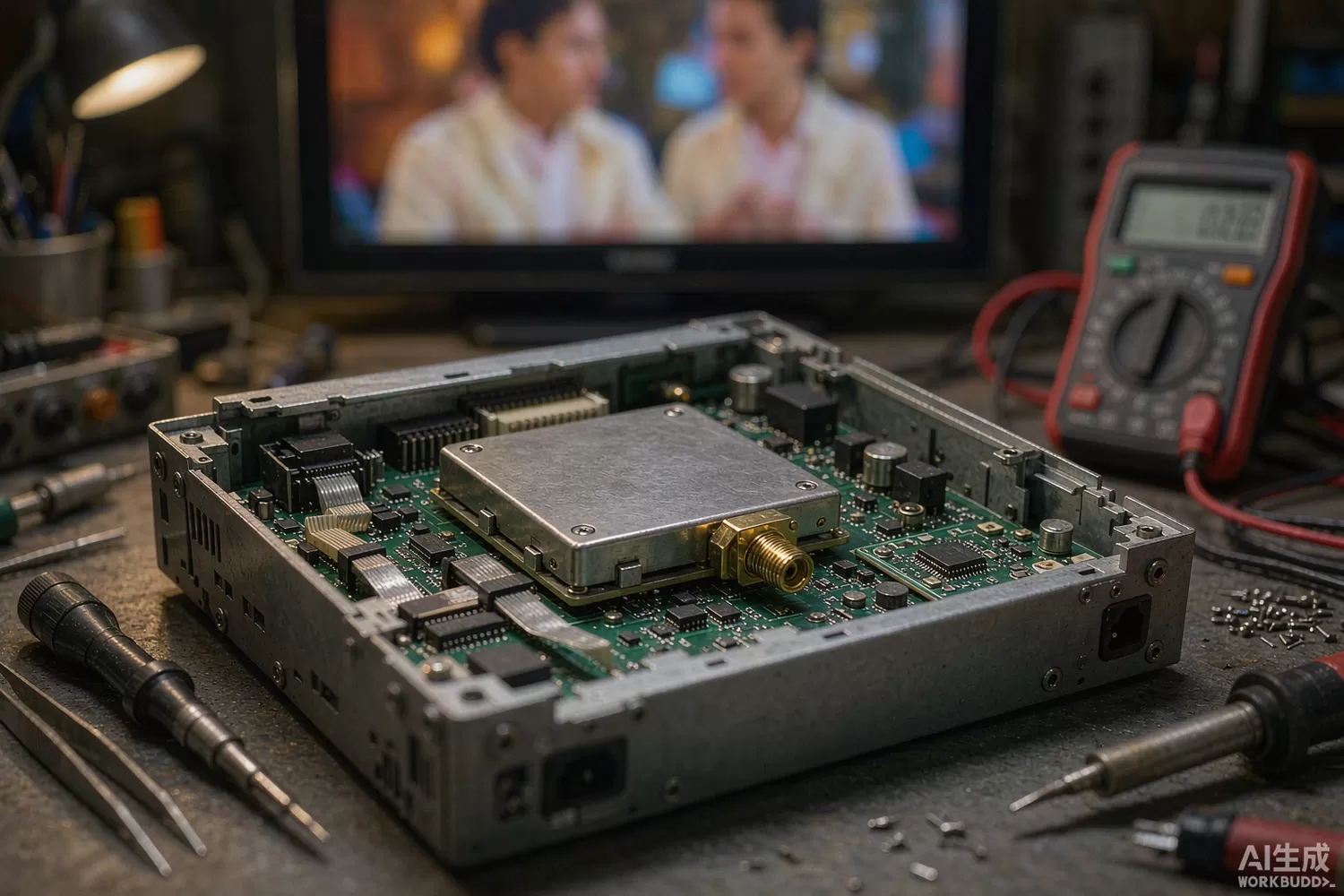
The tuner is the least glamorous RF block in consumer electronics and one of the most unforgiving. It must take an antenna port that sees everything from a milliwatt of wanted signal to volts of co-channel interference, select one 8 MHz slice out of a crowded spectrum, convert it to a low intermediate frequency with just enough gain and no more distortion than the demodulator can tolerate, and hand over a clean digital stream — for ten years, in a hot plastic box, at a bill-of-materials price of a cup of coffee. This article looks at the tuner-demodulator chain as a chip-level design problem: the application logic, the datasheet numbers that actually decide picture robustness, the technology shifts of the last few years, and the domestic supply picture. For the satellite dish end of the chain, our SATCOM RF chain article covers the LNB side.

Application logic: cable, terrestrial and satellite differ in the ways that matter
All three delivery paths share the same skeleton — antenna port, channel filter, downconverter, analogue-to-digital conversion, demodulator — but the pressures differ. A satellite (DVB-S2/S2X) input at 950–2150 MHz arrives pre-amplified and down-converted by the LNB, so the tuner works at modest levels and the dominant enemies are phase noise (the demodulator hunts at 30–50 Msps with symbol rates that leave almost no phase-noise margin) and cross-polarisation leakage. A terrestrial (DVB-T2) input at 48–790 MHz sees huge dynamic range: the wanted channel may sit 40 dB below the neighbouring multiplex, so linearity — blocking and intermodulation, not noise — is the spec that decides whether the picture holds. A cable (DVB-C/J.83) input has the mildest RF environment but the highest constellation densities, which again pushes phase-noise and echo-tolerance requirements.
Architecture follows those pressures. The traditional two-chip split — a silicon tuner (one die, RF to low-IF) plus a separate demodulator — remains the default in cost-sensitive designs, while the integrated tuner-demodulator single-die families have taken over set-top boxes and TV mainboards where volume justifies the mask. Two frequency-planning choices dominate modern tuners: zero-IF / low-IF direct conversion, which removes an intermediate filter and reduces cost but must manage DC offsets and second-order distortion, and up-conversion-plus-down-conversion architectures that trade an extra synthesiser for far better blocking behaviour — a trade the terrestrial variants usually accept.
Datasheet parameters that decide picture robustness
- Phase noise of the internal synthesiser at 10–100 kHz offset — for DVB-S2X with high-order APSK, this is the number that separates a working design from one that loses lock in rain fade.
- Noise figure for satellite inputs — the LNB already sets 2–3 dB; the tuner adds its own, and every extra decibel directly eats the rain-fade margin.
- Blocking and intermodulation for terrestrial inputs — co-channel and adjacent-channel tests with analogue strong carriers (still broadcast in many markets) are the honest figure of merit.
- Input return loss and ESD tolerance at the F-connector — cable and satellite ports suffer surges and hot-plugging; the front-end must survive both without a tuning shift.
- Loop-through gain flatness — receivers that pass the signal to a second tuner must not shape the spectrum while doing it.
- Symbol-rate and constellation support — DVB-S2X goes to 100 Msym/s and 256APSK; DVB-T2 to 256QAM with 32k carriers; the demodulator, not the tuner, is usually the ceiling here.
- Power consumption in standby and active — a TV that must wake in under a second keeps the tuner alive in standby, so quiescent current is a consumer-visible spec.
- Automatic gain control behaviour — attack time and loop stability under impulsive interference decide robustness against LED lighting and motor noise more than any steady-state spec.
What is new in tuner-demodulator technology
Four movements are visible in current product families. First, integration: single-die tuner-demodulator families with on-chip synthesiser, channel filter and DVB-S2X or T2 demodulator have collapsed the two-chip bill of materials, and the newest TV SoCs embed the whole demodulator, leaving only the tuner front end external. Second, wideband-receiver architectures: instead of tuning one channel, some terrestrial designs digitise tens of megahertz at once and demodulate multiple services in software — the same idea that swept through cellular receivers, arriving last in broadcast because broadcast never had a power budget to afford it. Third, S2X-ready phase noise: the newer satellite profiles demand 10–20 dB better close-in phase noise than first-generation S2 tuners, which has quietly invalidated a decade of “compatible” tuner stock. Fourth, multi-standard flexibility: export set-top boxes must handle DVB-T2, ISDB-T, ATSC3 and analogue out of one platform, so the demodulator has become a multi-standard DSP with the tuner as the only truly RF part.
For the aftermarket and repair channel the change is practical: many legacy boxes now fail on a tuner that is out of production while the demodulator is still available, which makes understanding the tuner-demodulator split a procurement question, not just an engineering one. Our general note on keeping legacy RF designs alive covers the sourcing side of exactly this failure mode.
Domestic alternatives: families and indicative cost
This is a segment where the domestic ecosystem exists and is real, but where public model-level documentation is thinner than in consumer RF front ends, so the honest framing is family level. Guoxin Technology (Guoxin Technology, stock code 688262) has published digital-television demodulator and set-top-box SoC families for the domestic cable and satellite market; Lantek (Lantek) offers tuner and demodulator SoC families that trace back to the Montage lineage widely deployed in Asian and Latin American set-top boxes; and additional listed suppliers serve the domestic DTMB terrestrial standard. Imported anchors remain the Silicon Labs Si2xxx tuner family, ST's STV-series satellite demodulators and NXP's TDA tuner lineage, all still active in export markets. Where only brand and family level information is public, the table below says so — verify the exact part with the supplier against your symbol-rate and constellation requirements.
Supporting parts for a tuner front end are straightforward catalogue items: a Mini-Circuits LFCG-2600+ low-pass filter to clean the LNB supply feed, a MACOM MAAL-011136 buffer amplifier for long cable runs, a MACOM SW-456TR-3000 switch for A/B satellite inputs, and an Artery AT32F403ACGT7 MCU for system control in non-SoC designs.
Price figures below are indicative public-market reference ranges for moderate volumes, compiled from publicly observable listings. They fluctuate with the spot market, package option, grade (industrial, automotive, screened) and order quantity, and must not be read as a quotation. Ask us for a firm price on your exact part numbers and quantities.
| Function (imported anchor) | Example import part / class | Indicative import price (USD) | Domestic candidate | Indicative domestic price (USD) |
|---|---|---|---|---|
| Silicon tuner, RF to low-IF, satellite + terrestrial | Silicon Labs Si2xxx family; NXP TDA lineage | 1.2 – 3.5 | Lantek tuner SoC family (family level); Guoxin Technology STB SoCs | 0.6 – 1.8 |
| DVB-S2X demodulator | ST STV-series demodulators | 2.0 – 5.0 | Guoxin Technology demodulator family (family level) | 1.0 – 2.8 |
| Integrated tuner + demodulator SoC | Lantek/Montage-class import SoCs | 1.8 – 4.0 | Lantek / Guoxin integrated STB SoC families | 1.0 – 2.2 |
| Front-end LNA / buffer, 950–2150 MHz | Mini-Circuits MAAL-011136; MACOM gain blocks | 0.8 – 2.5 | In-stock import class; Vanchip / Maxscend small-signal families | 0.3 – 1.2 |
| LTCC / SAW channel filter, IF and band definition | Mini-Circuits LTCC series; Murata SAW | 0.2 – 0.8 | Tai-Saw SAW (site stock: TB0614A); in-stock LTCC class | 0.06 – 0.3 |
| A/B input switch | Skyworks / MACOM SPDT ICs | 0.3 – 1.0 | Maxscend MXD switch family | 0.06 – 0.3 |
| System-control MCU (non-SoC designs) | STM32F103-class | 1.2 – 3.0 | AT32F403ACGT7 (Artery) | 0.4 – 0.9 |
Read the table as a screening tool, not a quotation. The practical reality: for DVB-S2/S2 and cable set-top boxes destined for price-sensitive export markets, domestic demodulator and integrated SoC families are competitive on both cost and robustness, because the standards they target have been stable for a decade. The gap, where it remains, is in the newest S2X profiles at high symbol rates and in ATSC3-class terrestrial demodulation, where the imported silicon still leads. If your product targets those profiles, split the bill of materials: imported tuner-demodulator where the standard demands it, domestic silicon where the standard is mature.
Validation flow before you commit
Test the tuner the way the installation will abuse it. Sweep blocking: place a strong analogue carrier 3 channels away and measure the symbol-error degradation at minimum and maximum wanted level. Measure phase noise as delivered to the demodulator, not as the synthesiser claims it, by looping the IF into a spectrum analyser. Run the AGC through a scripted interference profile — LED lamp bursts, motor switching, a neighbour's uplink — and watch for tuning drift and AGC pumping. Exercise the F-connector ESD and surge paths with the port hot-plugged, because that is how field failures actually arrive. Finally, soak the design at 45 °C inside a closed set-top chassis for a week: reference-spur drift and synthesiser lock problems that never show on a cold bench appear reliably there.
Frequently asked questions
Is an integrated tuner-demodulator SoC always the right choice?
Not always. Integration wins at volume and saves a decibel of gain flatness, but the two-chip split gives you a second source for each half and lets you upgrade the demodulator standard without re-qualifying the RF front end.
Why does my box lose signal in rain when the same dish works elsewhere?
Rain fade eats the link margin, and whatever phase noise and tuner noise figure you added on top of the LNB decides how much margin survives. S2X profiles with high-order APSK are the least forgiving.
Can domestic silicon handle DVB-S2X high-order profiles?
For the mainstream S2 and lower-order S2X profiles, domestic demodulator families are competitive. For the newest high-symbol-rate, high-order profiles, imported silicon still leads; verify against your exact modulation plan.
What killed most legacy set-top boxes in the field?
Tuner obsolescence: the demodulator SoC survives but the tuner die is end-of-life. Design for a second source or stock the tuner at the start of production.
About us & trademarks: JTDZ Tech (Shenzhen Jingteng Electronics Technology Co., Ltd.) is an independent distributor of electronic components. We are not an authorised distributor or representative of the imported manufacturers named in this article. Manufacturer, brand and part names are used for identification purposes only; all trademarks remain the property of their respective owners. Cross-reference information in this article is based on publicly available sources, is subject to change, and is not a substitute for your own engineering validation. Always verify specifications against the manufacturer's datasheet before design-in or purchase.
