
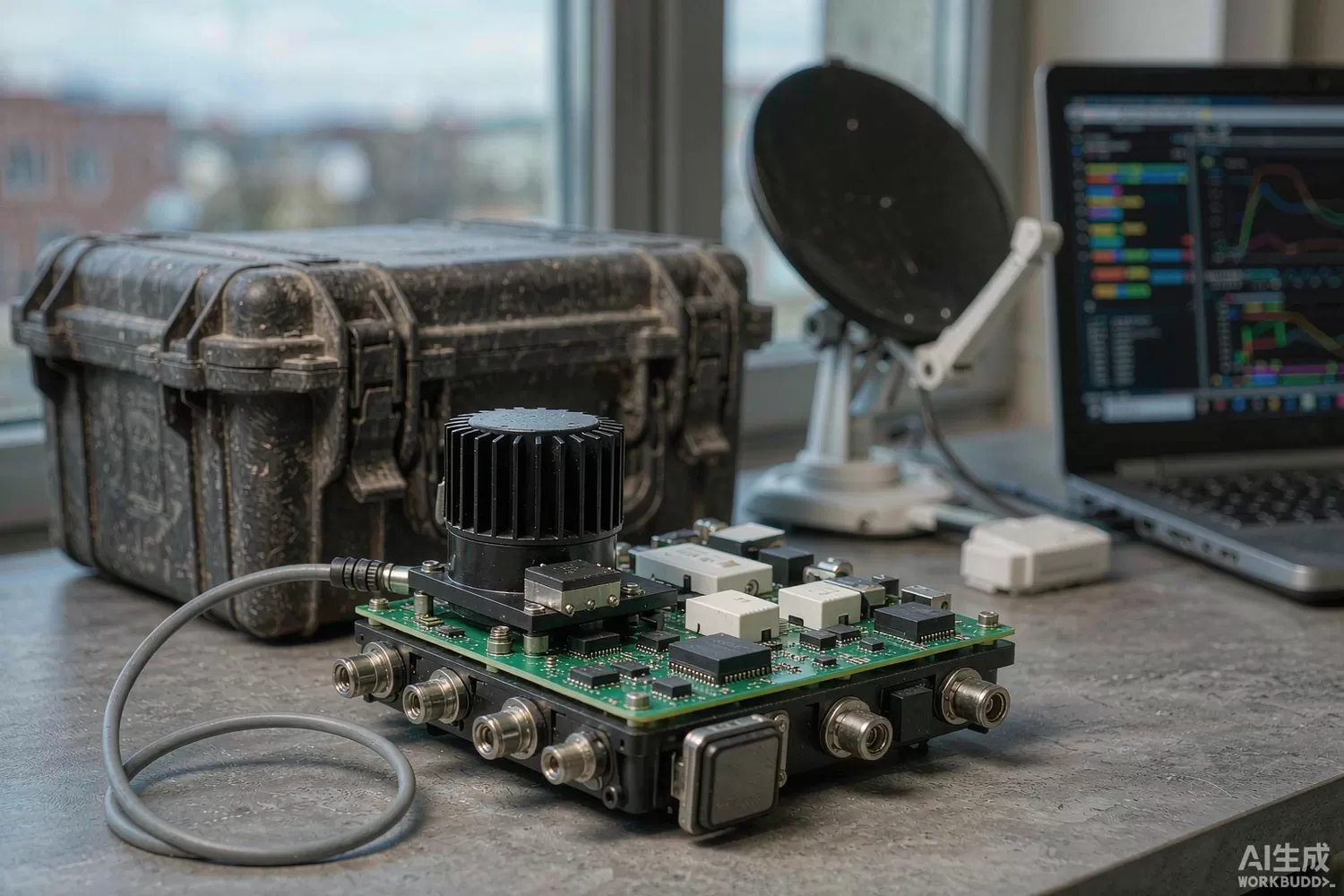
A normal cellular modem assumes its base station is a few hundred metres away and standing still. A satellite IoT modem must assume the opposite: the “base station” is 500–1,500 km overhead, moving at 7.5 km/s, and visible for ten minutes at a time. 3GPP non-terrestrial networks (NTN) — Rel-17 and Rel-18, built on NB-IoT and eMTC — are the industry's answer, and they have turned a niche of proprietary satellite modems into a mainstream chipset category. This article looks at the RF side of a direct-to-device terminal: the application logic that decides the architecture, the parameters that decide the link, what is new in the silicon, and which domestic options are worth benchmarking. For the wider satellite signal chain — earth-station upconverters, LNAs and block conversion — see our satellite communications RF chain overview.

Application logic: what the orbit does to the modem
The first architectural question is which orbit the constellation flies. A low-earth-orbit (LEO) smallsat at 550 km gives a slant range from about 550 km at zenith to roughly 1,300 km at 10° elevation, a path loss near 155–165 dB in L-band, and a Doppler offset that swings from about ±35 kHz at horizon to nearly zero overhead. A geostationary (GEO) payload removes the Doppler problem but costs 20 dB more path loss and needs a near-directional antenna. The chipset follows the orbit: LEO IoT terminals are built from a low-gain, near-omnidirectional antenna and a receiver that must acquire a carrier already shifted by tens of kilohertz; GEO terminals are built around pointing and a steeper link budget.
NTN solves the kinematics in the protocol, not in hardware alone. Time and frequency pre-compensation — using the terminal's own GNSS fix and the satellite ephemeris — lets a standard NB-IoT waveform survive a Doppler shift of tens of kilohertz and a differential delay across the coverage area that dwarfs a normal cyclic prefix. The RF front end therefore has three jobs that a terrestrial modem does not have:
- Receive a weak, Doppler-shifted uplink from other terminals — sensitivity is set by the LNA's noise figure; every 0.5 dB of NF buys roughly 5% more range at a fixed detection threshold.
- Transmit at the regulatory EIRP cap — typically 23 dBm conducted into a −3 to 0 dBi antenna; the PA must be efficient at exactly that power because the duty cycle is tiny but the peak current is not.
- Share the antenna with terrestrial cellular or GNSS — switches and diplexers must present the right isolation so the satellite path is not desensitised by an active terrestrial receiver or the terminal's own PA.
The application then splits by antenna gain, and this is the single most useful decision variable. Wearable and asset tags accept a −5 to 0 dBi antenna and buy range with protocol repetition; fixed terminals for agriculture, maritime and utility metering use a 3–8 dBi patch and cut their power budget accordingly; vehicular and maritime terminals with high-gain antennas enter a different regulatory class entirely. A chipset that is optimal at one tier is usually wrong at the next.
Datasheet parameters that decide an NTN link
- Satellite-receiver noise figure over temperature — the downlink is the weak direction; specify NF at −30 °C and +70 °C, not 25 °C, because a passive antenna and a cold LNA change the budget by more than a decibel.
- Reference sensitivity with and without repetition — NTN lives on coverage enhancement levels; ask what the modem needs in dBm to close a link at CE level 2, not just level 0.
- Doppler search range and acquisition time — ±40 kHz of pre-compensation uncertainty is normal in LEO; the narrower the internal search, the more your GNSS lock must carry.
- PA output power and efficiency at the EIRP cap — a PA that is efficient at full power but poor at 14 dBm back-off will drain the battery of an asset tracker that mostly transmits short bursts.
- Receive-path linearity and out-of-band blocking — L-band sits next to terrestrial LTE and GNSS bands; the front-end filter and LNA IIP3 decide whether a nearby phone uplink desensitises the satellite path.
- Coexistence behaviour — time-multiplexed TX/RX with a shared antenna needs explicit switch timing in the modem; some chipsets hard-guarantee it, others leave it to the integrator.
- Wake-up and synchronisation current — an asset tracker sleeps 99.9% of the time; the sleep-to-first-burst energy often dominates the battery model more than transmit efficiency.
- Antenna and module footprint — antenna-in-package variants trade a decibel of gain for a decibel of integration pain; know which one your mechanical design can afford.
What is new in NTN silicon
Three shifts define the current generation. First, standards consolidation: the 3GPP NTN waveform is now implemented by several mainstream cellular IoT silicon families rather than only by proprietary satellite vendors, which collapses the modem software cost and makes the satellite link a software option on a terrestrial product line. Second, direct-to-standard-device services: L-band and S-band operators now offer messaging and SOS to unmodified phones and to low-cost modules, pulling the chipset industry from thousands of units per year to millions. Third, integrated GNSS + NTN: because pre-compensation needs a position fix, the newest terminals integrate the GNSS receiver on the same die, cutting acquisition time and bill-of-materials count.
On the network side, the payload itself has moved onboard satellites that regenerate rather than bend-pipe the signal, which changes the terminal's timing loop but not its front-end architecture. Regulators in several markets have opened L-band and S-band MSS allocations to land-mobile IoT use, and each opening converts a proprietary terminal design into a standards-based one. The practical consequence for a hardware team is that the modem chip is becoming a commodity while the differentiator moves to the antenna, the RF filtering between antenna and chipset, and the power architecture that keeps an always-listening terminal alive on a primary cell for years. Our notes on LNA front ends and SAW/BAW filtering cover those supporting tiers in depth.
Domestic alternatives: chipsets, modules and indicative cost
Domestic coverage of this segment is real but young, and it should be described honestly. UNISOC (UNISOC) has published an NTN-capable satellite communication chipset (the V8821 class), demonstrated end-to-end NB-IoT NTN calls with constellation operators, and its cellular IoT platform is widely deployed on the terrestrial side. Module makers — Quectel, Fibocom and MeiG among them — have announced or shipped NTN-capable modules derived from such chipsets, several with GNSS integrated. Imported anchors are the Qualcomm 212S-class cellular IoT chipsets with NTN support, the Sony Altair ALT1250 family used in early direct-to-device services, and Sequans' Monarch line. Beyond the chipset tier, the domestic supply of specialised L-band SAW filters, low-noise front-end MMICs and TCXOs for NTN is thinner than for terrestrial bands, and many designs still mix domestic chipsets with imported filtering — a legitimate transitional architecture worth stating plainly.
For a prototype, the supporting parts can be assembled largely from catalogue stock: a receive LNA such as the Mini-Circuits PHA-13LN+ in the IF or L-band stage, a Tai-Saw TA0224A SAW filter for band definition, a MACOM SW-456TR-3000 SPDT switch for the antenna share, and an Artery AT32F403ACGT7 MCU for terminal control and store-and-forward buffering.
Price figures below are indicative public-market reference ranges for moderate volumes, compiled from publicly observable listings. They fluctuate with the spot market, package option, grade (industrial, automotive, screened) and order quantity, and must not be read as a quotation. Ask us for a firm price on your exact part numbers and quantities.
| Function (imported anchor) | Example import part / class | Indicative import price (USD) | Domestic candidate | Indicative domestic price (USD) |
|---|---|---|---|---|
| NTN-capable cellular IoT chipset | Qualcomm 212S-class; Sony ALT1250 family | 9 – 22 | UNISOC V8821-class NTN chipset | 5 – 14 |
| NTN module with GNSS, L-band | Sony / Sequans based modules | 22 – 40 | Quectel / Fibocom / MeiG NTN modules | 15 – 28 |
| Terrestrial NB-IoT / Cat.1 companion modem | Qualcomm / ASR / Sequans Cat.1bis | 2.5 – 6 | UNISOC 8910DM-class; EigenComm EC616-class | 1.5 – 3.5 |
| L-band receive LNA (0.5–2 GHz, 0.6–0.8 dB NF) | Mini-Circuits PHA-13LN+; Qorvo / MACOM LNA families | 1.2 – 3.5 | Vanchip / Maxscend LNA families; CETC 13th Institute MMIC (family level) | 0.4 – 1.5 |
| L-band SAW filter | Murata / Taiyo Yuden SAW families | 0.25 – 0.9 | Tai-Saw TB/TA series (site stock: TA0224A, TB0614A) | 0.08 – 0.3 |
| Antenna SPDT switch | Skyworks / Qorvo / pSemi switch ICs | 0.3 – 1.2 | Maxscend MXD switch family | 0.06 – 0.35 |
| Terminal MCU for control & buffering | STM32F103-class | 1.2 – 3.0 | AT32F403ACGT7 (Artery) | 0.4 – 0.9 |
Read the table as a screening tool, not a quotation. The engineering reality: at the chipset and module tier the domestic NTN path is already commercially credible because the heavy lifting is protocol software that has been proven on the terrestrial side. What still separates suppliers is constellation interoperability — certified integrations with specific operators — and the availability of RF reference designs with measured sensitivity plots at the band edges. Ask any candidate supplier for a live over-the-air demo on the constellation you intend to use, and for their noise-figure data at your worst-case temperature, before you commit a design.
Validation flow before you commit
Reproduce the link the way the constellation will exercise it. Start with conducted tests: inject an NTN waveform pre-shifted by ±40 kHz of Doppler and measure acquisition time and sensitivity at CE levels 0–2 across temperature. Then add the real antenna in a chamber and measure the achieved EIRP and the receive sensitivity with the antenna detuned by a hand, a metal bracket and a rain-wet radome — satellite terminals live outdoors and the antenna is the part that fails first. Exercise the coexistence paths: phone-class LTE active on the adjacent terrestrial antenna while the satellite receiver sits at sensitivity, and the terminal's own transmit burst leaking into its own receive slot. Finally, run a duty-cycle battery model against the measured wake-up and burst currents, because the difference between a two-year and a five-year asset tracker is almost never the PA efficiency — it is how much current the modem spends deciding that there is nothing to receive.
Frequently asked questions
Do I need a special chipset for NTN, or can any NB-IoT modem be used?
The waveform is NB-IoT, but the modem must support the NTN timing-advance and frequency pre-compensation extensions and long-standing synchronisation gaps. A standard terrestrial-only modem will not acquire a LEO satellite, whatever its datasheet sensitivity says.
LEO or GEO for my asset tracking use case?
LEO suits battery-powered, near-omnidirectional terminals and covers the poles; GEO suits fixed terminals with a pointing margin and gives constant visibility. The chipset choice follows the orbit because Doppler and link budget differ by tens of kilohertz and tens of decibels respectively.
Are domestic NTN chipsets production-proven?
The UNISOC V8821-class platform has public operator trials and module derivatives in volume planning, which is credible but earlier in maturity than imported anchors. Verify with a live constellation demo and your own sensitivity measurements before committing volume.
What dominates the terminal battery budget?
Wake-up and synchronisation current, not transmit bursts. Measure sleep-to-first-transmit energy across temperature; that number usually decides the battery, and it varies more between modem firmware versions than between chipsets.
About us & trademarks: JTDZ Tech (Shenzhen Jingteng Electronics Technology Co., Ltd.) is an independent distributor of electronic components. We are not an authorised distributor or representative of the imported manufacturers named in this article. Manufacturer, brand and part names are used for identification purposes only; all trademarks remain the property of their respective owners. Cross-reference information in this article is based on publicly available sources, is subject to change, and is not a substitute for your own engineering validation. Always verify specifications against the manufacturer's datasheet before design-in or purchase.
