
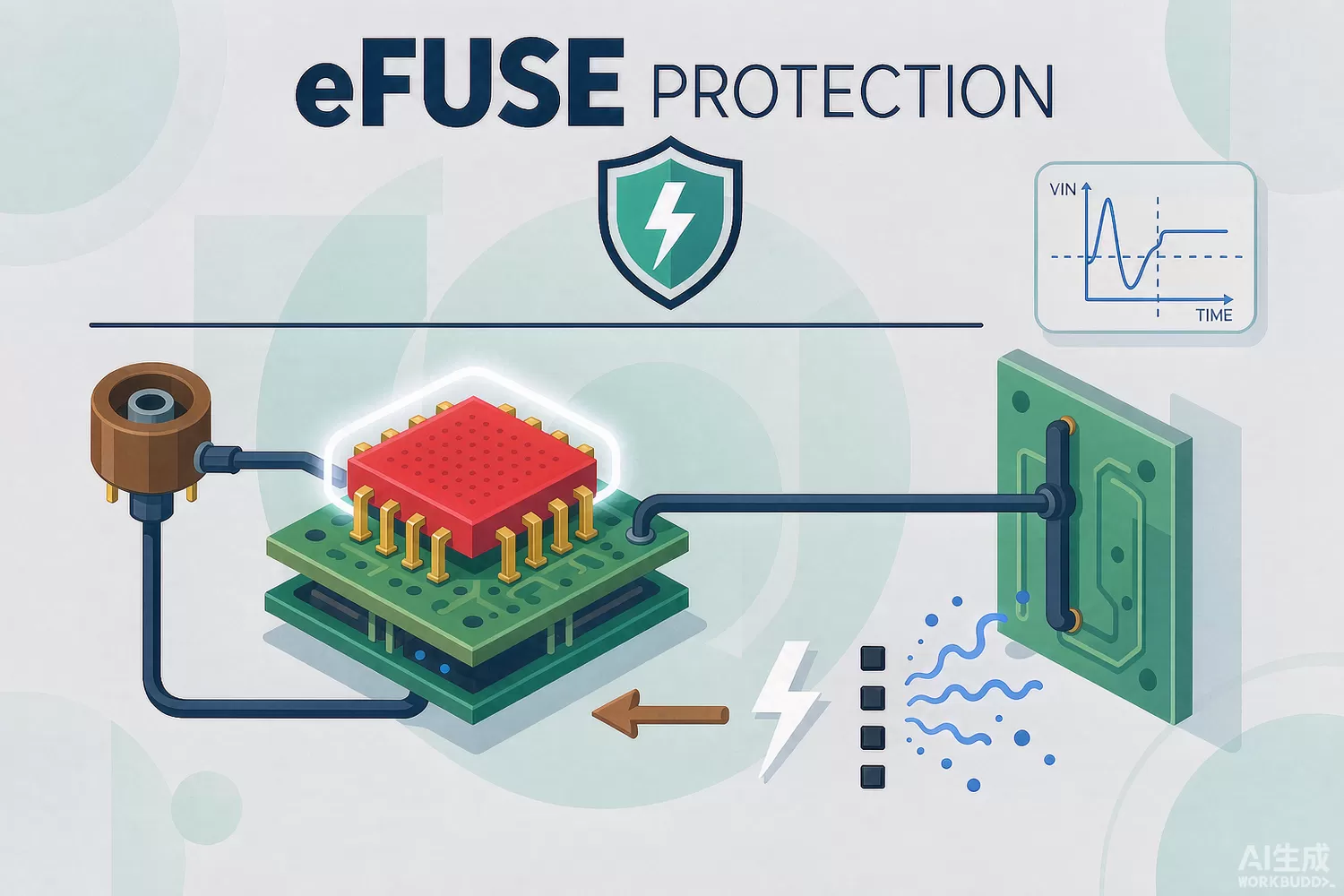
Two failure modes dominate field returns on boards with external power: the inrush event, where a big input capacitor charges through connectors and traces at turn-on and welds or erodes them over cycles; and the fault event, where a shorted load, a wrong supply or a cable mishap dumps uncontrolled current into the board. The eFuse (electronic fuse) and hot-swap controller exist to make both boring: they ramp the supply voltage at a controlled slew, watch the current continuously, and open the path faster than any wire fuse — and faster, usually, than the damage threshold of what follows.

Application logic: where the protection belongs
Placement is a system decision. A hot-swap controller with an external FET and a controlled slew belongs where boards plug into live backplanes or power shelves — the classic -48 V telecom card and the modern 12 V shelf. An integrated eFuse (FET on chip) belongs at lower currents — USB ports, module supply inputs, fan and motor taps — where integration beats flexibility. A load switch, the simplest member, handles enable/disable without protection depth. Downstream, each rail repeats the pattern at its own scale: a wide-input board may run a hot-swap at the connector, a point-of-load eFuse per rail, and per-rail supervision on the sensitive supplies — the LDO and buck regulation behind that layering is covered in our low-noise LDO and buck-converter articles.
The RF-system angle: radio boards mix sensitive receive chains and amp-heavy transmit rails. A transmit-rail fault that propagates into the receive path costs a front end, not just a fuse — so the eFuse's response time and the coordination between rails matter as much as the headline current rating.
Datasheet parameters that decide success
- Input voltage range including transients, and the absolute maximum against your worst cable event.
- Current limit accuracy and response: fast-response paths react in microseconds to hard shorts; current-limit mode ride-through for inrush-like events.
- Inrush control: slew-rate or gate-slew setting, and whether the part enforces it during retries and faults.
- On-resistance of the internal (or recommended external) FET — this is your thermal and efficiency bill at full load.
- Fault reporting and retry policy: power-good flag, fault pin, latch-off versus auto-retry, and whether the state is readable by the system MCU.
- Feature set: reverse-current blocking, over-voltage cut-off, power-sequencing inputs, thermal shutdown with hysteresis.
New technology in power-path protection
Four visible trends: sub-10 mΩ integrated eFuses that push continuous currents previously reserved for external-FET controllers into single-chip parts; ideal-diode and reverse-blocking integration, so a single part replaces the series diode, the fuse and the inrush limiter; digital telemetry, where I2C/SPI-enabled eFuses report voltage, current and fault history to the host — turning the protection device into condition-monitoring; and wide-input industrial grades with surge-rated front ends for 24/48 V industrial buses. The isolation between the protected domain and the host logic that reads it is a separate problem — our digital isolator article covers that tier.
Domestic alternatives: families and indicative cost
Domestic power-management vendors have pushed hard into exactly this category. SouthChip (SouthChip, stock code 688484) documents eFuse and load-switch families across the consumer and industrial current ranges. Joulwatt (Joulwatt) documents protection and load-switch families alongside its better-known converter lines — our stock carries the JW5060T buck converter as a working example of the vendor's mainstream catalogue. Import anchors remain the TI TPS25xx/TPS26xx eFuse and hot-swap families and onsemi's protection lines. For the surrounding board, domestic supply is already product-level: the COS29302WU high-current LDO, the TPS7A4700 low-noise regulator and the INA226 current monitor complete a monitored, protected rail.
Price figures below are indicative public-market reference ranges for moderate volumes, compiled from publicly observable listings. They fluctuate with the spot market, package option, grade (industrial, automotive, screened) and order quantity, and must not be read as a quotation. Ask us for a firm price on your exact part numbers and quantities.
| Function (imported anchor) | Example import part / class | Indicative import price (USD) | Domestic candidate | Indicative domestic price (USD) |
|---|---|---|---|---|
| 12-24 V industrial eFuse, 2-5 A | TI TPS25xx-class eFuses | 0.80 – 2.50 | SouthChip eFuse family (family level) | 0.20 – 0.80 |
| Backplane hot-swap controller with external FET | TI TPS26xx-class controllers | 1.50 – 4.00 | Domestic hot-swap families (family level) | 0.50 – 1.80 |
| Load switch, 3.3-5 V rails | Import load-switch families | 0.15 – 0.50 | Joulwatt / SouthChip load-switch families | 0.03 – 0.15 |
| Wide-input buck feeding the protected rail | JW5060T (Joulwatt, in stock) | 0.20 – 0.60 | Same part, domestic supply | 0.15 – 0.40 |
| Rail current telemetry behind the eFuse | INA226AIDGSR | 1.20 – 2.50 | Domestic current-monitor families | 0.30 – 1.00 |
| High-current LDO for post-protection point-of-load | COS29302WU | 0.80 – 2.00 | Same part, domestic supply | 0.50 – 1.20 |
The qualification focus for domestic eFuses is fault behaviour, not datasheet numbers: measure the actual short-circuit response on your board with a fast scope, verify retry behaviour under repeated faults, and confirm the FET's thermal budget at your real load. Do that, and the five-fold cost gap does the rest of the arguing.
Qualification flow
Measure inrush with a current probe at your real input capacitance; verify the slew setting keeps the connector and upstream supply inside their ratings. Apply hard shorts at the load end and capture response time and peak current. Cycle faults twenty times to observe retry and thermal behaviour. Verify power-good and fault flags against your MCU's handling code, and run a 48-hour load soak to profile FET temperature. Where the rail feeds radio circuitry, repeat sensitivity checks before and after a fault to prove no soft damage. Our companion article on PA bias control and drain sequencing covers the transmit-rail side of this same protection story.
Frequently asked questions
Is an eFuse really faster than a wire fuse?
By orders of magnitude for hard shorts: an eFuse reacts in microseconds, a wire fuse needs milliseconds to seconds depending on the overload, and by then a sensitive rail has already seen the energy.
Do I need both a hot-swap controller and eFuses on one board?
Commonly yes: the hot-swap handles the connector-level inrush and fault for the whole card, and per-rail eFuses protect each subsystem so one shorted load does not brown out the board.
What kills eFuses in the field?
Repeated faults into a marginal thermal budget and transients above the absolute maximum. Check the retry-versus-thermal behaviour and add input surge protection where the cable environment demands it.
Are domestic eFuse families production-ready?
Public families from SouthChip and Joulwatt document the standard feature set. Qualify fault response and thermal behaviour on your own board; the economics at one-fifth the import price close quickly when the behaviour matches.
About us & trademarks: JTDZ Tech (Shenzhen Jingteng Electronics Technology Co., Ltd.) is an independent distributor of electronic components. We are not an authorised distributor or representative of the imported manufacturers named in this article. Manufacturer, brand and part names are used for identification purposes only; all trademarks remain the property of their respective owners. Cross-reference information in this article is based on publicly available sources, is subject to change, and is not a substitute for your own engineering validation. Always verify specifications against the manufacturer's datasheet before design-in or purchase.
