
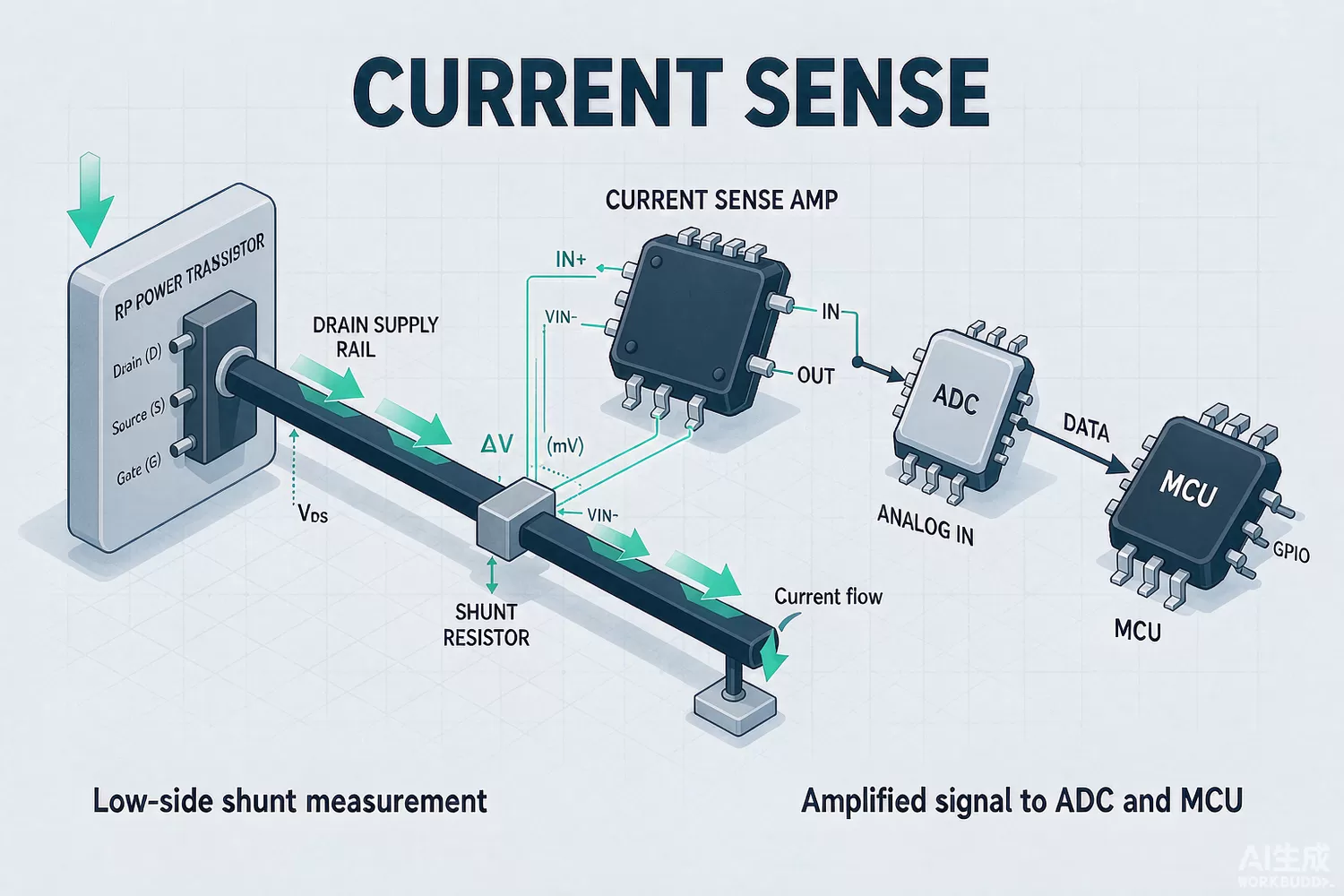
A power amplifier's drain rail tells the truth about the whole transmitter: quiescent health, modulation draw, mismatch stress and thermal drift all show up as current. The current-sense amplifier is the small part that makes that truth readable — a precision resistor in the rail, a differential amplifier across it, and an output the bias loop or the host MCU can trust. Between the PA transistor and the sequencing logic described in our PA bias-control article, the sense chain is what closes the loop and enforces the limits.

Application logic: high side, low side, and where to put the shunt
Three placements dominate. High-side sensing puts the shunt between supply and load: the amplifier must accept a common-mode voltage equal to the rail — for a 28 V or 48 V PA drain, a 36–80 V-rated part — and the load stays grounded. This is the default for PA drain monitoring because the drain feed must not float. Low-side sensing puts the shunt between load and ground: the amplifier sees millivolt-level common-mode, so precision is cheap, but the load is no longer at ground potential — acceptable for monitoring-only taps, awkward for RF chains where ground integrity matters. Isolated sensing uses an isolated amplifier or a modulator across the shunt when the rail sits at dangerous potentials or ground loops must be broken — common in high-voltage and medical-adjacent systems.
Bandwidth matters as much as topology. A quiescent-only monitor can be slow; a monitor that must see modulation envelope or protect against fast faults needs tens or hundreds of kilohertz of signal bandwidth, and a protection-grade path reacts in microseconds. Decide which job the reading does — telemetry, loop feedback, protection — because each has a different accuracy-and-speed price.
Datasheet parameters that decide success
- Common-mode voltage range and its transient rating — PA drain rails spike during VSWR events, and the sense amplifier must survive them.
- Gain error and offset (and offset drift): at a 10 mΩ shunt, 100 µV of offset is 10 mA of reading error — meaningful inside a bias loop.
- Bandwidth and settle time for envelope or fault duty.
- Input differential range: large-signal events (a hard modulation peak) must stay inside the linear input span.
- Output swing and reference pin behaviour for single-supply ADC interfacing.
- Shunt selection interacts with everything: lower resistance saves heat but magnifies offset error; higher resistance measures cleanly but burns voltage headroom.
New technology in current sensing
The current generation: wide-common-mode parts in small packages — 36–80 V-rated amplifiers in SOT-23 and DFN formats that once required bespoke high-side designs; integrated shunts, where the resistor and the amplifier ship in one package to kill layout error; isolated amplifiers and sigma-delta modulators with built-in isolation for high-voltage rails; and digital output monitors like the I2C-class parts that report bus voltage, current and power over the bus — effectively a small telemetry IC on every rail. In PA systems the trend is toward closed-loop everything: envelope-tracking supplies and smart bias both consume drain-current data continuously, raising the accuracy and bandwidth bar on the sense chain.
Domestic alternatives: families and indicative cost
Domestic supply here is verifiable at product level in our own catalogue: the COSINA180A3 current-sense amplifier and the COSINA180HA3 variant are COSINE parts cross-referenced against the widely used INA180A3 class — a 26 V-class, 100 V/µs current-sense amplifier family — at a fraction of the import price. NOVOSENSE (NOVOSENSE) documents isolated current-sensing families for the high-voltage tier, and 3PEAK (3PEAK) documents current-sense amplifier families across the industrial range. Import anchors remain the TI INA18x/INA24x/INA226 families, the AD821x class and MAX40056-style wide-CM parts. For the digital-monitor tier, the INA226AIDGSR remains the reference behaviour to compare against.
Price figures below are indicative public-market reference ranges for moderate volumes, compiled from publicly observable listings. They fluctuate with the spot market, package option, grade (industrial, automotive, screened) and order quantity, and must not be read as a quotation. Ask us for a firm price on your exact part numbers and quantities.
| Function (imported anchor) | Example import part / class | Indicative import price (USD) | Domestic candidate | Indicative domestic price (USD) |
|---|---|---|---|---|
| High-side sense amp, 26 V class, 500 kHz | INA180A3-class (TI) | 0.40 – 1.00 | COSINA180A3 (COSINE, in stock) | 0.08 – 0.25 |
| High-side variant, higher bandwidth | INA180HA3-class | 0.45 – 1.10 | COSINA180HA3 | 0.09 – 0.28 |
| Digital current/power monitor (I2C) | INA226AIDGSR (TI) | 1.20 – 2.50 | Domestic digital monitor families (family level) | 0.30 – 1.00 |
| Isolated current sensing for HV rails | Isolated amplifier families | 2.50 – 7.00 | NOVOSENSE isolated sensing families (family level) | 1.00 – 3.00 |
| Buffer/interface op amp behind the sense chain | COS2172SRB 40 V op amp | 0.30 – 0.90 | Same part, domestic supply | 0.20 – 0.60 |
| Host MCU consuming the telemetry | GD32F303CBT6 | 1.00 – 2.50 | Same part, domestic supply | 0.80 – 2.00 |
The engineering truth: shunt-plus-amplifier accuracy is a layout and shunt-selection exercise more than a silicon exercise. A domestic amplifier that measures identically across your real common-mode and temperature range is identical — and the five-to-ten-fold cost gap closes the case.
Validation flow
Calibrate the shunt with a four-wire measurement, then verify the amplifier's gain error and offset across the rail's common-mode extremes and temperature range. Check transient survival by injecting a VSWR-event-shaped spike into the common-mode while the output is monitored. For bias-loop duty, characterise the loop's stability with the sense chain installed — bandwidth and phase behaviour interact. For telemetry duty, compare readings against a calibrated DMM across the load current range. Our low-noise supply article covers the rail this chain watches, and the zero-drift amplifier article covers the precision tier below it.
Frequently asked questions
Why does my current reading drift with temperature?
Offset drift and shunt TCR. A 50 ppm/C shunt drifts 0.14% over 50 C; an amplifier with 5 uV/C offset drift adds more at low shunt voltages. Specify both, and consider zero-drift-class parts for loop duty.
High side or low side for a 28 V PA drain?
High side. The drain feed must stay grounded, and the sense amplifier must be rated for the rail's common-mode including VSWR transients.
How fast must the sense chain be for protection?
Fast enough to open the path before the transistor's failure energy: microseconds-class for hard faults. Telemetry-only chains can be slow; protection chains cannot.
Are domestic current-sense amplifiers trustworthy for bias loops?
Product-level domestic parts such as the COSINA180 family document matching gain, bandwidth and CMR classes. Validate gain error and drift across your temperature range before closing the loop with them.
About us & trademarks: JTDZ Tech (Shenzhen Jingteng Electronics Technology Co., Ltd.) is an independent distributor of electronic components. We are not an authorised distributor or representative of the imported manufacturers named in this article. Manufacturer, brand and part names are used for identification purposes only; all trademarks remain the property of their respective owners. Cross-reference information in this article is based on publicly available sources, is subject to change, and is not a substitute for your own engineering validation. Always verify specifications against the manufacturer's datasheet before design-in or purchase.
