
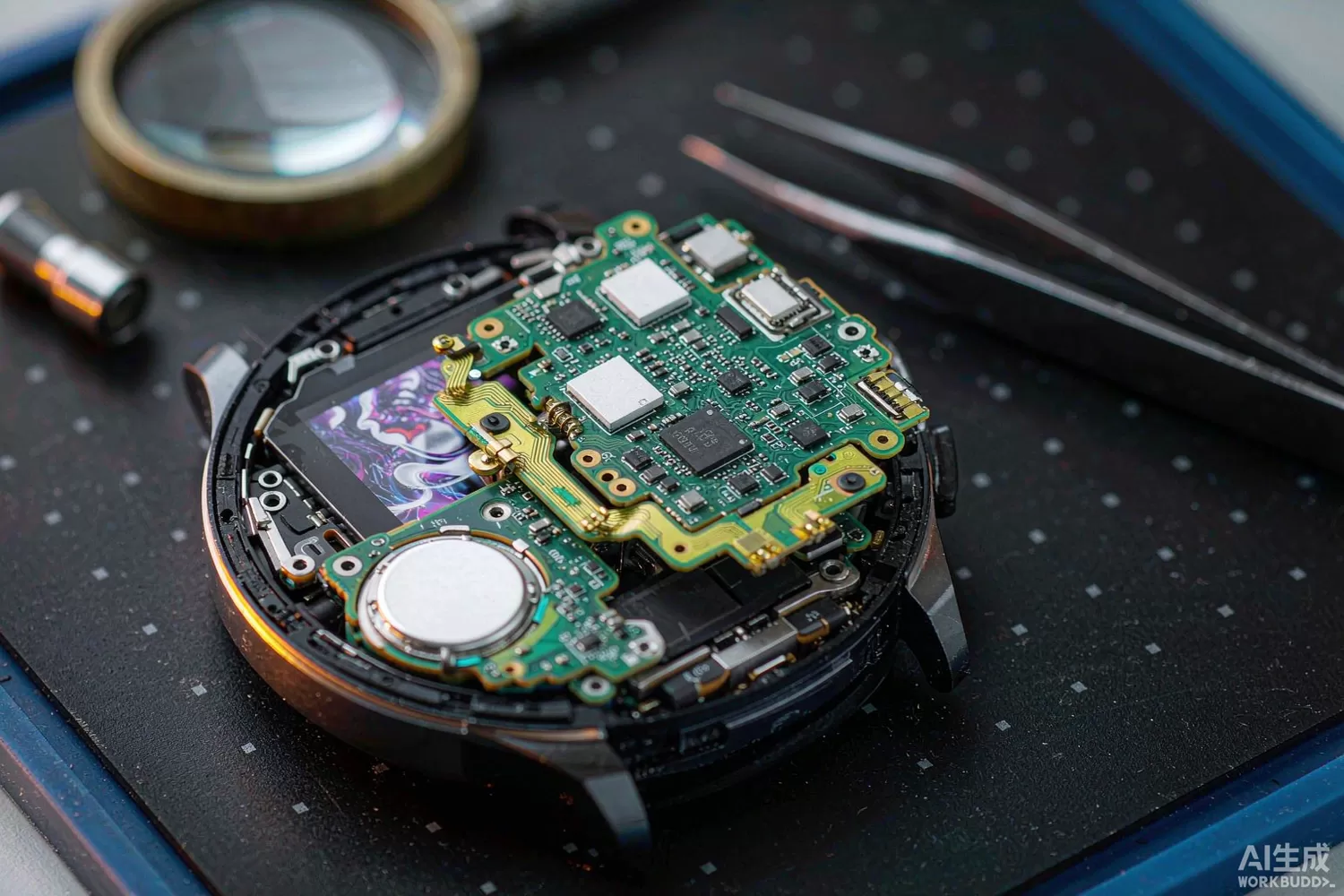
A smartwatch is the most constrained radio product most teams will ever design. The battery is around 300 mAh, the case is metal, the antenna is a few centimetres from a human body that absorbs 2.4 GHz energy, and the product is expected to run for a week while measuring heart rate continuously and receiving notifications every few minutes. The chip architecture that makes this possible is a lesson in duty cycling: a Bluetooth SoC that sleeps almost always, a positioning receiver that runs for seconds, a sensor hub that wakes the application processor only when something interesting happened, and a power tree that loses less than a tenth of the battery to its own quiescent draw. This article covers that architecture, the parameters that decide real battery life, what changed in the last two generations, and domestic candidates with an indicative cost comparison. The general Bluetooth comparison is in our low-power Bluetooth SoC article.

Application logic: everything sleeps, nothing idles
- Connection budget — a phone link at a 100–500 ms connection interval costs a few hundred microamps on average; stretching the interval saves power but delays notifications, so the firmware negotiates per use case rather than globally.
- Advertising and reconnection — when the phone is away the watch advertises on a slow interval; the advertising current multiplied by the reconnect cadence is often the largest single line in the budget.
- Sensor hub duty cycling — the accelerometer and optical front end run from a low-power domain that wakes the main core on threshold crossings, so continuous heart-rate and step counting do not require the application processor to be awake.
- Positioning in bursts — a run-tracking session powers the receiver for a defined window, then sleeps; assisted data shortens the fix and the receiver's backup domain keeps ephemeris alive between sessions.
- Display and haptics — the biggest instantaneous loads in the product, and the reason the power tree needs a boost for the display and a separate rail for the haptic driver.
- Charging and gauging — a linear charger is simple and hot on the wrist; a switching charger is efficient and radiates; the fuel gauge's accuracy decides whether the watch says 5 per cent and dies at 12.
The parameters that decide whether the week-long claim survives
- Sleep and advertising current — the numbers that matter are measured with the radio in its real states, not the datasheet's deepest sleep; ask for advertising current at your interval and connection current at your interval.
- Receiver sensitivity in a body-worn antenna — the antenna is detuned by the wrist and the case, so link margin must be evaluated in situ; a 6 dB loss against the datasheet is normal.
- Transmit power versus efficiency — running at +8 dBm instead of 0 dBm costs several milliamps; in most wearable links 0 dBm with a decent antenna is enough.
- GNSS energy per fix — cold, warm and hot start differ by an order of magnitude; the assist path and the backup domain are what make run tracking viable.
- Power-path and charger efficiency at low currents — charging a 300 mAh cell at 0.5 C spends a meaningful share of the energy in the charger itself, and the termination behaviour affects cycle life.
- Package and pin count — WLCSP with fine pitch saves the board area a watch does not have, and the assembly yield is somebody's problem later.
- Firmware update and rollback — OTA over BLE is slow and power-hungry; dual-bank flash and resumable transfer are mandatory, and both consume the memory budget.
What is changing: standardised ranging, dual-band positioning and integrated front ends
The most interesting shift is standardised distance measurement over Bluetooth. Channel sounding turns a BLE link into a ranging link with phase-based distance estimation, which gives find-my-device features a standard mechanism instead of a vendor protocol — and it competes with UWB at lower cost and lower power, at the price of accuracy. Our UWB article covers the precision end of that spectrum. Second, dual-band positioning reached watches: L1 plus L5 receivers reject multipath in cities and improve accuracy under tree cover, and the energy cost is manageable because the receiver runs in short bursts. Third, integration: the BLE SoC now includes the DC-DC converters, the charger, the fuel gauge and sometimes the sensor-hub core, which is what allows a 300 mAh product to exist at all — the fewer external rails, the fewer quiescent currents to account for.
Domestic alternatives: suppliers and indicative cost
Domestic coverage is strongest in Bluetooth and power, and thinner but improving in positioning for wearables. Goodix (listed) supplies BLE SoC families (the GR551x and GR552x lines) with the low-power modes and on-chip DC-DC that wearables need; Telink's multi-protocol families cover BLE plus 802.15.4 designs; Bestechnic (listed) covers wearable and audio SoCs with integrated power management. For positioning, Zhongke Microelectronics' AT6558R family and Techtotop's modules are the volume domestic choices, while Southchip and SGMicro cover charging and regulation. Imported anchors are Nordic's nRF52840 and nRF5340, Ambiq's Apollo4 Blue for ultra-low-power application cores, ST's STM32WBA and TI's CC2340R5. Compare on measured current in the states you will actually use, and on whether the vendor's reference design survives a metal case.
Bench hardware for a wearable prototype: a Nordic-class nRF52840-QIAA-R as the radio reference, an Artery AT32L021C8T7 if you need a separate sensor-hub core, a Cosine COS29302WU for the always-on rail, a BME280 for environmental logging in the prototype, a VL53L0X if the product adds proximity sensing, and a Titan Micro TS2502PN at the antenna port.
Price figures below are indicative public-market reference ranges for moderate volumes, compiled from publicly observable listings. They fluctuate with the spot market, package option, grade (industrial, automotive, screened) and order quantity, and must not be read as a quotation. Ask us for a firm price on your exact part numbers and quantities.
| Function (imported anchor) | Example import part / class | Indicative import price (USD) | Domestic candidate | Indicative domestic price (USD) |
|---|---|---|---|---|
| BLE SoC with integrated PMIC | Nordic nRF52840 class | 2.60 – 5.50 | Goodix GR551x / GR552x families (family level) | 0.90 – 2.30 |
| Ultra-low-power application core | Ambiq Apollo4 Blue class | 3.50 – 7.00 | Domestic low-power Cortex-M families | 1.20 – 3.00 |
| Multi-protocol SoC (BLE + 802.15.4) | Nordic nRF5340 class | 3.80 – 7.50 | Telink multi-protocol families (family level) | 1.40 – 3.40 |
| GNSS receiver for wearables | Imported low-power GNSS, L1+L5 class | 2.50 – 5.50 | Zhongke Micro AT6558R family; Techtoptop modules | 0.70 – 1.90 |
| Charger / power path | Imported switching charger, 0.5 A class | 0.55 – 1.40 | Southchip and SGMicro charger families | 0.18 – 0.55 |
| Fuel gauge | Imported impedance-tracking gauge | 0.80 – 2.00 | Domestic gauges, accuracy varies (family level) | 0.30 – 0.90 |
| Always-on LDO | General-purpose 300 mA LDO | 0.25 – 0.65 | COS29302WU (Cosine) | 0.07 – 0.20 |
| Antenna-port ESD protection | Imported low-capacitance TVS | 0.12 – 0.40 | TS2502PN (Titan Micro) | 0.03 – 0.10 |
Read the ranges as structure. The radio SoC and the display dominate the bill, and domestic BLE silicon is roughly half the imported price at comparable integration; positioning is where the gap narrows, because low-power multi-band receivers are still a small club. The honest caveat for this category is tooling: wearable firmware is a power-optimisation exercise, and a part with a mature profiler and a well-documented low-power mode saves more battery life than a cheaper die with a thin SDK.
Validation flow before you commit
Measure on a wrist, not on a bench. Build five units, wear them for a week with logging, and compare the recorded discharge curve with your duty-cycle model; the difference is your model's error and usually lives in advertising current and sensor-hub wake rate. Then test the radio in the situations that hurt: phone in the opposite pocket, body between watch and phone, wrist under a sleeve, and a crowded 2.4 GHz environment such as a gym. For positioning, log time-to-first-fix and track quality while running in a city with tall buildings, and measure the receiver's energy per session rather than its average current. Verify charging from 0 to 100 per cent with the watch running a notification load, and check the gauge's accuracy at the low end. Finally, run an OTA update on a half-discharged battery and confirm the rollback works when the link drops.
Frequently asked questions
Does Bluetooth channel sounding replace UWB for find-my-device?
No. Channel sounding gives metre-class ranging at very low power and cost, which suits item finders and proximity features; UWB remains the choice for centimetre-level and secure ranging use cases.
Why does my watch lose 20 per cent overnight?
Usually advertising current plus sensor-hub wake rate, not the radio link. Log the states and count wake events; a slow advertising interval and a tighter accelerometer threshold are the usual fixes.
Is a dual-band GNSS receiver worth the power in a watch?
Yes for outdoor sports accuracy in cities and under cover, provided the receiver runs in short assisted bursts. Continuous tracking at dual band is still too expensive for a 300 mAh cell.
Can a domestic BLE SoC meet a week of battery life?
Yes when the part has genuine sub-microamp sleep, an integrated DC-DC and hardware event handling that keeps the main core asleep. Verify with advertising-current measurements, not datasheet sleep figures.
About us & trademarks: JTDZ Tech (Shenzhen Jingteng Electronics Technology Co., Ltd.) is an independent distributor of electronic components. We are not an authorised distributor or representative of the imported manufacturers named in this article. Manufacturer, brand and part names are used for identification purposes only; all trademarks remain the property of their respective owners. Cross-reference information in this article is based on publicly available sources, is subject to change, and is not a substitute for your own engineering validation. Always verify specifications against the manufacturer's datasheet before design-in or purchase.
