
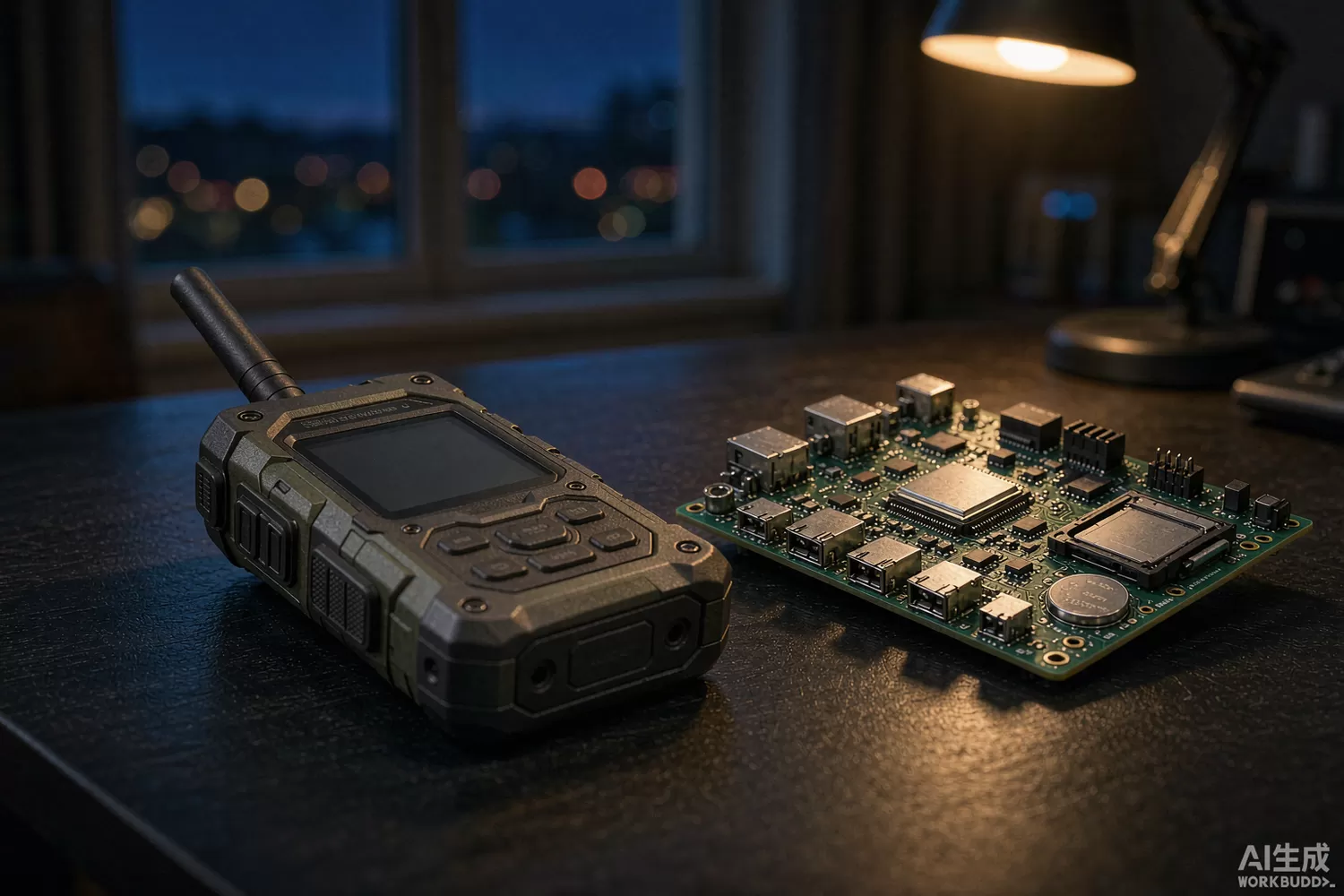
Most satellite navigation chips are listeners: they receive, compute, and keep quiet. The Beidou Radio Determination Satellite Service (RDSS) adds the missing half of the conversation — a certified terminal can transmit short messages and location reports back through the constellation, without any ground network in between. That two-way capability, unique among global navigation systems, has quietly built its own silicon category: the RDSS SoC, which integrates an S-band transmitter, an L-band receiver, baseband processing and application firmware on one die. This article explains how RDSS terminals are actually engineered, what the 2020s generation of silicon changed, and which domestic parts carry public part numbers. For the 3GPP-standardised direct-to-device wave, see our NTN chipset article — a complementary, not identical, technology.

Application logic: a two-way radio wearing a navigation badge
RDSS is architecturally a transponder service: the terminal transmits an inbound signal at S-band (around 2.4–2.5 GHz for Beidou-3 regional service), the GEO/IGSO constellation relays it to a ground station, and the response returns at L-band. The engineering discipline follows:
- Service authorisation is part of the stack — RDSS messaging requires a service card/SIM issued through the licensed operator chain; the chip provides the ISO/IEC 7816-class interface and the security partition, but airtime is a regulatory relationship, not a datasheet row.
- Message budget, not bandwidth — regional short-message service moves hundreds to about a thousand Chinese characters per entry on current SoCs, with strict per-day message allowances; the application design is a store-and-forward queue, not a streaming link.
- Location reporting as the core workload — the dominant use is periodic position reports: the terminal receives its RNSS fix locally (often from the same chip's navigation engine) and transmits a compact report; fleet, fishery, emergency and meteorological applications are all variations of this loop.
- Link budget both ways — the S-band inbound path from a handheld is power-limited, so coding, repetition and capture sensitivity matter as much on transmit as receiver sensitivity does on receive.
- Antenna and integration constraints — a messaging terminal needs both L-band receive and S-band transmit coverage; antenna efficiency at S-band from a small wearable is a genuine engineering constraint, not a datasheet footnote.
- Regional scope honesty — regional RDSS service covers China and surrounding areas; global short-message capability is a separate, later-generation service tier. Terminal specs and marketing must not conflate the two.
Parameters that decide whether the message gets through
- Inbound EIRP and coding gain — transmit power, antenna gain and the chip's FEC/coding scheme together set the message success rate at low elevation angles; ask for capture-sensitivity data, not just output power.
- Outbound decode sensitivity — the L-band receive chain must demodulate responses at negative SNR margins; current-generation SoCs publish decode sensitivities around −128 to −130 dBm-class thresholds.
- First-capture and reacquisition time — a messaging terminal that needs minutes to find the satellite wastes battery and message allowance; modern parts advertise sub-2-second first capture with pilot-aided acquisition.
- Transmit power consumption — the S-band burst dominates the energy budget; per-message energy, not standby current, decides battery sizing for a device that reports hourly.
- Integration level — whether the chip integrates its own LNA and pre-PA, the navigation engine, the security element interface and the RTOS decides how much board a wearable terminal can shed.
- Security architecture — message authentication lives in the service-card interface and the chip's secure boot; tamper behaviour is a procurement criterion for emergency-response fleets.
- Coexistence with the RNSS engine — single-chip parts that navigate and message simultaneously avoid the two-chip synchronisation logic older designs needed.
What is changing in RDSS silicon
Three shifts define the current generation. First, process and power collapse: the newest domestic SoCs moved to 22 nm-class CMOS with integrated baseband and RF, cutting working power to tens of milliwatts and package area to a few millimetres square — an order-of-magnitude reduction that moves RDSS from vehicle terminals into wearables and smartphones. Second, consumerisation: flagship handsets now ship with integrated Beidou messaging, and the chip-level consequence is a volume consumer supply chain where cost, not certification paperwork alone, drives selection. Third, service-model maturity: per-day message allowances, emergency-tier free messaging and fleet-management integrations have stabilised into a predictable commercial envelope, letting terminal designers actually budget for the messaging their product will sell. The interaction with NTN matters for planning: 3GPP NTN direct-to-device services, described in our NTN article, are a global-standard complement, while RDSS remains the regionally certified, regulated-capacity service with the head start in Chinese emergency and fishery infrastructure. For the RF front-end components both services share, see our LNA front-end article.
Domestic options: suppliers and indicative cost
This is a category where domestic silicon is not an alternative to imports — it is the only supply, because RDSS is a Beidou-system service. Shenzhen Huada Beidou (Allystar) publishes the HD6180 CYNOSURE IV RDSS SoC: 22 nm, single-die baseband-plus-RF with integrated LNA and pre-PA, S/L-band RDSS support, 1000-character-class short messages, ISO/IEC 7816 service-card interface, sub-2-second first capture, −130 dBm-class decode sensitivity and working power under 22 mW. Taidou Micro ships the TD3050, a 40 nm BDS-3 RDSS RF-baseband SoC supporting short-message communication and positioning. Both vendors wrap the SoCs into modules for terminal integrators. For cost contrast with the imported alternative — legacy Iridium-class SBD messaging modules — the honest comparison is service-to-service: regional RDSS terminals avoid the per-message satellite airtime economics of global messaging constellations but are regionally scoped, so the table below compares hardware with that framing stated. Where only family-level information is public, the table says so.
A terminal integration bench is quick to assemble from catalogue stock: an Artery AT32F403ACGT7 as the host controller for message-queue firmware, a Cosine COS2991S LDO for the clean analog rail, a Titan Micro TS2502PN guarding the antenna port, and a MACOM SW-456TR-3000 switching test antennas between transmit and receive paths.
Price figures below are indicative public-market reference ranges for moderate volumes, compiled from publicly observable listings. They fluctuate with the spot market, package option, grade (industrial, automotive, screened) and order quantity, and must not be read as a quotation. Ask us for a firm price on your exact part numbers and quantities.
| Function (contrast anchor) | Example part / class | Indicative price (USD) | Domestic candidate | Indicative domestic price (USD) |
|---|---|---|---|---|
| Two-way satellite messaging SoC | Iridium-class SBD module (global, per-message airtime) | 70 – 130 (module) | Huada Beidou HD6180 SoC (22 nm, regional service) | 12 – 28 (module class) |
| RDSS RF-baseband SoC (OEM level) | n/a - RDSS is Beidou-only | n/a | Taidou TD3050 (40 nm BDS-3 RDSS SoC) | 6 – 15 (chip class, family level) |
| Wearable messaging module | Import messenger-module classes | 60 – 120 | Domestic RDSS module families (family level) | 15 – 35 |
| Host MCU for message queue | STM32-class general purpose | 1.2 – 3.0 | AT32F403ACGT7 (Artery) | 0.4 – 0.9 |
| Antenna-port ESD protection | Classic TVS diode classes | 0.15 – 0.5 | TS2502PN (Titan Micro) | 0.05 – 0.2 |
| Clean analog rail LDO | Classic 150 mA LDO classes | 0.3 – 0.8 | COS2991S (Cosine) | 0.08 – 0.25 |
Read the table as a screening tool, not a quotation. The structural point for sourcing: RDSS silicon procurement is a domestic-market procurement, with two SoC vendors, module wrap options and a regulated service chain; the meaningful diligence is about service-card provisioning, message-allowance terms and long-term module availability, not about cross-referencing an imported part number that does not exist. Hardware pricing has already reached consumer-electronics economics at the chip level.
Validation flow before you commit
Validate the service, not just the radio. Run message success rate against satellite elevation on a real rooftop campaign — low-elevation failures are where regional messaging lives or dies — and log per-message energy through a full report cycle at your real reporting interval. Test the service-card provisioning path exactly as your fleet will use it, including replacement of a damaged card. Verify first-capture and reacquisition after cold start, after indoor-to-outdoor transitions and at battery-end voltage. Exercise the message queue under saturation (more queued reports than the daily allowance) and confirm the terminal degrades gracefully. Finally, confirm the regulatory scope in writing: regional versus global messaging tiers, allowance terms and any end-industry restrictions belong in the procurement contract, not in assumptions.
Frequently asked questions
How is RDSS different from the NTN direct-to-device services?
RDSS is the Beidou system's regulated two-way messaging service with its own silicon and service-card chain, regionally scoped and operational for years; NTN is the 3GPP-standardised global direct-to-device wave still rolling out. They are complements, and future terminals will increasingly carry both.
Does the RDSS chip also provide navigation?
Current-generation SoCs integrate the RNSS navigation engine alongside the messaging transceiver, so one chip both computes the fix and reports it - removing the two-chip synchronisation logic of earlier designs.
What does the service card actually control?
Message allowances, authentication and billing live in the licensed service chain via the card interface; the chip provides the secure interface but airtime is a regulatory relationship that must be contracted separately.
Is global short messaging available on current parts?
Global messaging is a separate service tier with its own terminal requirements; regional service is the volume path today. Procurement documents should state the tier explicitly.
About us & trademarks: JTDZ Tech (Shenzhen Jingteng Electronics Technology Co., Ltd.) is an independent distributor of electronic components. We are not an authorised distributor or representative of the imported manufacturers named in this article. Manufacturer, brand and part names are used for identification purposes only; all trademarks remain the property of their respective owners. Cross-reference information in this article is based on publicly available sources, is subject to change, and is not a substitute for your own engineering validation. Always verify specifications against the manufacturer's datasheet before design-in or purchase.
