
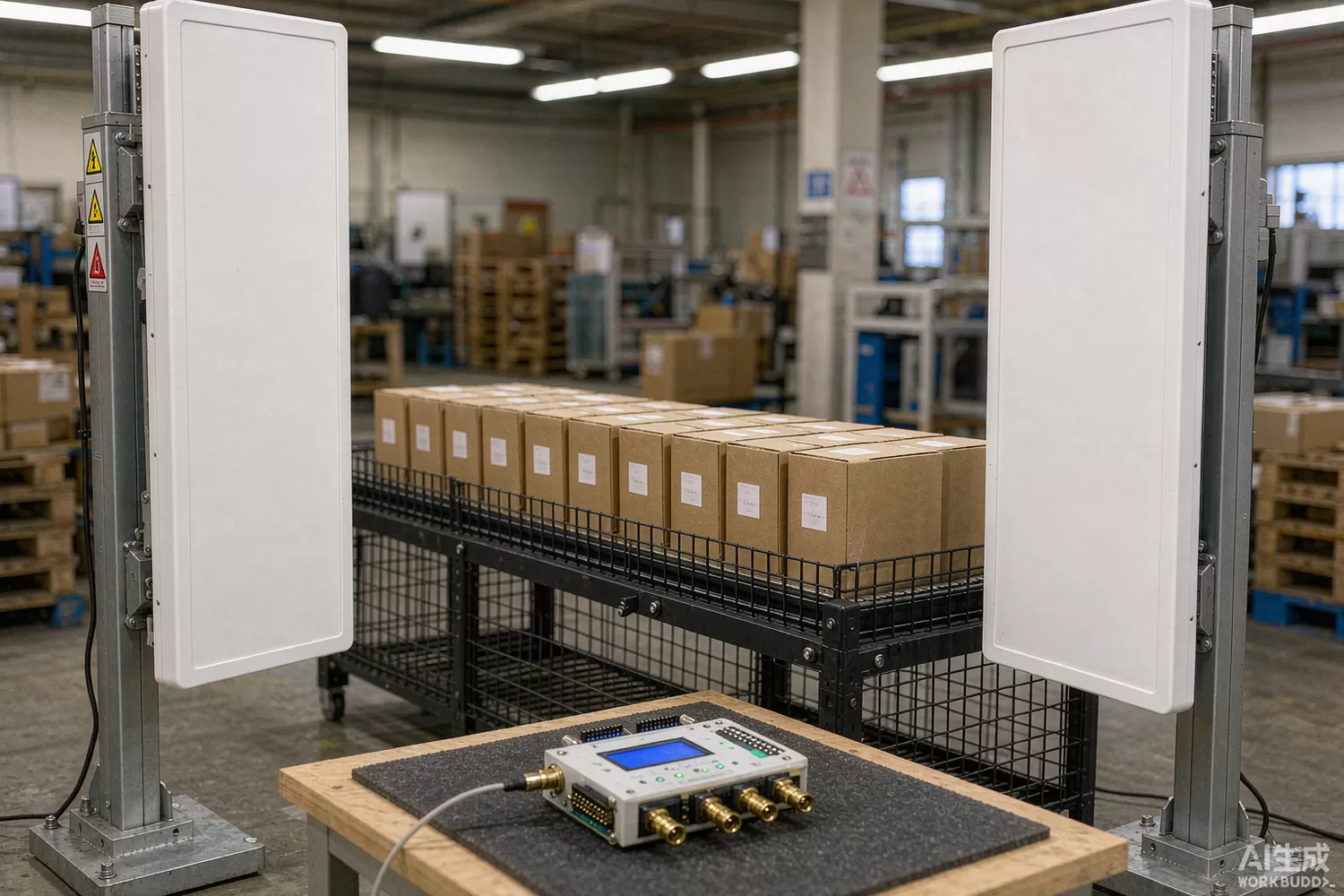
The UHF RFID tag gets all the attention — it is the part printed by the million — but the engineering difficulty lives on the reader side. A reader must transmit a continuous carrier to power passive tags while simultaneously demodulating the tags' faint backscatter replies, often while neighbouring readers do exactly the same thing a few metres away. The reader chipset is therefore a duplex RF problem, a protocol-timing problem and an interference-management problem at once. This article explains the application logic, the parameters that decide read-rate credibility in a warehouse, the technology shifts in reader silicon, and the domestic alternatives with public part numbers. For the tag side and the energy-harvesting physics, see our tag chip article and the energy-harvesting overview.

Application logic: talking and listening on the same channel
An EPC Gen2 (ISO 18000-63) reader session is a strictly scheduled conversation: the reader transmits a query, tags answer by modulating their antenna impedance (backscatter), and the protocol's T*rir and Tari timings define how fast each side may speak. The design discipline follows:
- Transmit leakage is the receiver's real noise floor — the reader's own continuous wave leaks through imperfect isolators and antenna mismatch straight into its receiver; phase-noise and leakage-cancellation quality decide whether a tag 8 m away is hearable at all.
- Dense-reader mode is mandatory in warehouses — neighbouring readers interfere through tag backscatter and direct carrier; spectral masks, frequency hopping (FCC regions) or channelised LBT (ETSI regions) and Miller-encoded uplinks keep a bank of readers from blinding each other.
- Session and flag state machine — Gen2 sessions S0–S3 decide how tags persist between inventories; misconfigured sessions are why one reader counts 100 % and its neighbour counts 60 % of the same shelf.
- Power budget to the tag, not from the wall — transmit power, antenna gain and frequency set the energising field that decides read range; the receive chain then has to survive its own transmitter's proximity while resolving millivolt backscatter.
- Q-value adaptation — the dynamic Q algorithm tunes how many tags answer each slot; a reader SoC with hardware support for fast inventory rounds outperforms a nominally identical part in dense-population shelves.
- Antenna port architecture — single-port handhelds, dual-port fixed readers and four-to-eight-port portal readers all exist; port switching, power per port and per-port phase calibration are selection criteria before silicon.
Parameters that decide read-rate credibility
- Receive sensitivity at the protocol's fastest data rates — quoted at specific Miller indices and BLF; high-throughput modes trade margin for speed, so sensitivity numbers must be read at the mode your inventory software actually runs.
- Transmit phase noise and leakage tolerance — these decide how much of the tag's own weak reply survives the reader's carrier leakage; this is the quiet differentiator between reader chips of the same price tier.
- Maximum and per-port transmit power with linearity — regulatory ceilings aside, power flatness across the 902–928 or 865–868 MHz band and port-to-port consistency decide uniform portal coverage.
- Inventory speed under load — tags per second through a portal with several hundred tags is a system number: silicon, antenna, Q algorithm and host software all contribute; benchmark the stack, not the chip.
- Interoperability across tag populations — a reader meets thousands of tag SKUs in the field; sensitivity to tag-modulation depth variations is a hidden quality metric measured only by fleet trials.
- Integrated security engines — Gen2v2 authenticate and crypto-suite support increasingly matters for brand-protection deployments; hardware SM-class and AES engines on the reader side complete what the tag offers.
- Integration level — newer single-chip reader SoCs fold the MCU, RF, baseband and memory onto one die, removing the external controller and the boot-time supervision between them.
What is changing in reader silicon
Three movements matter to buyers. First, single-chip integration: the newest reader SoCs put MCU, radio, baseband and memory on one CMOS die with the balun and power control built in, collapsing the classic two-chip reader board and — more consequentially for handhelds — cutting standby power enough to reshape battery sizing; integrated low-power tag-detection modes let battery devices wake the reader only when tags are actually present. Second, fixed readers become edge computers: portal-class products now ship Linux-class application processors with the reader silicon behind them, moving deduplication, filtering and business logic to the reader itself. Third, sensor-tag extension: passive UHF tags with on-chip sensing (capacitive, temperature) extend the reader population into condition monitoring, and reader silicon that supports the wider protocol feature set captures that growing installed base. The RF-component neighbours — the antenna switch and the harmonic filtering — are covered in our RF switch article and filter selection guide.
Domestic alternatives: suppliers and indicative cost
Domestic reader silicon crossed into production credibility in recent years. Fudan Micro (Fudan Microelectronics, stock code 688385) ships the FM13RD1616 series (RD1616E/G for the EPC and GB/T 29768 protocol families) and the third-generation FM13RD1618(RD1618) reader SoC — MCU, RF transceiver, baseband and storage integrated on one die, a Cortex-M0-class core, −102 dBm-class sensitivity in the highest-throughput M8 profile, 30–40 dB programmable output-power control, SM7 and AES security engines, and a low-power tag-detection mode that periodically pings for tags before powering the full receiver; the vendor wraps the same silicon into fixed-reader appliances. Additional domestic vendors serve the family-level handheld-reader market. Imported anchors — Impinj's E510/E710-class reader chips — remain the reference points in export infrastructure and the densest portal installations. Where only family-level information is public, the table says so; verify protocol support (EPC Gen2v2 and GB/T 29768 dual-stack) against your tag population.
A portal test bench is quick to assemble from catalogue stock: a MACOM SW-456TR-3000 switching four antenna ports, a Mini-Circuits LFCG-2600+ cleaning transmit harmonics, a Mini-Circuits PHA-202+ as a reference gain stage, a Titan Micro TS2502PN on the port interfaces, and an Artery AT32F403ACGT7 driving the inventory-state test harness.
Price figures below are indicative public-market reference ranges for moderate volumes, compiled from publicly observable listings. They fluctuate with the spot market, package option, grade (industrial, automotive, screened) and order quantity, and must not be read as a quotation. Ask us for a firm price on your exact part numbers and quantities.
| Function (imported anchor) | Example import part / class | Indicative import price (USD) | Domestic candidate | Indicative domestic price (USD) |
|---|---|---|---|---|
| Fixed/portal reader SoC | Impinj E710-class | 8 – 15 | Fudan Micro FM13RD1618G (third-gen single-chip SoC) | 2.5 – 6.0 |
| Handheld/compact reader chip | Impinj E510-class | 5 – 9 | Fudan Micro FM13RD1616E/G | 1.8 – 4.0 |
| Four-port antenna switch | pSemi / Skyworks SP4T classes | 0.8 – 2.5 | SW-456TR-3000 (MACOM); Maxscend SP4T family | 0.3 – 1.2 |
| Harmonic/reject filter | Mini-Circuits LTCC LPF classes | 0.8 – 2.5 | LFCG-2600+; domestic LTCC families | 0.3 – 1.0 |
| Reference gain stage | Mini-Circuits PHA-202+ class | 1.0 – 2.8 | PHA-202+; domestic gain-block families | 0.4 – 1.5 |
| Reader host MCU | STM32-class general purpose | 1.2 – 3.0 | AT32F403ACGT7 (Artery) | 0.4 – 0.9 |
| Port-interface ESD protection | Classic TVS diode classes | 0.15 – 0.5 | TS2502PN (Titan Micro) | 0.05 – 0.2 |
Read the table as a screening tool, not a quotation. The practical reality: domestic reader SoCs now integrate more silicon per die than the imported references and price at roughly a third, with dual-stack protocol support matching the Chinese tag population — a meaningful advantage where GB/T 29768 tags coexist with EPC stock. The remaining import advantage concentrates in the very densest portal environments and in the export-facing reference-design ecosystem. One engineering caution: read-rate benchmarks are stack results — silicon, antenna, Q algorithm and firmware — so evaluate candidate readers as integrated portals against your actual tag population, never on datasheet rows alone.
Validation flow before you commit
Validate with your tags, in your geometry. Run portal read-rate trials with several hundred mixed-SKU tags at production conveyor or portal speeds, then repeat with a neighbouring reader operating simultaneously at the real channel offset — dense-reader behaviour is the failure mode warehouses actually experience. Measure sensitivity at your software's real Miller index and BLF, and log per-tag read retries to expose marginal tags before production does. Exercise session-flag configurations across your host software's inventory cycles. Verify power flatness across the band and per-port consistency on multi-port readers. Finally, trial a fleet: hundreds of readers for weeks, in the hands of the staff who will live with them, because integration-level differences between chips show up in fleet statistics long before they show up in any bench number.
Frequently asked questions
Why is the reader side harder than the tag side?
The reader must power the tag with a continuous carrier while listening to millivolt backscatter through its own transmitter leakage - a duplex problem the passive tag never faces - and must do it while neighbouring readers do the same.
Can domestic reader SoCs replace imported parts?
For handhelds, shelf readers and most portals the domestic single-chip SoCs now deliver equal or better integration at roughly a third of the price, with dual EPC/GB protocol support. The densest export-facing installations still reference the imported silicon.
What is dense-reader mode and when do I need it?
A set of protocol options - channelised operation, Miller-encoded tag replies, strict timing - that lets many readers work without blinding each other. Any site with more than a couple of portals needs it planned, not hoped for.
What actually limits read rates in a warehouse?
Antenna geometry, Q-value tuning and host software far more than the chip's headline speed; benchmark portals as systems with your real tag population.
About us & trademarks: JTDZ Tech (Shenzhen Jingteng Electronics Technology Co., Ltd.) is an independent distributor of electronic components. We are not an authorised distributor or representative of the imported manufacturers named in this article. Manufacturer, brand and part names are used for identification purposes only; all trademarks remain the property of their respective owners. Cross-reference information in this article is based on publicly available sources, is subject to change, and is not a substitute for your own engineering validation. Always verify specifications against the manufacturer's datasheet before design-in or purchase.
