
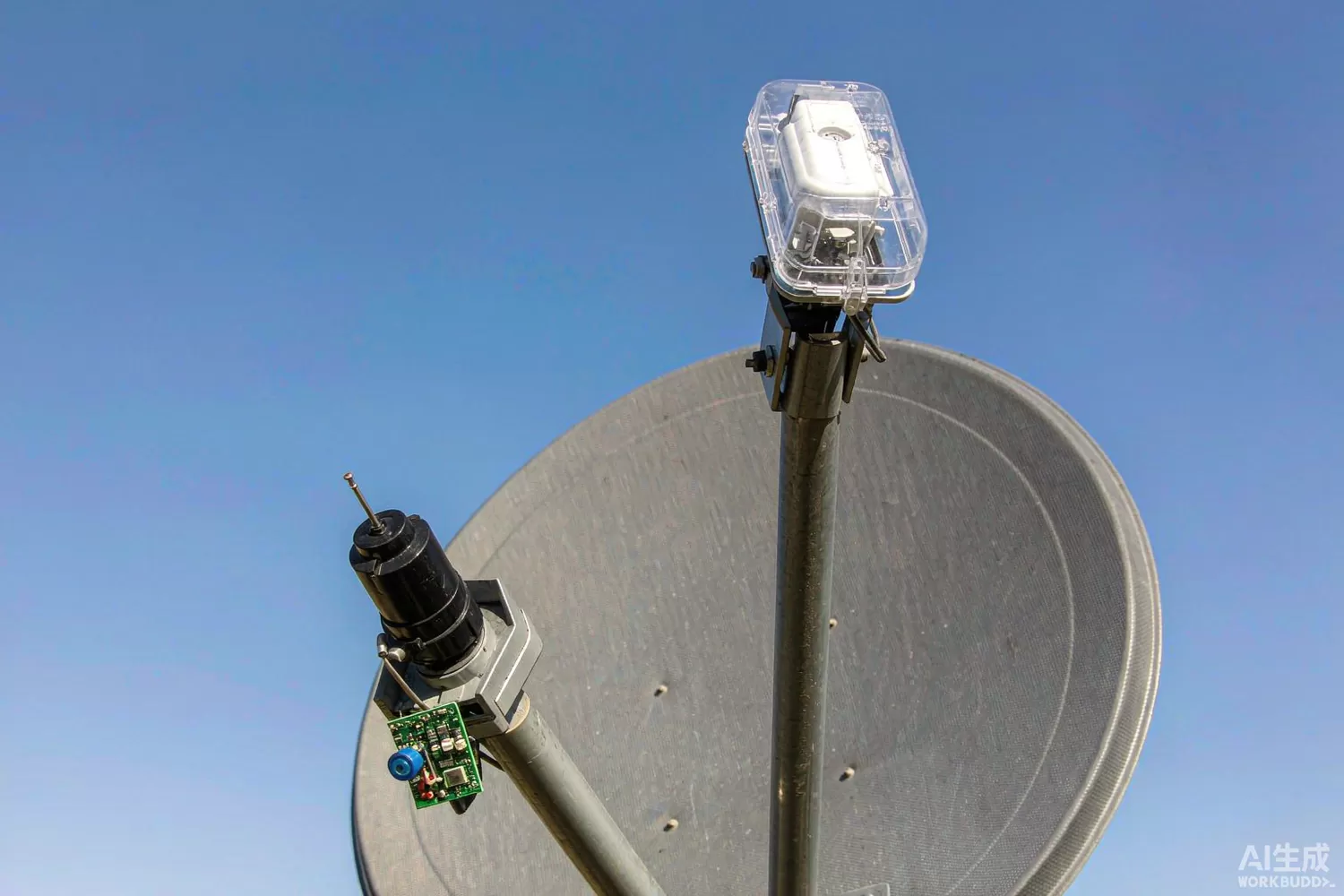
The low-noise block downconverter (LNB) is the small electronics package at the focus of every satellite dish, and it does two jobs that nothing else in the chain can do as cheaply: it amplifies the 10–12.75 GHz signal from space with as little added noise as physics allows, and it block-converts the whole band down to 950–2150 MHz so ordinary 75-Ω coax can carry it indoors. The DVB-S2X receiver chip at the other end of the cable — covered in our tuner front-end article — inherits whatever the LNB did or failed to do: every decibel of LNB noise figure is a decibel of dish efficiency, and every megahertz of local-oscillator drift lands directly on the tuner's capture range. This article explains the LNB's application logic, the parameters that separate a professional unit from a consumer one, the technology shifts in the silicon, and the domestic supply picture with concrete units and families.

Application logic: the last amplifier before the long lossy cable
Everything about LNB design follows from one cascade fact: noise added before gain is noise amplified forever. The discipline:
- The first transistor sets the number — the waveguide probe feeds a low-noise amplifier (GaAs pHEMT or, increasingly, silicon-germanium) whose noise figure at 10–12 GHz defines the unit's rating; 0.1–0.3 dB separates professional from consumer grades, worth a dish size in weak-satellite regions.
- Block conversion with a shared local oscillator — a 9.75 GHz (low band) and 10.6 GHz (high band) LO pair shifts the whole Ku downlink to 950–1950 MHz-class IF; a 22 kHz tone or supply-voltage change selects the band, and the same supply voltage carries polarisation selection (13 V vertical, 18 V horizontal).
- LO stability is a system parameter — consumer units tolerate ±0.5–1 MHz with dielectric-resonator oscillators; VSAT and DTH head-end units need PLL-referenced LOs (25 MHz crystal, phase-locked, often ±10–30 kHz-class or better) because modem capture margins and carrier spacing are tight.
- Gain must survive the cable, not just the bench — 55–70 dB of conversion gain overcomes coax loss and splitter trees; gain flatness and output level compression decide behaviour when one feed serves eight tuners.
- Weather is part of the datasheet — rain fade, feed-horn icing and sun outage are operational realities; professional units specify phase-noise and stability across −40 to +70 °C, and PIM-free mechanical construction matters at high power uplinks sharing the site.
- Multi-feed architectures — twin/quad/octo LNBs, monoblock units for adjacent satellites and motorised feed stacks all multiply the same two building blocks; isolation between outputs is the added parameter that separates good multi-feed units.
Parameters that decide whether the dish delivers
- Noise figure, honestly specified — 0.1–0.7 dB professional Ku grades versus 0.7–1.5 dB consumer; ask for measured, band-resolved values, because a single-band number hides the band-edge behaviour where transponders live.
- LO frequency accuracy and drift over temperature — DRO units drift with weather; PLL units hold ±kHz and turn the LNB from a consumer part into a carrier-grade one — the single biggest professional/consumer differentiator.
- Conversion gain and flatness — 55–70 dB typical with ±2–4 dB flatness; insufficient gain exposes the IF distribution to tuner noise, excessive gain invites compression in multi-tuner splitters.
- Phase noise at modem-relevant offsets — high-order modulation (16/32-APSK on DVB-S2X) demands LO phase noise the consumer DRO cannot deliver; professional PLL units publish offset-resolved phase-noise tables.
- Output P1dB and multi-tuner behaviour — an octo feed driving eight receivers through splitters needs output headroom; compression here reads as intermittent mystery faults on busy transponders.
- Cross-polarisation isolation — 20–25 dB minimum between orthogonal feeds; poor isolation reads as rain-fade-like symptoms on the opposite polarisation.
- Power-supply tolerance and feed behaviour — 11–21 V over long coax with band/polarisation signalling; the LNB's DC behaviour on a shorted or waterlogged cable should fail safe.
What is changing in LNB technology
Three currents matter. First, silicon-germanium and integrated downconverter chips: modern LNB units are built around single downconverter ICs integrating the LO, PLL, band/tone decoding and DC-DC management, cutting the external part count to a few dozen components and making PLL stability affordable at consumer price points — the same single-chip integration wave visible across the RF category. Second, professional-grade stability migrates down-market: 10 kHz-class PLL LOs that once lived only in VSAT head-ends now ship in mid-price DTH and small-aperture units, and multi-carrier small-terminal (aero, maritime, LEO user terminals) demand keeps pulling professional specifications into compact packages. Third, the LEO user-terminal wave: low-Earth-orbit consumer and enterprise terminals need phased or mechanically steered antennas with Ka-band block conversion or direct sampling — a different band and architecture, but built on the same noise-first discipline, and it is absorbing a growing share of the professional LNB industry's engineering capacity. For the cascade that follows the LNB, our LNA front-end article and the satcom chain overview cover the system context.
Domestic alternatives: suppliers and indicative cost
Domestic supply here is strong at the unit level and thin at the open-market chip level — an honest asymmetry. Anhui Bowei Electronics mass-produces Ku-band LNB units with published professional-grade specifications (65 dB-class gain, ≤3 dB-class and lower noise figures on premium grades, ±1 MHz-class and tighter LO stability, −40 to +70 °C operation, CE/FCC) and positions its professional units 20–30 % below comparable imported units; Probecom (Shaanxi) publishes the PR1803-class Ku LNB (10.75 GHz LO, 0.3 dB-class noise figure on premium grades, ≥65 dB gain) for TVRO and VSAT integrators; numerous Guangdong and Zhejiang manufacturers cover the consumer DTH volume segment. At the chip level, the downconverter ICs inside these units come from regional design houses — the Taiwan-region vendor AMICCOM's A7833-class single-LNB chips (9.75/10.6 GHz, integrated 22 kHz tone detection, polarisation-voltage handling and DC-DC management) are the publicly documented reference — while mainland design-in typically happens as complete units or with CETC 13th-Institute-class GaAs LNA MMIC families (family level). Imported anchors — professional LNB units from established European and North American VSAT brands — remain the qualification baselines in carrier programmes. Verify stability class and phase-noise tables against your modem's capture requirements.
A receive-chain bench is quick to assemble from catalogue stock: a Mini-Circuits PHA-13LN+ as an IF-chain reference amplifier, a Mini-Circuits LFCG-2600+ cleaning measurement spurs, a Cosine COS2991S LDO emulating the dish-feed supply rail, a Titan Micro TS2502PN on the IF interface, and an Artery AT32F403ACGT7 sequencing band/tone signalling in the test harness.
Price figures below are indicative public-market reference ranges for moderate volumes, compiled from publicly observable listings. They fluctuate with the spot market, package option, grade (industrial, automotive, screened) and order quantity, and must not be read as a quotation. Ask us for a firm price on your exact part numbers and quantities.
| Function (imported anchor) | Example import part / class | Indicative import price (USD) | Domestic candidate | Indicative domestic price (USD) |
|---|---|---|---|---|
| Professional Ku LNB unit (PLL, VSAT) | European/North American VSAT brands | 25 – 60 | Anhui Bowei professional Ku series (unit level) | 12 – 35 |
| Premium TVRO Ku LNB (low NF) | Premium consumer/professional classes | 8 – 25 | Probecom PR1803-class (unit level) | 4 – 15 |
| Consumer DTH single LNB | Volume consumer brands | 1.5 – 5.0 | Guangdong/Zhejiang DTH manufacturers (family level) | 0.8 – 2.5 |
| Twin/quad multi-feed unit | Import multi-feed classes | 5 – 15 | Domestic multi-feed families (family level) | 2.5 – 8.0 |
| Downconverter IC (inside unit) | Taiwan-region A7833-class single-LNB chip | 0.8 – 2.0 | Integrated in domestic units; open-market chip supply thin (stated as-is) | n/a (unit) |
| LNA MMIC at 10-12 GHz | Import pHEMT MMIC families | 2.0 – 6.0 | CETC 13th Institute GaAs MMIC families (family level) | 1.0 – 3.0 |
| IF-chain reference amplifier | Mini-Circuits PHA-13LN+ class | 1.2 – 3.5 | PHA-13LN+; domestic LNA families | 0.4 – 1.5 |
Read the table as a screening tool, not a quotation. The practical reality: for units — the level most integrators actually buy — domestic supply is mature, export-oriented and priced 20–50 % below the imported professional classes with documented specifications, and the consumer tier is already dominated by Chinese manufacturing regardless of brand. The chip-level asymmetry simply reflects how the market is structured: downconverter silicon is sourced inside unit manufacturing, so open-market chip procurement is the exception rather than the rule. The diligence that matters is specification honesty at band edges and temperature — ask every candidate, domestic or imported, for band-resolved noise figure and offset-resolved phase noise, measured, not typical.
Validation flow before you commit
Validate on the sky, not only on the bench. Characterise noise figure and gain across the full Ku downlink band with a noise-figure meter, then repeat at temperature extremes inside a thermal chamber — band-edge behaviour is where weak transponders are lost. Measure LO drift over a 24-hour thermal cycle and phase noise at your modem's relevant offsets; verify capture against the exact DVB-S2X modulation plan you will run. Exercise band-select (22 kHz) and polarisation-voltage signalling through a real long-coax tree with splitters, and confirm fail-safe behaviour on shorted and waterlogged cable. Run a live satellite campaign in rain and at low elevation before freezing the design. Finally, stress multi-feed isolation: an octo unit feeding eight tuners is a system test, and the faults it finds are the ones that reach installers first.
Frequently asked questions
Why block-convert instead of sending 12 GHz down the cable?
Coax loss at 12 GHz is several decibels per metre and tuners for 12 GHz are expensive; converting to 950-2150 MHz lets ordinary cheap coax and tuner silicon do the job - the block architecture is a cost-and-loss optimisation frozen into the industry.
What separates a professional LNB from a consumer one?
PLL-referenced LO stability, band-resolved noise figure, phase-noise tables that support high-order DVB-S2X modulation, output headroom for multi-tuner trees, and full-temperature specification - stability is the biggest single differentiator.
Can domestic LNB units replace imported professional units?
For VSAT and TVRO integration the domestic professional series carry published specifications at 20-30 percent below the imported classes and are already exported widely; carrier qualification still favours the established import brands in some programmes.
Why does local-oscillator phase noise matter so much?
High-order APSK modulation on DVB-S2X has tight phase-error budgets; a noisy LO rotates the constellation and costs symbol error rate long before the signal is actually weak.
About us & trademarks: JTDZ Tech (Shenzhen Jingteng Electronics Technology Co., Ltd.) is an independent distributor of electronic components. We are not an authorised distributor or representative of the imported manufacturers named in this article. Manufacturer, brand and part names are used for identification purposes only; all trademarks remain the property of their respective owners. Cross-reference information in this article is based on publicly available sources, is subject to change, and is not a substitute for your own engineering validation. Always verify specifications against the manufacturer's datasheet before design-in or purchase.
