
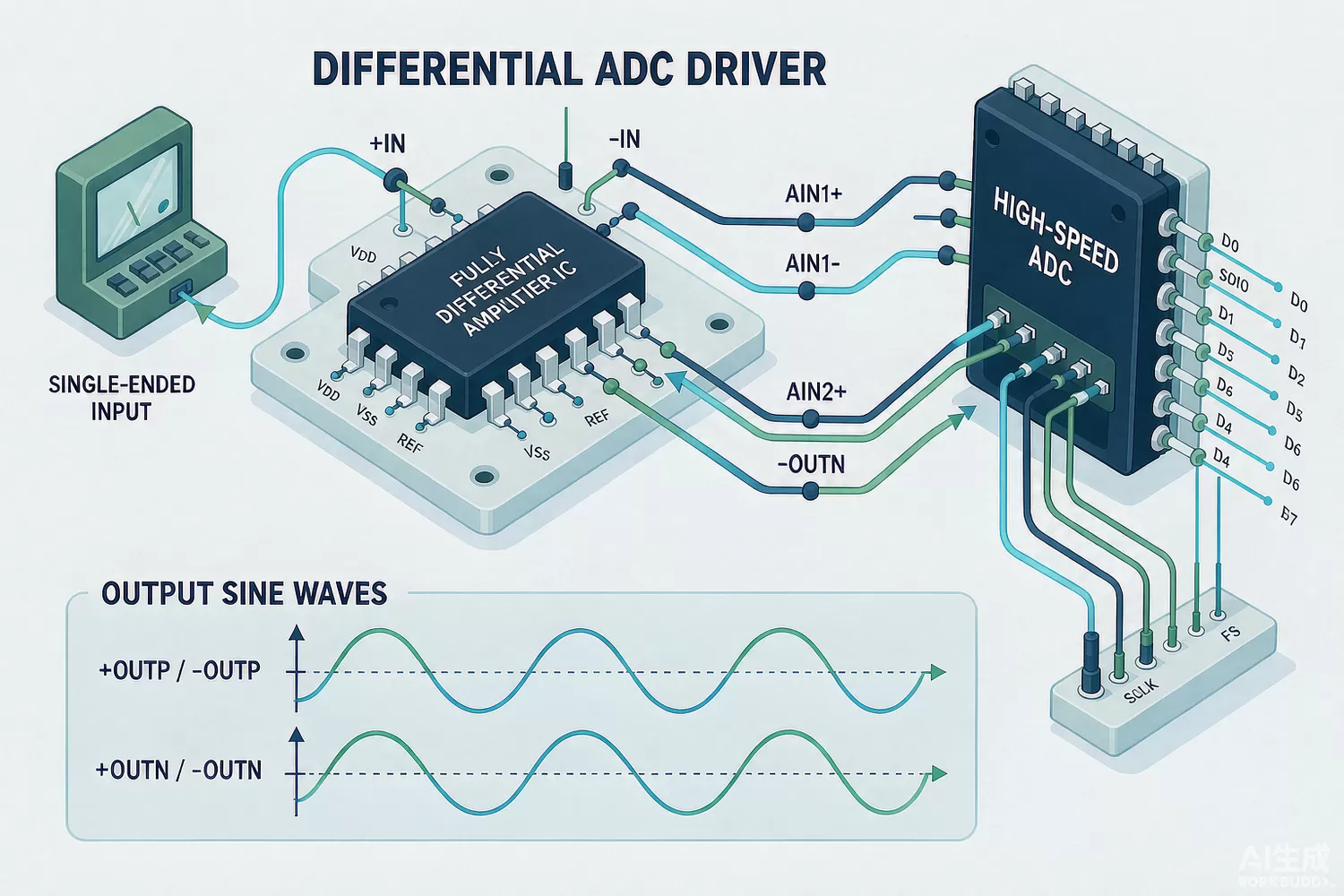
A fully differential amplifier (FDA) takes a single-ended or differential input and delivers two outputs that mirror each other around a common-mode voltage you set. That balanced drive is exactly what high-speed ADC inputs want: even-order distortion cancels, supply-noise coupling appears as common-mode and rejects, and the converter's dynamic range is spent on the signal instead of the offsets. In RF-adjacent signal chains — IF sampling receivers, software-defined radio front ends, impedance analysers, oscilloscope front ends — the FDA sits directly in front of the converter and quietly sets the distortion floor.

Application logic: when to drive an ADC with an FDA
The decision tree starts with the converter. A differential-input ADC at 10 MSPS and above rewards an FDA: the amplifier's output common-mode pin ties straight to the converter's reference, cancelling the common-mode charge kickback that would otherwise corrupt every conversion. Below a few megahertz, precision single-ended chains may prefer a conventional op amp plus a transformer. Where bandwidth exceeds what an amplifier gives, a passive balun drives the converter — zero noise, zero distortion contribution, but no gain, no DC coupling and no common-mode control. So: DC-coupled differential drive with gain and filtering — FDA; AC-coupled narrowband — balun; single-ended low rate — ordinary op amp. The RF-sampling converter tier behind this choice is covered in our RF-sampling ADC/DAC article.
Gain and filtering integrate neatly: four resistors set both the gain and the feedback, and diff-amp-style designs let the FDA implement a low-pass or band-pass response while it balances the outputs. That integration is why board area around modern converters shrinks even as performance climbs.
Datasheet parameters that decide success
- Bandwidth and slew rate at your gain — the loop must stay flat across the ADC's sampled band or intermodulation appears at the edges.
- Distortion (HD2/HD3 or SFDR) at your frequency and output swing; balanced operation suppresses HD2, so HD3 usually sets the floor.
- Input and output common-mode range, and the VOCM pin's control range against your converter's reference voltage.
- Input voltage and current noise, referred to the source impedance, plus resistor thermal noise — FDA noise design is a four-resistor exercise.
- Stability with the feedback network and any capacitive load; some FDAs specify minimum feedback resistors for stability.
- Output impedance and settle time against the ADC's charge kickback profile.
New technology in differential drive
Current generation trends: higher speed at lower power, with new generations holding gigahertz-class bandwidth at tens of milliwatts so portable SDR designs can afford balanced drive; integrated filters and match, where some devices fold a fixed-gain, pre-compensated network on chip to drive specific converter families; and process migration from bipolar SiGe toward CMOS-derived amplifier cores that integrate better with the digital domain — each trading a little noise for integration and cost. At the same time, transformer-coupled drive keeps evolving in the data-converter world because passive parts refuse to add noise; the choice between the two is system-level, not fashion.
Domestic alternatives: families and indicative cost
Domestic analogue vendors now document high-speed amplifier capability, though differential-specific catalogue depth is still growing. 3PEAK (3PEAK) publishes high-speed amplifier families with fully-differential-capable parts and documents the diff-drive use cases; SG Micro (SGMICRO) documents high-speed and high-precision amplifier families that cover the lower-speed end of differential drive. At family level, both are credible candidates for the 10–200 MHz band that most industrial IF chains live in. For the precision, lower-speed tier, our stock carries working domestic examples: the COS2387SRA zero-drift amplifier and the COS2172SRB 40 V rail-to-rail amplifier show the domestic amplifier supply chain in action, and a converter such as the ADC0832CCN marks the low-speed end where a single-ended drive still suffices.
Price figures below are indicative public-market reference ranges for moderate volumes, compiled from publicly observable listings. They fluctuate with the spot market, package option, grade (industrial, automotive, screened) and order quantity, and must not be read as a quotation. Ask us for a firm price on your exact part numbers and quantities.
| Function (imported anchor) | Example import part / class | Indicative import price (USD) | Domestic candidate | Indicative domestic price (USD) |
|---|---|---|---|---|
| High-speed FDA driving a 16-bit ADC, 100-300 MHz band | AD8138 / THS4521-class parts | 2.50 – 8.00 | 3PEAK high-speed amplifier family (family level) | 0.80 – 3.00 |
| Wideband FDA for SDR IF chains | ADA49xx / LMH54xx-class | 5.00 – 15.00 | Domestic high-speed amplifier families (family level) | 2.00 – 6.00 |
| Precision low-speed differential drive | OPA1632-class precision FDAs | 1.50 – 4.00 | COS2387SRA + discrete balance network | 0.30 – 1.00 |
| General high-voltage op amp in the same chain | COS2172SRB (COSINE, in stock) | 0.30 – 0.90 | Same part as domestic supply | 0.20 – 0.60 |
| MCU/DSP processing the converter output | STM32H743VIT6 | 5.00 – 10.00 | GD32F303CBT6-class parts | 1.00 – 2.50 |
The practical gap: domestic FDA-specific distortion data at high input frequencies is still sparser in public documentation than the import anchors' application notes. Where your distortion budget is tight, run the two parts head-to-head on your converter evaluation board before committing the layout.
Validation flow
Drop the candidate into the converter evaluation board, keep the four feedback resistors per the stability rules, and sweep a single tone across band while recording SFDR; then run a two-tone intermodulation test at your real IF. Verify the VOCM interaction with the converter reference by measuring offset and output swing at both code extremes. Compare against the balun-driven option on the same board — the passive path often surprises at the noise end. For the converter side, see the RF-sampling converter article; for the precision control loops behind an IF chain, the zero-drift amplifier article.
Frequently asked questions
Can I drive a differential ADC straight from a single-ended source?
Only if the converter tolerates the common-mode transient; most high-speed differential inputs misbehave. An FDA (or a balun) performs the conversion properly and cancels even-order distortion on the way.
FDA or balun for a narrowband IF chain?
Baluns add no noise and no distortion, but no gain and no DC coupling. If your IF is narrow, AC-coupled and you can afford the insertion loss, the balun wins on pure performance; an FDA wins when DC coupling, gain and filtering matter.
Why does my FDA circuit oscillate at high frequency?
Usually feedback resistors below the datasheet minimum, capacitive load on the outputs, or a VOCM pin left un-bypassed. Follow the stability rules in the datasheet and keep the output traces short.
Do domestic amplifiers reach import FDA performance?
At the 10-200 MHz industrial band, documented high-speed families from 3PEAK and SG Micro are credible candidates. Above that, request measured distortion data and qualify on your own converter board.
About us & trademarks: JTDZ Tech (Shenzhen Jingteng Electronics Technology Co., Ltd.) is an independent distributor of electronic components. We are not an authorised distributor or representative of the imported manufacturers named in this article. Manufacturer, brand and part names are used for identification purposes only; all trademarks remain the property of their respective owners. Cross-reference information in this article is based on publicly available sources, is subject to change, and is not a substitute for your own engineering validation. Always verify specifications against the manufacturer's datasheet before design-in or purchase.
