
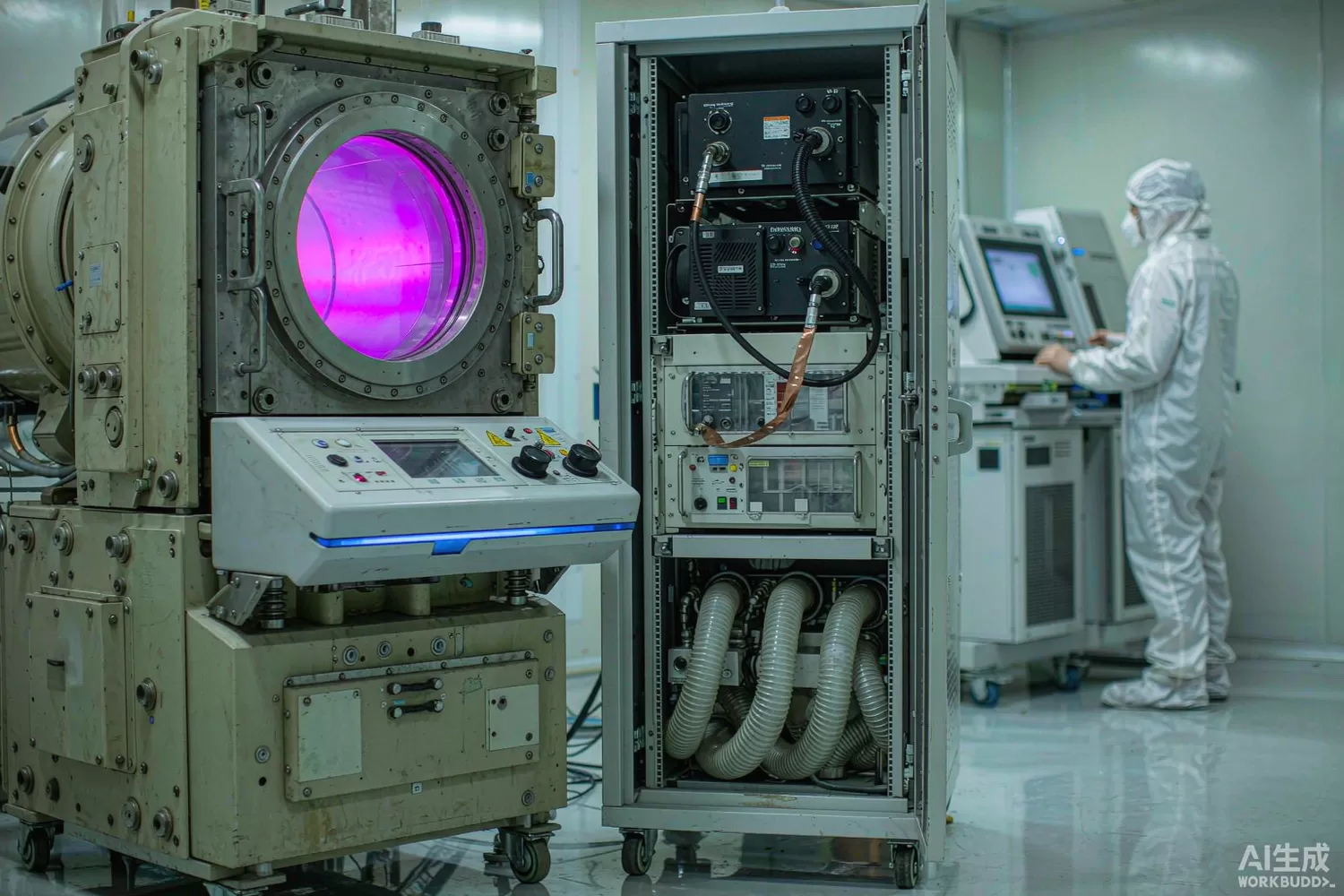
Every thin film deposited on a semiconductor wafer, every etch step, every sputtered coating on a piece of glass passed through a chamber where a radio transmitter at 13.56 MHz turned a gas into a plasma. That transmitter is not a communications device. It is an industrial power converter with a very narrow specification: deliver a kilowatt into a load whose impedance changes on a millisecond timescale, keep the reflected power near zero, and shut down safely when the plasma extinguishes. The generator and the matching network are the least discussed and most consequential part of the deposition tool. This article explains how they work, what the newest processes demand, and where domestic suppliers can now compete. For the discrete power stage that drives the amplifier, see our wide-bandgap power device article.

Application logic: a transmitter driving an unknown load
- The load is a plasma, not a resistor — an ignited plasma looks like a few ohms in series with a reactive element, and its impedance moves with pressure, gas chemistry and power. An extinguished chamber looks like an open circuit. The generator must survive both.
- Why 13.56 MHz — an industrial, scientific and medical allocation, low enough that the matching network can be built from lumped components and vacuum capacitors, high enough that the discharge sustains at reasonable voltage. Other allowed frequencies are used where the process demands them.
- The power stage — a class-E or class-D amplifier built from RF MOSFETs, driven by a gate driver with controlled dead time, fed through a combiner when the power exceeds a single device. Efficiency above 85 percent is normal; anything less becomes a cooling problem inside a tool cabinet.
- The matching network — two or three variable elements, typically vacuum capacitors driven by stepper motors, controlled by an algorithm that seeks minimum reflected power. Matching speed after ignition is a process parameter: too slow and the plasma collapses or the wafer is scraped.
- Reflected-power protection — a directional coupler measures forward and reflected power; the control loop folds back the drive within microseconds when the reflection exceeds a threshold. This protection is what keeps a generator alive through arcs.
- Arc handling — a micro-arcing event looks like a fast impedance collapse. Detection has to be faster than the energy that would damage the target, which means a hardware path, not a firmware one.
- Pulsed operation — atomic-layer processes switch the plasma on and off in bursts of tens of microseconds. That turns the generator into a pulsed power supply and puts the matching network under a duty cycle it was never designed for.
- The control interface — a tool host expects a deterministic interface with status, setpoint and fault codes. Losing that interface stops a tool worth millions, so the control electronics are held to an availability standard rather than a convenience standard.
The parameters that decide whether the process is stable
- Efficiency across the power range — a generator that is 88 percent efficient at full power and 60 percent at ten percent wastes more heat at low power, where many processes actually run. The efficiency curve, not the headline number, defines the cabinet.
- Power control accuracy and repeatability — a one percent error in delivered power becomes a film thickness error. The measurement chain, including the coupler’s directivity, sets the accuracy, and directivity degrades with connector wear.
- Matching speed and stability — the network must converge within a few milliseconds after ignition and must not hunt around the optimum. A hunting match modulates the plasma, which shows up as a defect signature on the wafer.
- Harmonic and spurious content — the chamber is a broadband load and the generator is a switching amplifier, so harmonic filters are mandatory. Excessive harmonics also disturb the sensors on the tool.
- Thermal design — the power devices are on a heatsink that is often water-cooled and often at a temperature the datasheet does not assume. Junction temperature margin is what separates a five-year generator from a two-year one.
- Arc energy per event — the specification that matters is the energy delivered before shutdown. It is determined by the detection bandwidth and the energy stored in the output network, which is why a fast detector cannot compensate for a large output capacitance.
- Repeatability across units — a fab qualifies a process on one tool and expects the second tool to behave identically. Unit-to-unit variation in the coupler and the match is a production problem disguised as an RF problem.
What is changing: wide-bandgap devices, digital control and pulsed processes
Three shifts are visible. First, wide-bandgap power devices: silicon carbide and gallium nitride transistors switch faster and lose less, which raises efficiency and shrinks the output network — and, importantly for arc handling, reduces the stored energy that has to be dumped during a fault. Second, digital control: the matching algorithm, the protection loop and the power regulation have moved from analog servos into a microcontroller or an FPGA, which makes the behaviour tunable per process recipe and lets a tool host log exactly what happened during an arc. Third, pulsed RF: atomic-layer deposition and etch have pushed the generator into microsecond-scale bursts, and that has exposed how poorly classical matching networks behave when the load changes faster than the motors can move; the answer has been a combination of faster electronics, preset match positions per recipe step and, in some tools, solid-state matching.
A fourth shift is supply chain. Fabs and equipment makers now ask for a second source for the generator itself, not just for the components inside it, and that has opened the door for domestic suppliers who can demonstrate power accuracy, arc performance and a service organisation within the region.
Domestic alternatives: suppliers and indicative cost
The domestic picture is stronger at system level than at device level. Chinese manufacturers of RF generators and matching networks supply the photovoltaic, coating and, increasingly, semiconductor equipment markets, and their published product ranges now cover the kilowatt class at 13.56 MHz. At component level, RF power MOSFETs, gate drivers, temperature-compensated attenuators and control microcontrollers all have domestic options; the specialised high-power RF LDMOS and the precision directional couplers remain import-dominated.
A representative control and drive chain: a PD84008-E RF power MOSFET as a driver or a lower-power stage reference, a COS4422DT gate driver for the hard-switched output stage, a TVA0500N03W3 temperature-variable attenuator to keep the drive level flat across the cabinet's temperature range, an AT32F425C8T7 for the control loop, protection sequencing and tool interface, a COS8551TRC for the coupler's detector conditioning, and a HX2001 for the housekeeping rail. Our watt-class driver amplifier article covers the stage that sits in front of the output devices.
Price figures below are indicative public-market reference ranges for moderate volumes, compiled from publicly observable listings. They fluctuate with the spot market, package option, grade (industrial, automotive, screened) and order quantity, and must not be read as a quotation. Ask us for a firm price on your exact part numbers and quantities.
| Function (imported anchor) | Example import part / class | Indicative import price (USD) | Domestic candidate | Indicative domestic price (USD) |
|---|---|---|---|---|
| 13.56 MHz generator, 1 kW class | Imported generator class (MKS, AE, Comdel) | 4,000 – 12,000 | Domestic generator makers (Compart, Yingjie Electric class, system level) | 1,500 – 5,000 |
| Automatic matching network, 1 kW class | Imported match class | 2,500 – 7,000 | Domestic match suppliers (system level) | 900 – 3,000 |
| RF power MOSFET, driver stage | ST PD84008 class | 3.0 – 8.0 | PD84008-E (in stock, imported) | 3.0 – 8.0 |
| High-current gate driver | TI TC4422 class | 1.0 – 2.5 | COS4422DT (Cosine) | 0.20 – 0.55 |
| Temperature-variable attenuator | EMC Technology thermopad class | 4.0 – 9.0 | TVA0500N03W3 (in stock, imported) | 4.0 – 9.0 |
| Control and protection MCU | STM32F4-class Cortex-M4 | 2.0 – 4.5 | AT32F425C8T7 (Artery) | 0.50 – 1.30 |
| Zero-drift detector amplifier | ADI AD8551 class | 0.90 – 2.20 | COS8551TRC (Cosine) | 0.15 – 0.40 |
| Ultra-low quiescent LDO | Imported 1 uA-class LDO | 0.15 – 0.40 | HX2001 (Hexin) | 0.03 – 0.12 |
Where the cost difference actually comes from
In this category the interesting comparison is at system level, not component level. A generator is mostly magnetics, heatsink, capacitors and assembly labour, so the silicon inside it is a small fraction of the price; the difference between an imported and a domestic generator comes from engineering overhead, service network and brand risk premium rather than from parts. That is why a domestic generator can be half the price and still be profitable — and why the buying decision hinges on demonstrated performance in a real chamber rather than on a bill of materials.
For a tool builder the risk-adjusted calculation is different from the purchase price. A generator that fails in a fab costs far more in downtime than it ever saved, so the qualification package — power accuracy over the full range, arc energy, MTBF data, spare parts availability — is what actually gets evaluated. Domestic suppliers who have invested in that package are now winning business; those who have only a price are not.
Validation flow before you commit
Test into a real load, not a dummy resistor: a dummy gives you efficiency data but tells you nothing about matching dynamics. Ignite a plasma in a test chamber and record the time from ignition to a match better than the specification, then repeat fifty times and look at the spread, not the average. Deliberately create arcs and measure the energy delivered before fold-back, using a current probe and a fast digitiser. Run the generator at ten percent power for an hour and measure the heatsink and device temperatures, because that is where the efficiency curve bites. Finally, run two units side by side on the same recipe and compare delivered power and film results — repeatability across units is the specification a process engineer will judge you on.
Frequently asked questions
Is a plasma generator just a high-power amplifier?
Electrically, largely yes, but the specification is different: it must survive an open circuit, match a load that moves in milliseconds, and limit arc energy. Those requirements drive the design far more than gain or bandwidth.
Why does matching speed matter so much?
Because the plasma is unstable until the match converges. A slow match means the discharge collapses or the wafer sees a different power than intended, which becomes a process defect rather than an electrical one.
Can a domestic generator be qualified for semiconductor tools?
Yes, and several already are, but qualification is a package — accuracy, arc performance, MTBF, service — rather than a single measurement. Budget for the evidence, not just for the hardware.
Does higher efficiency matter more than lower price?
In a fab, yes. Waste heat has to be removed from a cabinet inside a cleanroom, so every percent of efficiency is a cooling and reliability cost that recurs for the life of the tool.
About us & trademarks: JTDZ Tech (Shenzhen Jingteng Electronics Technology Co., Ltd.) is an independent distributor of electronic components. We are not an authorised distributor or representative of the imported manufacturers named in this article. Manufacturer, brand and part names are used for identification purposes only; all trademarks remain the property of their respective owners. Cross-reference information in this article is based on publicly available sources, is subject to change, and is not a substitute for your own engineering validation. Always verify specifications against the manufacturer's datasheet before design-in or purchase.
