
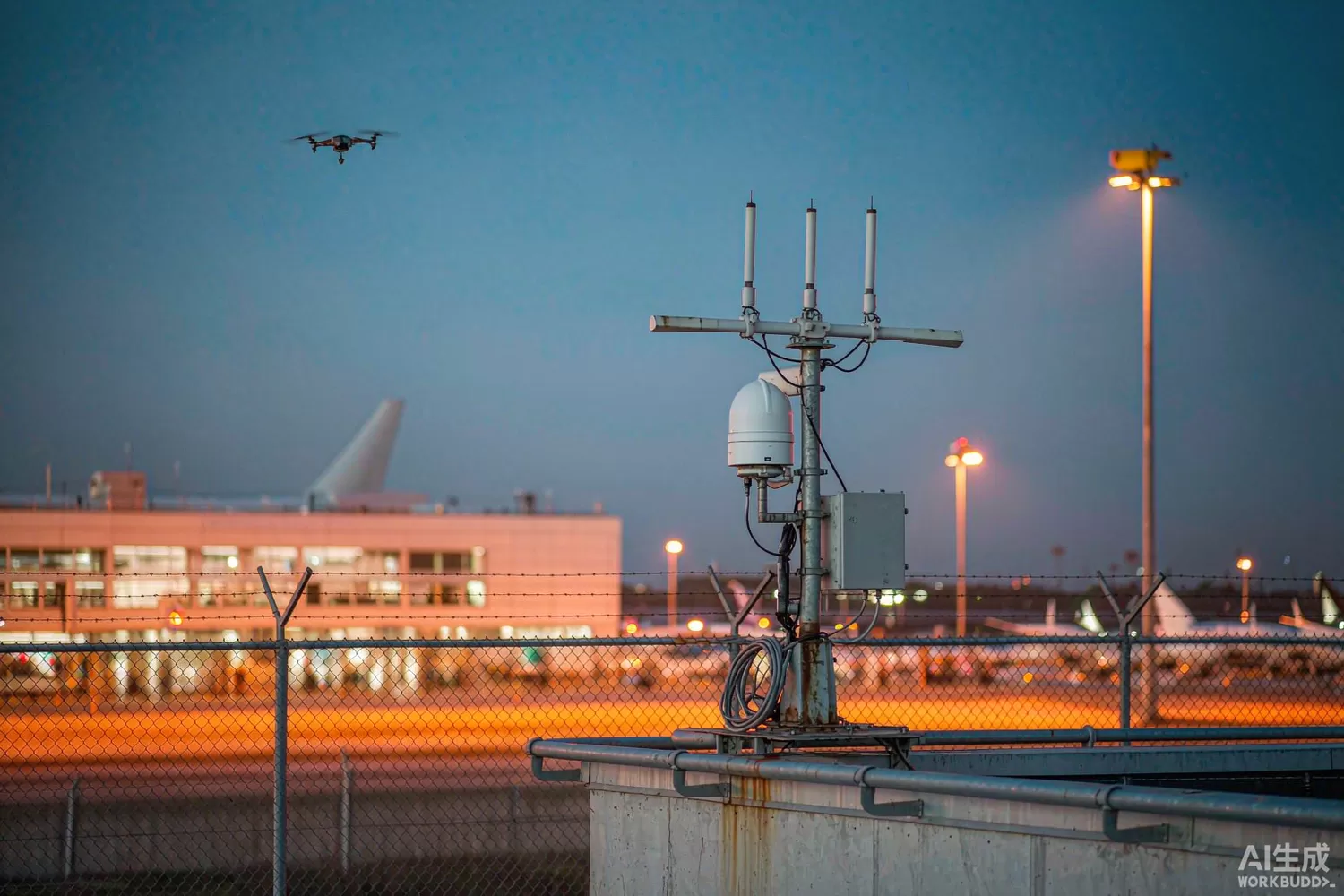
A drone crossing a perimeter fence at eighty metres is invisible to the eye, inaudible over a motorway, and too small for many radars to separate from a bird. Its radio link, however, is loud: a control channel hopping in the 2.4 GHz band, a video downlink at 5.8 GHz, and a GNSS receiver quietly listening. That asymmetry — a small physical target with a large electromagnetic signature — is the whole basis of RF-based drone detection, and it is why an RF sensor is usually the first layer of a counter-UAS installation. This article describes the receive architecture, the dynamic-range problems that decide whether the sensor works in the real world, the signature recognition that separates a drone from a Wi-Fi access point, and the domestic parts that can carry the design. For the antenna-port protection in front of such a receiver, see our limiter diode article.

Application logic: you are looking for behaviour, not for a signal
- The survey receiver — a wideband front end from roughly 70 MHz to 6 GHz, swept or channelised, measuring the energy in each band and looking for emissions that do not belong to the local environment.
- Why behaviour matters — a 2.4 GHz signal alone means nothing; the site is full of Wi-Fi. What identifies a drone is the pattern: a frequency-hopping control link with a characteristic dwell time, a wideband OFDM video downlink, or a burst structure that matches a known airframe family.
- Dynamic range is the hard part — the sensor is typically mounted on a mast a few metres from its own Wi-Fi access points and a cellular small cell. Those signals can be 60 decibels stronger than the drone link at two kilometres, and the receiver has to see both without blocking.
- Direction finding — a single sensor gives detection; two or more give a bearing and a position. Amplitude comparison across a switched antenna array is the inexpensive method, phase comparison is the accurate one, and both depend on calibration.
- Classification — a library of signatures plus a statistical model. The library has to be updated as airframes change, which makes the sensor a product with a maintenance contract rather than a box.
- Integration — RF detection, radar and electro-optics are fused at the command layer. RF gives the earliest warning and the widest field of regard; radar gives range; optics gives identification. Any one alone produces false alarms at a rate operators will not tolerate.
- False alarm economics — a site that generates ten nuisance alerts a night stops responding within a week. Tuning for a low false-alarm rate, at the cost of some detection probability, is usually the right engineering trade.
The parameters that decide whether the sensor is usable on a real site
- Instantaneous dynamic range and blocking — the specification that matters is not sensitivity but the level of the strongest nearby signal at which the weakest interesting signal is still detectable. That is set by the front-end intercept point, the pre-selection filtering and the converter’s linearity together.
- Preselection — a sub-octave filter bank in front of the first amplifier is what makes a wideband receiver survive a co-located transmitter. Without it, the receiver hears the site, not the sky.
- Scan speed and revisit time — a hopping control link dwells for a few milliseconds per channel. A receiver that takes a second to sweep the band will sample that link by luck rather than by design.
- Attenuator range and switching speed — step attenuators that switch in microseconds let the receiver follow a changing environment without losing the small signal. Their own switching transients, however, must not create false detections.
- Phase stability for direction finding — the cables, the switch and the array must hold their relative phase across temperature. A receiver that is stable on a bench and drifts on a mast produces bearings that wander.
- Thermal and weather — a mast-mounted enclosure in summer sun reaches well above ambient, and the receiver’s gain and noise figure move with it. Enclosure design is part of the RF specification.
- Size, weight and power — a mast site may offer power over Ethernet and nothing else. A receiver that needs fifty watts forces a power budget onto the whole installation.
What is changing: channelised receivers, learned signatures and low-altitude infrastructure
Three shifts are visible. First, channelised receivers: instead of sweeping, a fast converter digitises a wide slice of spectrum at once and a processor performs hundreds of narrowband transforms in parallel. That makes hop-pattern detection reliable rather than probabilistic, and it moves the engineering difficulty from analog to digital. Second, learned signatures: classifiers trained on real captures now separate airframe families and even firmware versions by their emission behaviour, and the models improve with every deployment. That changes the product into a subscription with a signature feed, which is a business-model shift as much as a technical one. Third, low-altitude infrastructure: with drone traffic becoming regulated and routine, the same receivers are being asked to serve both detection and cooperative monitoring, which means a sensor that must hear a hostile emitter and a friendly transponder in the same band.
A fourth change is regulatory and it cuts both ways: transmitting a jamming signal is heavily restricted in most jurisdictions, so the RF layer is increasingly asked to detect, classify and locate while the countermeasure is left to other layers. That puts a premium on direction-finding accuracy rather than on transmit capability.
Domestic alternatives: suppliers and indicative cost
Domestic supply divides cleanly. At system level, Chinese suppliers of spectrum monitoring and low-altitude surveillance equipment are competitive and already supply integrated counter-UAS installations. At component level, the broadband low-noise amplifiers, step attenuators and switches with published performance to 6 GHz are still largely imported, while general-purpose gain blocks, filters, comparators, microcontrollers and power devices have domestic options. Designing with what is available domestically is therefore a matter of architecture: put the imported part where it must be imported, and move everything else.
A reference chain: a PHA-13LN+ as the broadband first stage, a PE43610A or a DAT-31575-SP+ as the step attenuator that keeps the receiver out of compression, a MASWSS0162TR to switch antenna elements for amplitude-comparison direction finding, a LFCG-2600+ as a harmonic and out-of-band suppressor, a SGA5589Z as the second stage behind the attenuator, and an AT32F425C8T7 or an FPGA-class processor for the channelised transform and classifier. A TS2502PN protects the antenna port. Attenuator control and calibration follow the methods in our programmable attenuator article.
Price figures below are indicative public-market reference ranges for moderate volumes, compiled from publicly observable listings. They fluctuate with the spot market, package option, grade (industrial, automotive, screened) and order quantity, and must not be read as a quotation. Ask us for a firm price on your exact part numbers and quantities.
| Function (imported anchor) | Example import part / class | Indicative import price (USD) | Domestic candidate | Indicative domestic price (USD) |
|---|---|---|---|---|
| Broadband low-noise amplifier to 6 GHz | Mini-Circuits PHA-13LN+ class | 12.0 – 25.0 | PHA-13LN+ (in stock, imported) | 12.0 – 25.0 |
| Digital step attenuator, 6 GHz | pSemi PE43610 class | 6.0 – 14.0 | PE43610A (in stock, imported) | 6.0 – 14.0 |
| RF switch for antenna selection | Macom MASWSS0162 class | 1.5 – 4.0 | MASWSS0162TR (in stock, imported) | 1.5 – 4.0 |
| Gain block for the second stage | Qorvo SGA5589Z class | 1.2 – 2.5 | Domestic gain block families (family level) | 0.35 – 0.90 |
| LTCC low-pass filter | Mini-Circuits LFCG class | 1.5 – 3.5 | LFCG-2600+ (in stock, imported) | 1.5 – 3.5 |
| Wideband ADC, 500 MSPS class | Imported high-speed ADC class | 30.0 – 120.0 | Domestic high-speed ADC families (family level) | 12.0 – 45.0 |
| Control and classification MCU | STM32F4-class Cortex-M4 | 2.0 – 4.5 | AT32F425C8T7 (Artery) | 0.50 – 1.30 |
| Antenna-port ESD protection | Imported TVS array | 0.15 – 0.45 | TS2502PN (Titan Micro) | 0.03 – 0.12 |
Where the cost difference actually comes from
A counter-UAS RF sensor is a small part of an installation whose cost is dominated by masts, cabling, power, civil works and the command-and-control software. The receiver can be built for a few hundred dollars in parts and sold for a great deal more, because what the customer is buying is detection probability, a low false-alarm rate and a signature library that stays current. Component cost reduction therefore does not move the price much — but it does move the number of sensors per site, and more sensors means better direction finding and better coverage, which is the actual performance lever.
The place where domestic parts genuinely change the economics is the distributed sensor node: a low-cost, mast-mounted unit with a wideband front end and an edge processor, deployed by the dozen around a perimeter. Halving the node cost doubles the achievable density, and density beats sensitivity in a direction-finding network.
Validation flow before you commit
Do not validate with a signal generator on a bench. Set a stepped attenuator in front of the receiver and sweep a small test signal across the band while a strong local transmitter is present at a realistic level — that gives you the blocking curve, which is the only meaningful sensitivity specification for this application. Then emit a hopping pattern that mimics a real control link and measure the probability of intercept against dwell time and scan speed. Mount two sensors on a roof, put a cooperative transmitter at a known bearing, and record the bearing error across a day and a night to see the thermal drift. Finally, run a week of unattended capture on a real site and count the false positives the classifier produces, because that number decides whether an operator will keep the system switched on.
Frequently asked questions
Can an RF sensor detect a drone flying autonomously with no radio link?
Only by its other emissions, such as a GNSS receiver's local oscillator leakage or a video downlink. A fully silent autonomous drone must be detected by radar or electro-optics, which is why the layers are fused.
Why is a step attenuator needed if the receiver has automatic gain control?
Because automatic gain control reacts after compression, and by then the small signal is already lost. A fast step attenuator changes the front-end gain before the converter saturates.
How accurate is RF direction finding?
A few degrees with a calibrated phase-comparison array, and considerably worse with amplitude-only comparison. Two bearings from separated sensors typically locate a drone to tens of metres at a kilometre.
Does jamming belong to the same product?
Usually not. Transmitting is heavily restricted in most jurisdictions, so the RF layer is normally specified for detection, classification and localisation, with countermeasures handled separately.
About us & trademarks: JTDZ Tech (Shenzhen Jingteng Electronics Technology Co., Ltd.) is an independent distributor of electronic components. We are not an authorised distributor or representative of the imported manufacturers named in this article. Manufacturer, brand and part names are used for identification purposes only; all trademarks remain the property of their respective owners. Cross-reference information in this article is based on publicly available sources, is subject to change, and is not a substitute for your own engineering validation. Always verify specifications against the manufacturer's datasheet before design-in or purchase.
