
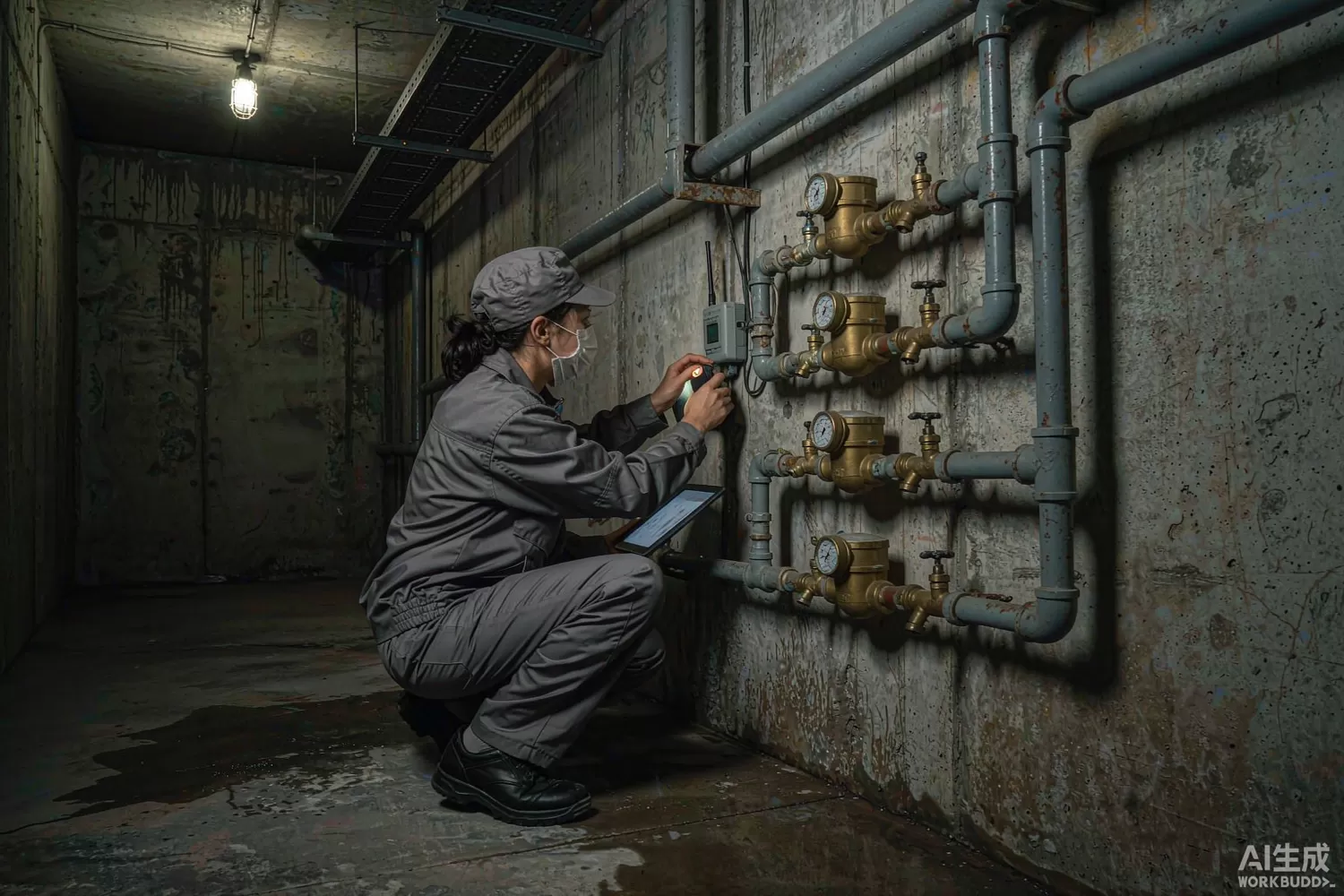
A water meter in a basement, three floors below the street, surrounded by concrete and cast iron, has to deliver a reading once a day for fifteen years from a single lithium cell. There is no installer to reposition the antenna, no mains supply to add a repeater, and no option to ask the customer to move the meter. Utility mesh radio is the discipline that solves that problem, and it is one of the few RF categories where the constraints are dominated by physics and economics rather than by bandwidth. This article covers the two dominant approaches — the standards-based mesh used for large water and gas rollouts, and the simpler framing used for smaller installations — and the domestic transceivers that can carry them. For the metering-adjacent power-line approach, see our dual-mode AMI article.

Application logic: the link exists to survive, not to be fast
- The real requirement — one reading per meter per day, plus alarms for leakage, tamper and reverse flow. That is a few dozen bytes per day, which means the radio can spend almost all of its life asleep and still meet the specification.
- Why a mesh — a basement meter cannot reach the concentrator directly. Neighbouring meters and repeaters forward the message, so the network builds its own coverage out of devices that are already installed and already powered.
- Sub-GHz carrier — 868 MHz in Europe, 915 MHz in North America and in many Asian deployments. Lower frequency means better penetration through walls and pits, smaller Doppler, and a regulatory regime that allows a low duty cycle.
- Routing and discovery — the network must form itself, heal when a meter is removed, and avoid the instability that comes from every node trying to be a router. Hop count, parent selection and route maintenance are firmware problems with radio consequences.
- Duty cycle and politeness — listen-before-talk, channel hopping and a randomised back-off keep a dense network from collapsing into collisions. A meter that transmits whenever it has data destroys a neighbourhood.
- Battery budget — fifteen years from a cell means an average current in the low microamps, which forces the receiver to be off almost always. That in turn dictates a scheduled, synchronised wake-up rather than a listening radio.
- Security — billing data and valve commands must be authenticated and encrypted end to end, and keys must survive a firmware update. A meter that can be told to close its valve by anyone with a radio is a liability.
- The concentrator — one per few hundred meters, backhauled by cellular or fibre. Concentrator placement is what actually determines the read rate, and it is decided from a site survey rather than from a datasheet.
The parameters that decide the read rate after five years
- Receiver sensitivity at the data rate used — a meter link at 50 kilobits per second gives up roughly 10 decibels against one at 4.8 kilobits. Choosing the slower rate is often the difference between 98 and 85 percent read success.
- Transmit power and its regulatory ceiling — the duty-cycle limit and the power limit together define the legal energy per hour. Designs that ignore the duty cycle pass the lab and fail the regulator.
- Frequency accuracy over temperature and ageing — a mesh relies on nodes waking at the same moment. A crystal that drifts outside its budget turns a scheduled wake-up into a missed message, and no amount of gain recovers it.
- Adjacent-channel rejection in a pit — a meter pit can contain several meters, a pump and a metal lid. The near-far problem inside one pit is more severe than across the neighbourhood.
- Antenna in a potted enclosure — the meter is typically potted for ingress protection, which detunes any antenna inside it. Efficiency measured in free space is meaningless.
- Firmware and protocol overhead — header compression, fragmentation and route maintenance all cost bytes, and bytes cost energy. A standards-compliant stack can be several times more expensive in energy than a proprietary one, which is the real reason utilities choose between them.
- Long-term availability — a product with a fifteen-year field life cannot change its radio without a new certification. The supplier’s roadmap and end-of-life policy are part of the electrical specification.
What is changing: dual-mode meters, leak analytics and synchronised wake-up
Three shifts are visible. First, dual-mode metering: a mesh link for routine reading plus a cellular or NB-IoT path for alarms and on-demand reads has become the default architecture for large utilities, because it combines the energy efficiency of mesh with the availability of cellular. That pushes the design towards a single board with two radios and a shared antenna strategy, which is a coexistence problem more than a radio-selection problem. Second, leak analytics: meters now sample flow at fine resolution and run a small amount of pattern detection locally, which increases the data rate without increasing the reporting rate. Third, synchronised wake-up: newer low-power radio features let a node listen for a very short window at a scheduled time instead of polling, which is what makes a fifteen-year battery credible with a standards-based stack.
A fourth shift is commercial: several utilities now specify open standards precisely so that they can change meter vendor without changing the concentrator. That is good for competition and hard on firmware teams, because a standards-compliant mesh is significantly more complex than a proprietary star.
Domestic alternatives: suppliers and indicative cost
The domestic supply chain here is mature, because China is one of the largest markets for smart water and gas meters and the transceivers were localised early. HOPERF's CMT series, Panchip's PAN3028 family and a number of 802.15.4-based sub-GHz SoCs from domestic vendors cover the mainstream requirements, and several suppliers offer complete module-level solutions with the mesh stack already ported. The gap is in the certified protocol stack and the interoperability testing, not in the silicon.
A representative meter node: an AT32L021C8T7 as the metering and protocol engine, an HX2001 as the always-on regulator with microamp quiescent current, a GD25Q32CSIG for the reading log and firmware image, a TS2502PN on the pulse-input terminals and the antenna port, and a LM393SR comparator pair for the reed-switch pulse input and the battery threshold. The transceiver itself should come from a domestic family with a published reference design; the always-on rail budget is covered in our standby current article.
Price figures below are indicative public-market reference ranges for moderate volumes, compiled from publicly observable listings. They fluctuate with the spot market, package option, grade (industrial, automotive, screened) and order quantity, and must not be read as a quotation. Ask us for a firm price on your exact part numbers and quantities.
| Function (imported anchor) | Example import part / class | Indicative import price (USD) | Domestic candidate | Indicative domestic price (USD) |
|---|---|---|---|---|
| Sub-GHz mesh transceiver | Silicon Labs EFR32FG class | 3.0 – 6.5 | HOPERF CMT series (family level) | 0.70 – 1.80 |
| Sub-GHz transceiver with integrated PA | TI CC1310 class | 2.5 – 5.0 | Panchip PAN3028 family (family level) | 0.70 – 1.40 |
| 802.15.4 sub-GHz SoC | Imported 802.15.4 sub-GHz class | 3.0 – 6.0 | Domestic 802.15.4 sub-GHz SoC families (family level) | 1.00 – 2.50 |
| Low-power MCU | STM32L0-class | 0.60 – 1.50 | AT32L021C8T7 (Artery) | 0.20 – 0.55 |
| Ultra-low quiescent LDO | Imported 1 uA-class LDO | 0.15 – 0.40 | HX2001 (Hexin) | 0.03 – 0.12 |
| Data log and firmware flash | 32 Mbit serial NOR | 0.35 – 0.80 | GD25Q32CSIG (GigaDevice) | 0.10 – 0.30 |
| Pulse input comparator | Imported dual comparator | 0.12 – 0.35 | LM393SR (Cosine) | 0.03 – 0.10 |
| Terminal and antenna ESD | Imported TVS array | 0.15 – 0.45 | TS2502PN (Titan Micro) | 0.03 – 0.12 |
Where the cost difference actually comes from
A water or gas meter is a mechanical product with electronics inside, so the radio is one line in a bill of materials dominated by the metering element, the housing and the valve. Halving the radio cost moves the meter price by a few percent. What domestic silicon buys in this market is not margin but supply certainty at volume: a utility rollout of two hundred thousand units in eighteen months is a procurement problem before it is an engineering problem, and a domestic transceiver with domestic module support is easier to secure than an imported one on allocation.
The cost that actually matters is the cost per successful reading, which is a function of read rate, truck rolls and concentrator density. A radio that costs a dollar more but delivers three percent more reads on the first attempt usually pays for itself within the first year, because a single manual read costs far more than the whole transceiver.
Validation flow before you commit
Build a pilot in the worst building you can find, not in the laboratory. Measure the read rate per meter over thirty days, with the real stack, the real duty cycle and the real concentrator placement, and log which meters fail and why. Then remove a repeater and confirm that the mesh heals within the specified time, because a network that only works when nothing changes is not a mesh. Measure the average current with a coulomb counter over a full week, including a firmware update and an alarm burst. Finally, run the fifteen-year extrapolation against the cell's derating curve at the highest expected temperature, not at room temperature, because that is where the promise is usually broken.
Frequently asked questions
Why not use a cellular modem in every meter?
Because a cellular modem costs more energy per byte and needs a subscription per device. Mesh is chosen for routine reading, with cellular reserved for alarms, on-demand reads and sites where mesh coverage fails.
Is Wireless M-Bus the same as Wi-SUN?
No. They are different ecosystems: one is a compact European metering framing with simple one-way and two-way modes, the other is a full IPv6-based mesh standard. The choice is usually made by the utility, not by the designer.
How important is the crystal?
It is one of the most under-specified parts of the design. A scheduled wake-up mesh depends on frequency accuracy over temperature and ageing, and a marginal crystal shows up as an intermittent missed message years later.
Can a domestic transceiver pass utility certification?
The silicon can, but the certificate belongs to the product and its stack. Budget for interoperability testing and for the stack port, not just for the part.
About us & trademarks: JTDZ Tech (Shenzhen Jingteng Electronics Technology Co., Ltd.) is an independent distributor of electronic components. We are not an authorised distributor or representative of the imported manufacturers named in this article. Manufacturer, brand and part names are used for identification purposes only; all trademarks remain the property of their respective owners. Cross-reference information in this article is based on publicly available sources, is subject to change, and is not a substitute for your own engineering validation. Always verify specifications against the manufacturer's datasheet before design-in or purchase.
