
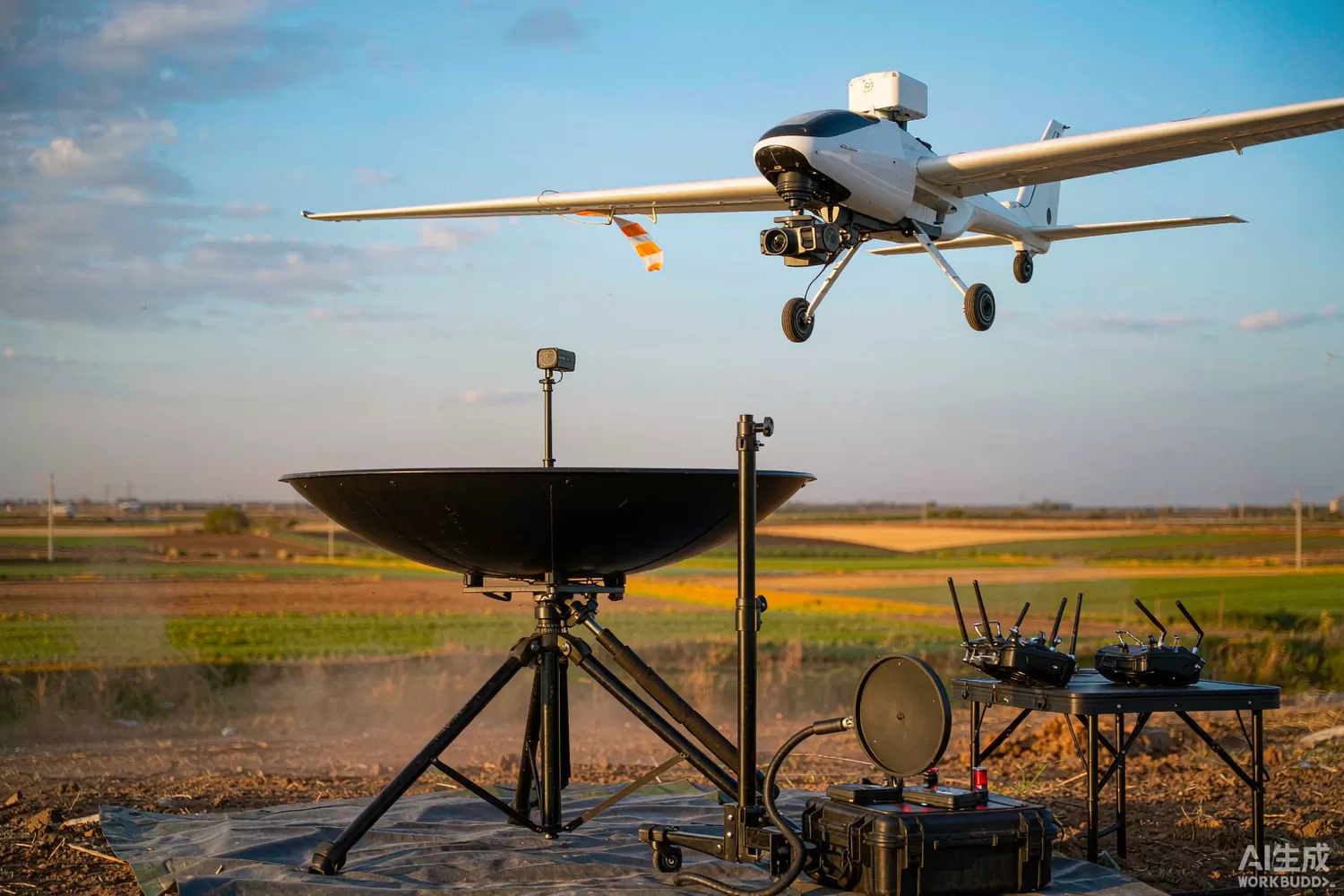
Every commercial drone flight depends on two radios that must not fail: a command-and-control link carrying pilot inputs and telemetry, and a video downlink carrying what the camera sees. Both share spectrum with Wi-Fi, Bluetooth and every other unlicensed user in the area, so the design problem is not raw range — it is graceful behaviour in interference, redundancy, and link margin that survives a banking turn with the antenna pointing the wrong way. This article works through the link budget, the hopping and diversity strategies, the air-unit and ground-unit RF chains, and a component-level domestic build with indicative costs. For the video-link power stage, see our 5.8 GHz ISM power amplifier article.

Application logic: two links, one hostile spectrum
- The C2 link — control and telemetry typically lives at 2.4 GHz (frequency-hopping spread spectrum) or in the 868/915 MHz bands where regulations allow; it is low rate but must be essentially never lost, so it is engineered for robustness rather than throughput.
- The video downlink — digital video at 5.8 GHz (and increasingly dual-band) needs megabits per second, so it uses OFDM with adaptive modulation; it tolerates brief drops but not sustained interference, and its latency budget is tens of milliseconds.
- Frequency hopping — the C2 link hops dozens of times per second across the band, avoiding occupied channels; hopping rate, dwell time and channel-blacklist logic decide how the link degrades in a Wi-Fi-saturated environment.
- Diversity and antenna strategy — two receive chains with separated antennas turn deep fades from a lost frame into a routine event; on the ground unit, a tracking or switched-patch antenna buys the decibels that extend range.
- Link budget discipline — transmit power is capped by regulation, so range comes from receive sensitivity, antenna gain and noise management; every decibel of front-end loss is metres of range.
- Coexistence engineering — the air unit carries GPS, Wi-Fi, Bluetooth and the C2/video radios centimetres apart; filtering, shielding and scheduling (listen-before-talk, time slicing) keep them from deafening each other.
- Redundancy and failsafe — professional systems carry a second C2 path (cellular or satellite IoT) and a defined failsafe; the RF architecture must support graceful degradation, not binary loss.
- Regulatory features — remote identification, power limits, duty-cycle rules and regional band plans shape the radio design as much as physics; a link designed for one market must be re-planned, not just re-tuned, for another.
The parameters that decide whether the link survives
- Receive sensitivity at the operating data rate — quoted sensitivities assume clean channels; in interference, the adjacent-channel rejection and blocking behaviour matter more than the headline number.
- Front-end noise figure and filter loss — the SAW or LTCC filter ahead of the LNA costs insertion loss but buys survival next to the aircraft's own transmitters; the trade is deliberate and measurable in range.
- Hopping agility and blacklist speed — how fast the C2 link detects a jammed channel and moves decides whether interference is an inconvenience or an abort.
- Adaptive modulation behaviour — the video link must drop modulation order smoothly as the aircraft recedes, with artefacts rather than freezes; the AGC and scheduling logic is the product experience.
- Diversity switching speed — combining or switching between antennas must happen within the guard interval; slow diversity is decoration.
- Power amplifier linearity at 5.8 GHz — OFDM needs back-off or correction; a compressing amplifier raises error-vector magnitude and collapses the adaptive link earlier than necessary.
- Harmonic and spurious emissions — the 2.4 GHz and 5.8 GHz transmitters must not desensitise the aircraft GNSS receiver; filtering and layout discipline protect the navigation fix.
- Power budget — every milliwatt on the air unit is flight time; the radio chain is designed against a strict energy budget, which favours efficient amplifiers and sleep-timed receivers.
What is changing: multi-band autonomy, meshed links and detection-aware design
Three shifts define current link design. First, multi-band radios: professional platforms increasingly carry 2.4 and 5.8 GHz (plus 900 MHz and cellular) in one RF architecture, switching bands per environment; that multiplies the filter, switch and PA content per aircraft. Second, relayed and meshed video: multiple aircraft or ground nodes relay video, which adds receive-while-transmit requirements and pushes toward full-duplex-capable front ends. Third, interference-aware operation: as counter-UAS systems and dense unlicensed use spread, links are designed to detect, characterise and route around interference, and regulators in several markets are formalising C2 reliability requirements for beyond-visual-line-of-sight operations. Component demand concentrates in dual-band front-end modules, high-linearity PAs, fast switches, SAW/LTCC filtering and low-power control — categories where domestic supply is strong and deepening.
Domestic alternatives: suppliers and indicative cost
At system level, domestic drone and datalink makers dominate large segments of the global market and build their own RF chains. At component level: Wi-Fi and sub-GHz SoCs, front-end modules, gain blocks, SAW and LTCC filters, switches, digital attenuators, low-power microcontrollers and regulators all have strong domestic families; the highest-linearity 5.8 GHz PA die and premium front-end modules remain areas where imported parts still hold reference-design status in some builds.
A realistic domestic-leaning air-unit chain: a TA0224A SAW filter defining the 2.4 GHz C2 receive passband, with a TB0614A on the alternative channel plan; an RFFM8209TR class front-end module as the reference Wi-Fi-band chain, with domestic FEM families on the cost-reduced variant; an SGA5589Z as the video IF or driver gain stage; a SE2595L-R class switch for the diversity antenna paths; a LFCG-2500+ low-pass taming the 5.8 GHz harmonics; a PE4302-52 digital attenuator in the transmit power-control path; an AT32L021C8T7 managing power modes and the link supervision logic; and a HX2001 for the quiet analog rail. The receiver supply-rail design is covered in our low-noise LDO article.
Price figures below are indicative public-market reference ranges for moderate volumes, compiled from publicly observable listings. They fluctuate with the spot market, package option, grade (industrial, automotive, screened) and order quantity, and must not be read as a quotation. Ask us for a firm price on your exact part numbers and quantities.
| Function (imported anchor) | Example import part / class | Indicative import price (USD) | Domestic candidate | Indicative domestic price (USD) |
|---|---|---|---|---|
| 2.4 GHz C2 receive filter | TA0224A SAW class | 0.15 – 0.40 | TA0224A (Tai-Saw, in stock); domestic SAW families (family level) | 0.15 – 0.40 / 0.05 – 0.15 |
| Wi-Fi band front-end module | Qorvo RFFM8209TR class | 1.2 – 2.8 | RFFM8209TR (in stock, imported); domestic FEM families (family level) | 1.2 – 2.8 / 0.4 – 1.2 |
| 5.8 GHz video PA / driver | Imported 5.8 GHz PA die class | 3.0 – 9.0 | Domestic 5.8 GHz PA families (family level, per project) | 1.0 – 4.0 (where qualified) |
| Video gain block / driver | SGA-5589Z class | 1.2 – 2.5 | Domestic gain-block families (family level) | 0.35 – 0.90 |
| Diversity switch | Skyworks SE2595L-R class | 0.8 – 1.8 | SE2595L-R (in stock, imported); domestic switch families (family level) | 0.8 – 1.8 / 0.2 – 0.7 |
| TX power-control attenuator | PE4302-52 class | 1.0 – 2.2 | PE4302-52 (in stock, imported); domestic DSA (family level) | 1.0 – 2.2 / 0.3 – 0.9 |
| Harmonic low-pass filter (5.8 GHz) | Mini-Circuits LFCG-2500+ class | 1.5 – 3.5 | LFCG-2500+ (in stock, imported) | 1.5 – 3.5 |
| Power-management / supervision MCU | STM32 L0 class | 1.0 – 2.5 | AT32L021C8T7 (Artery) | 0.4 – 1.0 |
| Analog rail LDO | Imported low-noise LDO | 0.30 – 0.80 | HX2001 (Hexin) | 0.03 – 0.12 |
Where the cost difference actually comes from
On a consumer drone the radio bill of materials is under a few dollars, but on a professional platform — with dual-band diversity, a 5.8 GHz video chain and a redundant C2 path — the RF content per aircraft reaches tens of dollars and the airframe margin justifies serious qualification. Domestic component supply matters here in an unusual way: the domestic drone industry is the largest in the world, so the domestic component ecosystem is co-designed with the aircraft rather than retrofitted, and lead times are measured in weeks. The imported reference parts still matter at the performance edge (the highest-linearity PAs, the premium FEMs), which is why the practical build is domestic-first with imported reference alternatives held qualified for the flagship models.
Validation flow before you commit
Range-test the reference and domestic builds in the same flight envelope with the same antennas, logging packet loss, hopping statistics and video artefact events against distance and interference conditions — an industrial estate with dense Wi-Fi is a better test than an empty field. Verify coexistence on the aircraft: GNSS fix quality with all transmitters active, C2 latency under simultaneous video load, and thermal behaviour at maximum duty. Cycle the failsafe: jam or blacklist channels and confirm graceful degradation and recovery times. Finally, validate the regulatory configurations per target market — power, duty cycle, remote identification and band plan — because a link that fails a market test fails the product. The dual-band filtering strategy is covered in our SAW and BAW filter article.
Frequently asked questions
Why not just raise transmit power to fix range?
Regulatory power caps aside, more transmit power raises interference for everyone and desensitises the aircraft's own receivers; range is bought with sensitivity, antennas and diversity, which is where the design effort pays.
How does the C2 link survive a Wi-Fi-saturated environment?
Fast frequency hopping with channel blacklisting, narrow bandwidth, robust modulation and two receive chains; the goal is graceful degradation, not maximum throughput.
Why keep an imported FEM in the reference build?
The premium front-end modules set the sensitivity and linearity reference; domestic FEMs qualify against it, and holding both qualified protects the product line through allocation cycles.
What is the first domestic substitution to attempt?
Filters, switches, gain blocks and the low-power control chain: they are cheap, bench-verifiable and appear on every aircraft, so the savings and the supply security compound.
About us & trademarks: JTDZ Tech (Shenzhen Jingteng Electronics Technology Co., Ltd.) is an independent distributor of electronic components. We are not an authorised distributor or representative of the imported manufacturers named in this article. Manufacturer, brand and part names are used for identification purposes only; all trademarks remain the property of their respective owners. Cross-reference information in this article is based on publicly available sources, is subject to change, and is not a substitute for your own engineering validation. Always verify specifications against the manufacturer's datasheet before design-in or purchase.
