
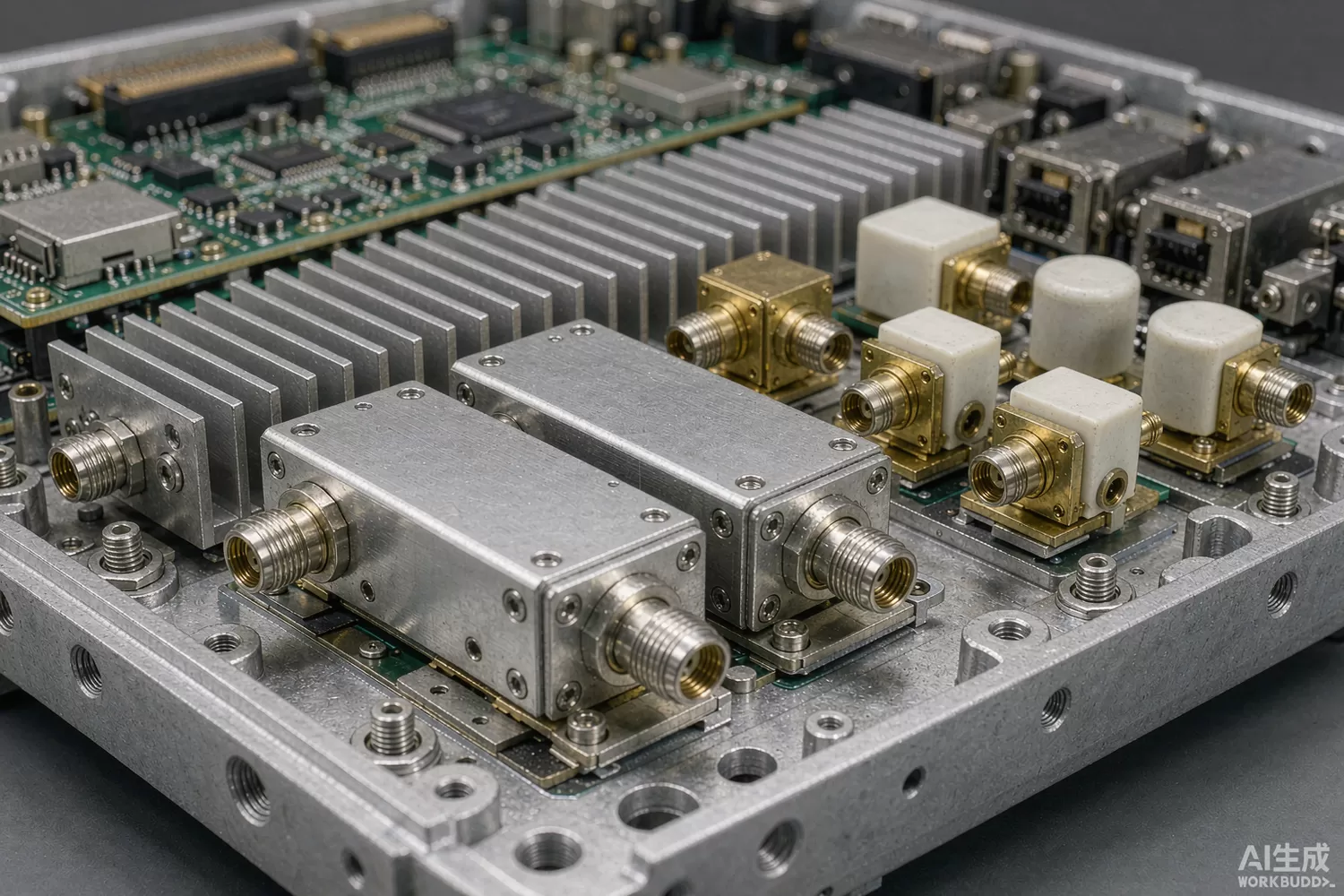
A 5G base station talks to dozens of phones at once in a 200-MHz-wide band while its own 200-watt transmitters roar a few decimetres away on the same panel. The parts that make that possible are filters — not the chip-scale filters of consumer electronics, but cavity resonators and ceramic dielectric blocks the size of a fist, engineered to pass one band, reject the transmitter next door, and survive a decade of sun, ice and vibration on a tower. This article covers the selection logic between filter technologies at base-station scale, the parameters that decide a deployment, the technology shifts that restructured the industry, and the domestic supply chain that now leads it. For the chip-scale end of the filter family, see our SAW/BAW filter article and LTCC filter article.

Application logic: why base stations still need fist-sized filters
The filter requirement at a base station is set by three simultaneous facts. First, the duplexer problem: the transmitter and receiver share an antenna in adjacent bands, so the receiver filter must reject the station's own transmit power by well over 100 dB at a frequency offset of a few tens of megahertz — a steepness that only high-Q resonators deliver. Second, the power problem: transmit-path filters handle hundreds of watts with low loss, because every decibel lost is a watt of PA output and a degree of heat. Third, the intermodulation problem: passive components in the strong-signal path must not generate interference of their own. The technology menu answers with three tiers:
- Cavity filters — machined aluminium or silver-plated resonant cavities; the highest Q and power handling, tunable by screws, and correspondingly bulky. The traditional backbone of macro-site filtering.
- Dielectric (ceramic) filters — temperature-stable ceramic resonator blocks in metal housings; Q approaching cavities at a fraction of the volume, which is what made 64T64R massive-MIMO panels mechanically possible.
- Chip-scale filters (SAW/BAW) — for small cells and CPE where watts and steepness relax; covered in our SAW/BAW article and used here only at the receive small-signal tier.
Massive MIMO then multiplied everything: a 64-transceiver panel needs receive filtering per channel, and multiply that by 64 channels times three sectors times every band — the filter count per site grew roughly an order of magnitude between 4G and 5G. That volume explosion is precisely why the industry re-engineered the filter from machined metal to sintered ceramic.
Parameters that decide a deployment
- Q and skirt steepness — unloaded Q of 1,000–10,000 in cavities and dielectric blocks vs a few hundred for chip filters; steepness is what separates receiver protection from receiver desense.
- Insertion loss at transmit power — 0.3 dB vs 0.5 dB is a heatsink decision at 200 W; measure loss hot, not only at room temperature.
- Passive intermodulation (PIM) — −160 to −170 dBc-class hardware with PIM screening at the factory; a single poor joint in the high-power path desenses a whole sector.
- Temperature drift of the passband — cavity filters drift with expansion, ceramic formulations are engineered for near-zero TCDk; a drift of half a channel width is an outage.
- Power handling and thermal design — hot-spot management inside the filter housing determines long-term PIM stability as much as contact quality.
- Size and mass per channel — the metric that decided the dielectric transition: volume and wind load on the panel translate directly into installation cost.
- Integral vs distributed architecture — filter-in-antenna and filter-integrated panels remove connectors and cables (each a PIM source) at the cost of field replaceability.
- Vibration and environmental qualification — tower hardware lives through decades of wind loading and thermal cycling; screw-tuned cavities detune, bonded ceramic structures do not.
What is new in base-station filtering
Three shifts restructured the category. First, the ceramic transition: dielectric-loaded and fully ceramic resonator filters replaced machined cavities in massive-MIMO volumes, cutting filter volume by 40–70% and making 64-channel panels buildable — the material science story (high-Q, temperature-stable ceramic formulations and their metallisation) is the industry's core competence now. Second, integration into the antenna: filter-in-antenna architectures merge radiating elements, calibration networks and filtering into one laminated or cast structure, removing cable interfaces and their PIM risk; the calibration-network discipline involved is an electrical cousin of the beam-steering chains in our phased-array article. Third, the supply-chain inversion: what was a European and North American component industry in the 4G era became a Chinese-dominated volume industry in 5G, with ceramic formulations and automated tuning/assembly lines as the moat — a genuine, documented case of full-stack domestic leadership rather than a substitution project. Newer work on tunable and reconfigurable filtering targets the multi-band re-farming problem, though deployed volumes remain small.
Domestic alternatives: the supply chain that leads this market
Unusually for this series, the domestic side is not the challenger but the market leader, and the article says so plainly. Canqin Technology (stock code 688182) leads high-Q ceramic dielectric filter materials and filters; Tatfook Technology (300134) and Wuhan Fingu (002194) anchor the volume cavity and ceramic filter supply to the major equipment makers; Dongshan Precision moved into the tier through its filter and structural acquisitions; and Guoren Communications supplies site filtering and amplification systems. Imported players — the filter businesses of the traditional European and American radio vendors — survive mainly inside integrated radio product lines rather than as component suppliers. For a buyer, the practical consequence is straightforward: specify by measurable performance (Q, loss, PIM, drift, environmental qualification), qualify second sources among the domestic leaders for supply security, and treat this category as solved — the engineering attention belongs in the integration and installation disciplines, where field problems actually originate.
Small-signal and bench support parts stay catalogue items: Tai-Saw TA0224A and TB0614A SAW filters for receiver coexistence tiers, a Mini-Circuits HFCN-8400+ for out-of-band reject experiments, a Qorvo SZM-3166Z for lab-scale transmit emulation, and an Artery AT32F403ACGT7 for test-rack sequencing.
Price figures below are indicative public-market reference ranges for moderate volumes, compiled from publicly observable listings. They fluctuate with the spot market, package option, grade (industrial, automotive, screened) and order quantity, and must not be read as a quotation. Ask us for a firm price on your exact part numbers and quantities.
| Function (imported anchor) | Example import part / class | Indicative import price (USD) | Domestic candidate | Indicative domestic price (USD) |
|---|---|---|---|---|
| Cavity bandpass filter, sub-6 GHz, high power | Traditional European cavity classes | 15 – 45 | Tatfook / Wuhan Fingu cavity families (family level) | 4 – 14 |
| Ceramic dielectric filter, n78/n79 class | Import ceramic filter classes (rare standalone) | 10 – 25 | Canqin dielectric filter families (family level) | 2.5 – 8 |
| Filter-in-antenna integrated panel filtering | Integrated radio vendor internal | not standalone | Integrated domestic panel supply (system level) | system pricing |
| Small-cell receive SAW filter | Murata / Tai-Saw SAW classes | 0.25 – 0.9 | Tai-Saw SAW (site stock: TA0224A) | 0.08 – 0.3 |
| Receiver LTCC / high-pass tier | Mini-Circuits LTCC classes | 0.3 – 1.5 | Domestic LTCC families; site stock HFCN-8400+ | 0.1 – 0.5 |
| Lab transmit emulation PA | Qorvo SZM-3166Z class | 20 – 60 | Vanchip / Qorvo PA families | 8 – 30 |
| Test-rack control MCU | STM32F103-class | 1.2 – 3.0 | AT32F403ACGT7 (Artery) | 0.4 – 0.9 |
Read the table as a screening tool, not a quotation. The economics here are structural rather than a substitution discount: the domestic leaders own the ceramic formulations, the volume lines and the qualification history with the major radio OEMs, so the buying decision is about second-source depth, PIM screening discipline and delivery reliability — not about whether domestic supply can perform. For export and private-network projects, the same leaders sell internationally, which makes this the one category in the series where "domestic alternative" is simply "the market".
Validation flow before you commit
Validate filters the way the tower will abuse them. Sweep the full passband and rejection mask across temperature (−40 to +55 °C inside the housing), because drift hides at the edges of the mask, not the centre. Run two-tone PIM tests at contractual power before and after thermal cycling, vibration and — critically — after simulated installation torquing, since most field PIM is installed, not manufactured. Power-soak transmit-path filters at rated watts for hundreds of hours and re-measure loss and PIM; contact degradation is slow and cumulative. For integrated panel architectures, qualify the whole panel including the calibration network, and verify that filter replacement philosophy matches your maintenance model — integration removes connectors and also removes field serviceability, which is a cost trade, not just an electrical one.
Frequently asked questions
Cavity or dielectric filter for my site design?
Cavity for the highest power and steepness where volume allows; dielectric where panel volume, mass and channel count dominate - which is essentially the massive-MIMO case. Chip filters serve only the small-signal receive tier.
Why does PIM matter so much more at 5G sites?
More transmitters per panel and receive antennas adjacent to strong transmit paths multiply intermodulation risk. The whole high-power path - filters, jumpers, connectors - must meet a system PIM budget, screened at the factory and at installation.
Is the domestic filter supply chain proven?
It is the global volume leader with the major radio OEMs as customers. Qualify second sources for supply security and verify PIM and drift data on your own test set; performance is not the open question.
What fails in base-station filters in the field?
Installation-induced PIM and long-term contact degradation dominate; detuning from vibration is rarer with bonded ceramic structures than it was with screw-tuned cavities.
About us & trademarks: JTDZ Tech (Shenzhen Jingteng Electronics Technology Co., Ltd.) is an independent distributor of electronic components. We are not an authorised distributor or representative of the imported manufacturers named in this article. Manufacturer, brand and part names are used for identification purposes only; all trademarks remain the property of their respective owners. Cross-reference information in this article is based on publicly available sources, is subject to change, and is not a substitute for your own engineering validation. Always verify specifications against the manufacturer's datasheet before design-in or purchase.
