
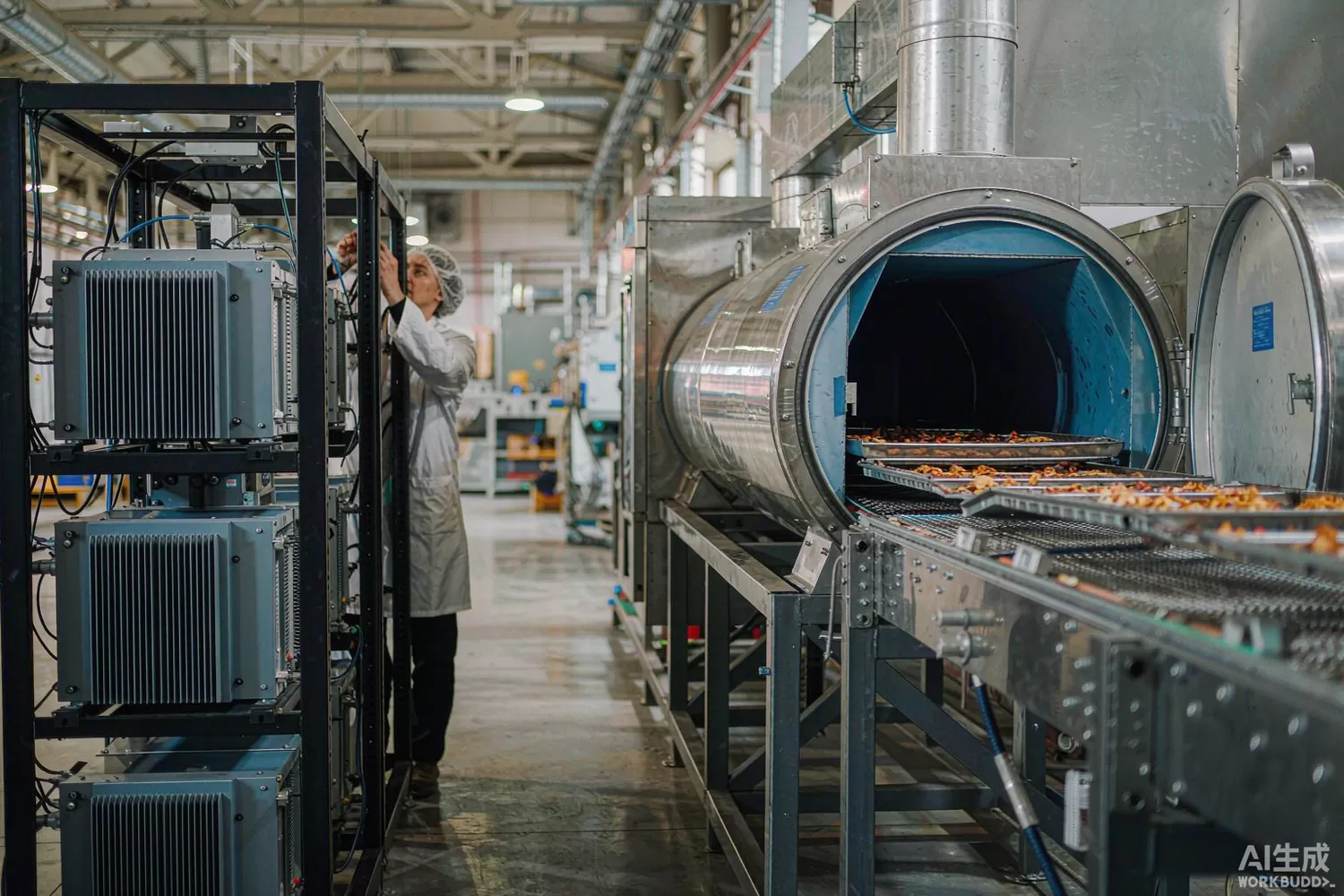
The microwave oven magnetron has heated food and industrial materials for seventy years because it is cheap and rugged. It has two weaknesses that industry increasingly refuses to accept: its frequency wanders with temperature and load, and it dies after a few thousand hours. A solid-state source — amplifiers built from power transistors, combined to hundreds or thousands of watts — holds its frequency, offers fast power control, and lasts the life of the machine. In drying tunnels, thawing systems, rubber preheating and food processing, the economics have quietly tipped. This article works through what a solid-state microwave source must do, why control (not raw power) is the real product, and how a domestic component build can carry most of the design. For the closely related plasma-application power chain, see our 13.56 MHz plasma generator article.

Application logic: a power amplifier that must survive its load
- ISM allocations — industrial heating uses 915 MHz (Region 2) and 2450 MHz worldwide; the source must stay inside the band while the load — wet rubber, frozen meat, wet timber — changes its dielectric properties minute by minute.
- Why solid state wins on control — the output frequency can be nudged across the band tens of times per second, which spreads the hot spots that a fixed-frequency magnetron cannot avoid; uniformity is bought with agility, not with bigger cavities.
- Power architecture — one module is typically 50 to 400 watts; modules are combined with Wilkinson or radial combiners into kilowatt units, and a system runs several combined units with independent phase control.
- The load is hostile — a thawing tunnel can present a severe mismatch; circulators or isolators route reflected power into a water-cooled dummy load, and the amplifier must tolerate high VSWR without folding back unpredictably.
- Feedback sensing — forward and reflected power, module temperature and load impedance are sampled continuously; the controller steers frequency and per-module phase to maximise absorbed power and evenness.
- Efficiency chain — end-to-end efficiency (mains to heated load) decides the business case; amplifier efficiency, combiner loss, circulator loss and control overhead all count, and a well-built solid-state system now competes with magnetron systems despite a higher unit price.
- Lifetime economics — a magnetron is a consumable with a filament; solid-state modules have no wear-out mechanism and are swapped hot, so the total cost comparison is over years, not purchase orders.
- Safety and leakage — the tunnel is a high-power microwave enclosure; choke seals, interlocks and leakage monitoring are part of the product, and the source must shut down cleanly when a door opens mid-pulse.
The parameters that decide whether the source earns its keep
- Saturated power and gain — each module must reach its rated power across the whole ISM band; gain flatness matters because frequency agility only works if the amplifier behaves identically at 2.40 and 2.50 GHz.
- Efficiency at back-off — the source rarely runs at saturation; efficiency at the realistic operating point, not the datasheet peak, decides the electricity bill.
- Phase consistency and control range — combining kilowatts from several modules requires phase control to a few degrees; modules must be swappable without a full-system re-tune.
- VSWR tolerance — the amplifier must survive full reflection indefinitely at rated drive; protection circuits that simply shut down on every mismatch defeat the purpose in a process application.
- Reflected-power handling of the combiner and circulator — the isolator and its dummy load absorb what the cavity rejects; their ratings, not the amplifier rating, set the real mismatch limit.
- Harmonic output — an ISM source must not leak harmonics into nearby services; the low-pass filtering after combining is a compliance requirement, not a nicety.
- Thermal design — kilowatts of dissipated heat in a food plant demands liquid cooling or generous airflow with clean service access; the thermal interface of the power transistor is a production parameter.
- Control and supervision — per-module current, temperature and reflected power feed the controller; the quality of that telemetry determines whether the plant can diagnose a weak module before it becomes a stoppage.
What is changing: coherent multi-source systems and digitally controlled heating
Three shifts are visible in current installations. First, coherent phased arrays of sources: instead of one big combined source, several independently phase-controlled radiators illuminate the cavity, and the controller steers the energy pattern in real time — the same digital-beamforming idea used in communications, applied to heating. Second, process-aware control: frequency sweep profiles are now tied to product state (moisture, temperature, throughput) rather than to a fixed recipe, which turns the microwave source into an instrumented process component with logged data. Third, module standardisation: oven builders increasingly buy standard solid-state modules the way they once bought magnetrons, which is exactly the procurement pattern that favours suppliers with documented, repeatable, multi-source component chains. Domestic GaN and LDMOS power devices have progressed rapidly for these bands, and domestic module makers now export; the highest-power, highest-efficiency devices are still dominated by imported parts at the top end, so the honest build at kilowatt level is frequently mixed.
Domestic alternatives: suppliers and indicative cost
At module and system level, domestic solid-state microwave source makers are established and price aggressively against imported modules. At component level: RF power transistors for these bands, gate drivers, current-sense amplifiers, low-pass filters, terminations, microcontrollers and regulators all have domestic families in production; the top-efficiency GaN die for multi-hundred-watt modules remains the main imported dependency.
A realistic component build for a 2450 MHz module: an SBB-5089Z class driver ahead of the final stage; a FLU35XMT class device or a PD84008-E class LDMOS for the module-level output stage, with domestic GaN families qualified for the kilowatt-module dies; a COS3122SR gate driver for the switching and bias sequencing; a LFCG-2500+ low-pass after combining for harmonic compliance; a SMT2010TALNF termination on the reflected-power measurement and test ports; a COSINA180A3 on the drain supply for per-module telemetry; a COS724TR in the detector and control conditioning; an AT32F425C8T7 for module control and frequency-steering logic; and a HX2001 for the analog rails. The device-level trade-offs are covered in our GaN and LDMOS article, and the circulator-and-load protection chain in our circulator and isolator article.
Price figures below are indicative public-market reference ranges for moderate volumes, compiled from publicly observable listings. They fluctuate with the spot market, package option, grade (industrial, automotive, screened) and order quantity, and must not be read as a quotation. Ask us for a firm price on your exact part numbers and quantities.
| Function (imported anchor) | Example import part / class | Indicative import price (USD) | Domestic candidate | Indicative domestic price (USD) |
|---|---|---|---|---|
| 2450 MHz module output device | Imported GaN HEMT 100-300 W class | 35 – 110 | Domestic GaN families (family level, qualification required); PD84008-class LDMOS for mid-power | 12 – 45 (where qualified) |
| Module driver amplifier | SBB-5089Z class | 2.0 – 4.0 | Domestic gain-block families (family level) | 0.5 – 1.3 |
| Gate driver / bias sequencing | FAN3122 class | 0.50 – 1.20 | COS3122SR (Cosine) | 0.10 – 0.30 |
| Harmonic low-pass filter | Mini-Circuits LFCG-2500+ class | 1.5 – 3.5 | LFCG-2500+ (in stock, imported); domestic LTCC families (family level) | 1.5 – 3.5 / 0.5 – 1.5 |
| Reflected-power termination | EMC SMT2010TALNF class | 4.0 – 9.0 | SMT2010TALNF (in stock, imported) | 4.0 – 9.0 |
| Drain telemetry current sense | INA180 class | 0.15 – 0.45 | COSINA180A3 (Cosine) | 0.04 – 0.12 |
| Detector conditioning op-amp | Low-noise op-amp class | 0.30 – 0.90 | COS724TR (Cosine) | 0.06 – 0.20 |
| Module control MCU | STM32F1-class | 1.5 – 3.5 | AT32F425C8T7 (Artery) | 0.5 – 1.2 |
| Circulator + water load (module level) | Imported coaxial circulator class | 60 – 180 | Domestic circulator families (family level) | 25 – 80 |
Where the cost difference actually comes from
This is one of the few application areas where the domestic-versus-imported comparison is decisive at product level rather than board level, because the power transistors and the circulator are the two biggest line items in a module. A kilowatt-class solid-state source still costs several times a magnetron at purchase; the argument that wins the order is lifetime, control quality and downtime, and a domestic power-device chain strengthens exactly the part of the argument that involves serviceability and price. Qualify the domestic output devices against the imported reference on efficiency at back-off, phase consistency and VSWR survival — those three numbers decide whether the module maker can switch.
Validation flow before you commit
Bench-test every output device at the real operating point: saturated power, efficiency and phase across both band edges, then into 3:1 mismatch with rated drive for a full thermal cycle. Combine four modules and verify that swapping any one module does not require re-phasing the others. Run a process trial with the real load — a thawing trial measures things no lab load can — and log absorbed power, uniformity and module telemetry over a full shift. Verify harmonic and leakage compliance with the tunnel closed and the conveyors running. Finally, compare total cost over a three-year horizon including magnetron replacements, circulator service and downtime, because that is the number the plant manager signs. Thermal design of the module is covered in our thermal design guide.
Frequently asked questions
Is a solid-state source really cheaper than a magnetron over its life?
Usually yes in continuous industrial duty: no filament or cathode wear-out, hot-swappable modules, and less downtime; the purchase-price gap has also narrowed as domestic GaN supply matured.
Why does frequency agility improve heating uniformity?
Hot spots sit at fixed field maxima for a fixed frequency; sweeping the frequency across the band moves the maxima, averaging the energy deposition over the product.
What limits how many modules can be combined?
Combiner loss, phase consistency and the circulator rating; beyond roughly eight modules, most systems switch to independently radiating phased sources instead of a single combiner.
Are domestic power transistors accepted in export equipment?
Module makers qualify them per project; the acceptance test is efficiency at back-off, phase consistency and VSWR survival, which is exactly what our validation section measures.
About us & trademarks: JTDZ Tech (Shenzhen Jingteng Electronics Technology Co., Ltd.) is an independent distributor of electronic components. We are not an authorised distributor or representative of the imported manufacturers named in this article. Manufacturer, brand and part names are used for identification purposes only; all trademarks remain the property of their respective owners. Cross-reference information in this article is based on publicly available sources, is subject to change, and is not a substitute for your own engineering validation. Always verify specifications against the manufacturer's datasheet before design-in or purchase.
