
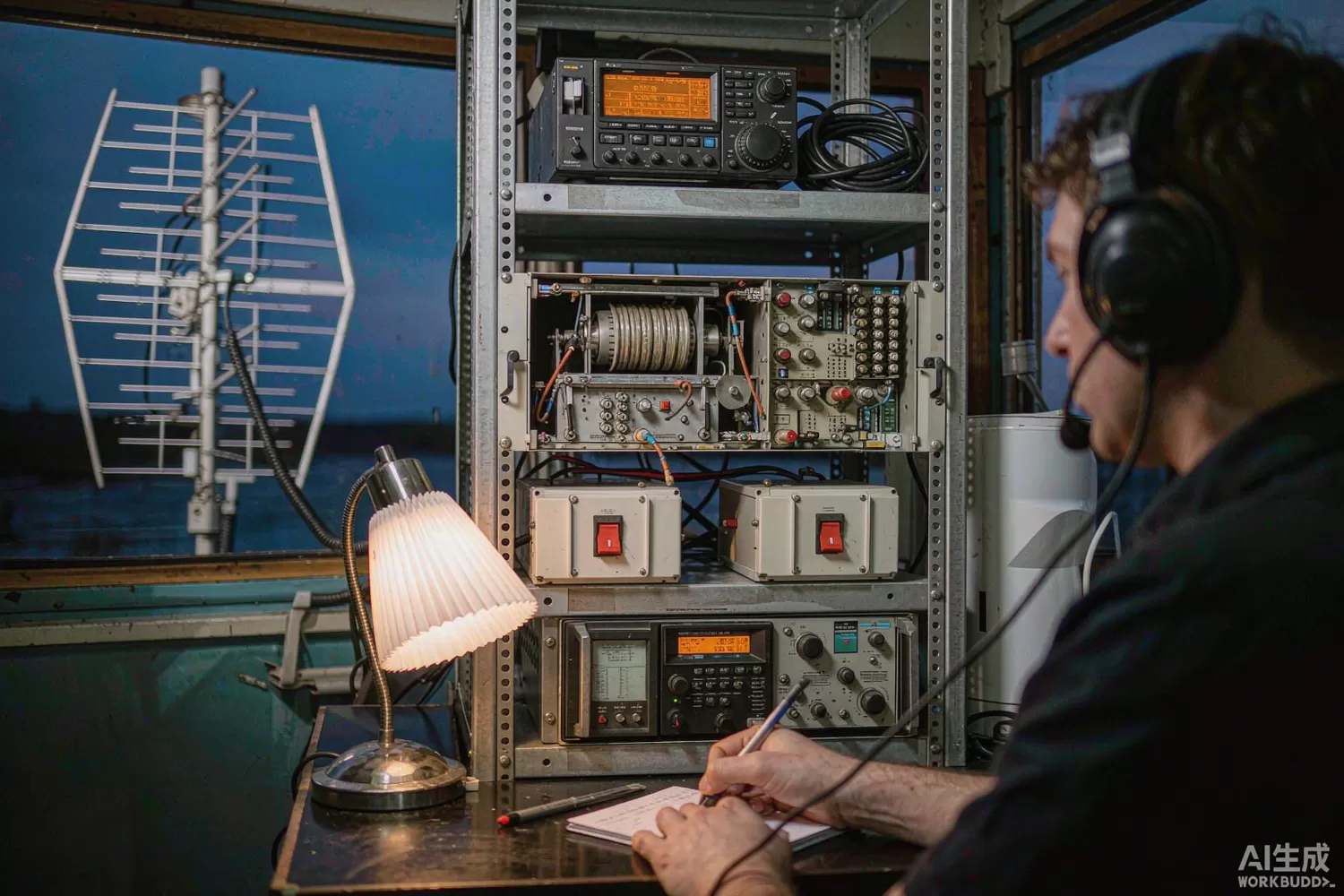
Most radio front ends fight to hear a weak signal in noise. An HF front end fights to hear a weak signal while the ionosphere drops dozens of kilowatt-class shortwave broadcasters on top of it. The noise floor at these frequencies is set by the sky and the environment, not by the receiver, so sensitivity is rarely the binding constraint — blocking, intermodulation and dynamic range are. That is why a serious 1.6 to 30 MHz front end looks more like a filter bank and a linearity exercise than an amplifier stack. This article works through the preselector, the first conversion, the AGC and the transmit side of an HF SSB transceiver, what software-defined architectures change, and a component-level domestic build with indicative costs. For the synthesiser side, see our PLL and VCO article.

Application logic: a hostile spectrum and a shared antenna
- The environment — propagation skips thousands of kilometres, so the band is crowded with distant high-power transmitters; atmospheric and man-made noise raise the floor to levels a modern receiver would envy, which frees the design budget for linearity instead of noise figure.
- Preselection — a bank of band-pass filters (or a tracking preselector) ahead of the first active stage keeps out-of-band broadcasters from loading the mixer; at these frequencies the filters are compact and cheap, which is why the preselector is the cheapest dynamic-range you can buy.
- Front-end protection — the same antenna that receives also transmits 100 watts or more, and co-located transmitters can inject tens of volts; switched protection diodes and relay or PIN-diode T/R routing must clamp fast and recover cleanly.
- The first conversion — classic designs upconvert to a high first IF with a high-level mixer, relying on mixer linearity and a good diplexer; software-defined designs digitise early and push selectivity into DSP, but the front-end linearity problem remains identical.
- AGC discipline — the gain distribution must keep the converter and digitiser in their sweet spot across a 100 dB input range; attack and release times are tunable per mode, and the control law is part of the product's personality.
- The transmit chain — a driver and a final stage deliver 100 to 125 watts of SSB with low intermodulation; harmonic filtering and an antenna tuner complete the path, and reverse-power protection guards against a mismatched antenna.
- Frequency control — channel spacing is fine and phase noise sets adjacent-signal performance; automatic link establishment needs frequency accuracy that a high-stability or disciplined reference provides.
- Operational reality — these radios live on ships, in remote camps, in vehicles and in emergency networks; the front end must tolerate lightning-adjacent environments, wide temperature swings and operators who key the transmitter into a bad match.
The parameters that decide whether the receiver earns its keep
- Third-order intercept — two strong broadcasters mixing in the front end can land exactly on your signal; every decibel of front-end IP3 is worth more than a decibel of sensitivity in this band.
- Blocking dynamic range — the receiver must keep demodulating a usable signal while an off-frequency station 100 kHz away is 100 dB stronger; the preselector and mixer choice decide this.
- Phase noise of the local oscillator — reciprocal mixing converts LO phase noise into adjacent-channel noise; a synthesiser that is fine for a handheld VHF radio can be inadequate for a competitive HF receiver.
- AGC accuracy and click behaviour — gain must track fading without thumps; the detector and control-loop design separate a pleasant radio from a tiring one over long listening shifts.
- Transmit intermodulation — splatter into adjacent channels is a regulatory and a courtesy problem; the driver and final stage must be backed off and biased for linearity rather than maximum efficiency.
- Harmonic and spurious control — the low-pass filter bank after the final stage must hold harmonics down across the whole 30 MHz span, and the filter switching must handle the transmit current without relay weld.
- Protection recovery — clamping diodes that conduct during a co-site hit must not add capacitance or distortion after they recover; protection parts are specified for recovery, not just clamp level.
- Temperature and battery reality — a radio that works from minus 30 to plus 60 degrees on a fluctuating supply needs references and regulators chosen for drift and dropout, not headline specs.
What is changing: direct sampling, digital pre-distortion and wideband operation
Three shifts define current HF design. First, direct sampling receivers: a 14- or 16-bit converter clocked at 60-100 MHz can digitise the whole HF band directly, which deletes the first mixer entirely and moves every selectivity problem into DSP; the analog front end shrinks to protection, filtering and a differential driver, and the converter and its clock become the performance-critical parts. Second, digital pre-distortion on transmit: a feedback path samples the amplifier output and a processor corrects the drive, so solid-state final stages now meet linearity targets that once needed tubes, at better efficiency. Third, wideband instant-bandwidth operation: frequency-hopping and wideband waveforms for both defence and civil applications need front ends flat across the whole band with fast synthesiser settling — which raises the value of broadband transformers, fast-switch filter banks and clean wideband clocks. All three shifts concentrate value in the clock, converter, protection and filter-switching parts — categories where domestic supply is advancing fastest, while the highest-linearity mixers and references remain the usual imported core.
Domestic alternatives: suppliers and indicative cost
At system level, domestic HF transceiver makers are mature and export widely. At component level: gain blocks, PIN and switch diodes, VCOs, clock generators, digital attenuators, LTCC filters, transformers, terminations, comparators, microcontrollers and regulators all have domestic families in daily use; the very highest-linearity mixers, the lowest-phase-noise references and 100 W-class final-stage transistors remain mostly imported, and the honest build is mixed.
A realistic domestic-leaning front end: a TCM8-1+ class broadband transformer for balun and combining duty, with a MABA-011040 where a packaged balun is preferred; a LFCN-95+ low-pass to hold transmit harmonics below the 30 MHz edge, plus discrete band-pass banks ahead of the first active stage; a HSMP-3890 and MA4L101 for T/R switching and front-end clamping; an SGA5589Z or MGA-30889 where a modest post-filter gain stage is needed; a SMV2020L-LF VCO and a SI5351A-B-GMR clock generator for reference and auxiliary clocks; a DAT-31575-SP+ in the AGC path; a SMT2010TALNF termination for the protection and test ports; a FLU10XMT class device for a driver stage; an AT32F425C8T7 for control, tuner and protection logic; and a HX2001 for the analog rails. Filter trade-offs are covered in our LTCC filter article.
Price figures below are indicative public-market reference ranges for moderate volumes, compiled from publicly observable listings. They fluctuate with the spot market, package option, grade (industrial, automotive, screened) and order quantity, and must not be read as a quotation. Ask us for a firm price on your exact part numbers and quantities.
| Function (imported anchor) | Example import part / class | Indicative import price (USD) | Domestic candidate | Indicative domestic price (USD) |
|---|---|---|---|---|
| Broadband transformer / balun | Mini-Circuits TCM8-1+ class | 2.0 – 4.5 | Domestic wound-component families (family level) | 0.6 – 1.5 |
| T/R switching and clamp diodes | HSMP-3890 / MA4L101 class | 0.4 – 3.0 | APD0510 class domestic PIN families (family level) | 0.2 – 1.0 |
| Post-filter gain block | SGA-5589Z class | 1.2 – 2.5 | Domestic gain-block families (family level) | 0.35 – 0.90 |
| VCO / LO source | Z-Communications VCO class | 6.0 – 15.0 | SMV2020L-LF (in stock, imported); domestic VCO families (family level) | 2.0 – 6.0 |
| Clock / reference generation | Silicon Labs SI5351 class | 1.0 – 2.5 | SI5351A-B-GMR (in stock); domestic equivalents at family level | 0.4 – 1.2 |
| AGC digital attenuator | DAT-31575-SP+ class | 2.5 – 5.0 | Domestic DSA families (family level) | 0.8 – 2.0 |
| Driver-stage transistor | Sumitomo FLU10XMT class | 20 – 45 | FLU10XMT (in stock, imported); domestic HF drivers (family level) | 6.0 – 18.0 |
| 100 W final-stage transistor | Imported HF MOSFET 100 W class | 30 – 70 | Domestic HF power MOSFET (family level, qualification required) | 12 – 30 |
| Control microcontroller | STM32F1-class | 1.5 – 3.5 | AT32F425C8T7 (Artery) | 0.5 – 1.2 |
Where the cost difference actually comes from
An HF transceiver's cost is dominated by the enclosure, the magnetics, the EMC filtration and the certification, so a cheaper front-end bill of materials moves the product price modestly. The strategic value is different: HF radios are bought in fleets with decade-long service expectations, and the painful supply event is not a price rise but an end-of-life notice on a mixer or a final-stage transistor five years into a programme. Domestic qualification of the support chain buys continuity for that horizon, and fleet buyers know it — tenders increasingly score supply security explicitly. Build the reference unit with imported parts, qualify domestic equivalents with side-by-side intercept and blocking measurements, and switch with data.
Validation flow before you commit
Measure intercept and blocking with two real signals, not just tone generators, because broadcast spectra are messy and the preselector interacts with the mixer in ways spot tests miss. Sweep the AGC with a fading simulator and log gain versus time; clicks and hunting show up there. Cycle the protection path with repeated overloads and verify that insertion loss and distortion return to baseline after each event. Run transmit intermodulation at three drive levels and confirm the pre-distortion constants still hold over temperature. Finally, parallel-run the domestic and reference builds on air for a season; fading statistics, not bench numbers, are what an operator notices. The power-stage thermal and protection details are covered in our power transistor article.
Frequently asked questions
Is sensitivity really unimportant at HF?
Below roughly 20 MHz the external noise floor usually exceeds what a good receiver can achieve, so extra sensitivity is wasted; in quiet sites and at the top of the band sensitivity still matters, so optimise for the deployment.
Can a direct-sampling receiver delete the preselector?
It deletes the mixer, not the filter bank; strong out-of-band signals still load the converter, so preselection remains the cheapest dynamic-range improvement even in an SDR.
Why keep a VCO-based local oscillator when DDS exists?
A clean VCO loop still beats a DDS on phase noise and spurious in many budgets, and many designs combine both; the choice is set by the reciprocal-mixing requirement of the target signal environment.
What is the first domestic part to qualify?
The support chain: gain blocks, protection diodes, attenuators, clocking and control; they are bench-verifiable, cheap to test, and unlock the largest share of the procurement score.
About us & trademarks: JTDZ Tech (Shenzhen Jingteng Electronics Technology Co., Ltd.) is an independent distributor of electronic components. We are not an authorised distributor or representative of the imported manufacturers named in this article. Manufacturer, brand and part names are used for identification purposes only; all trademarks remain the property of their respective owners. Cross-reference information in this article is based on publicly available sources, is subject to change, and is not a substitute for your own engineering validation. Always verify specifications against the manufacturer's datasheet before design-in or purchase.
