
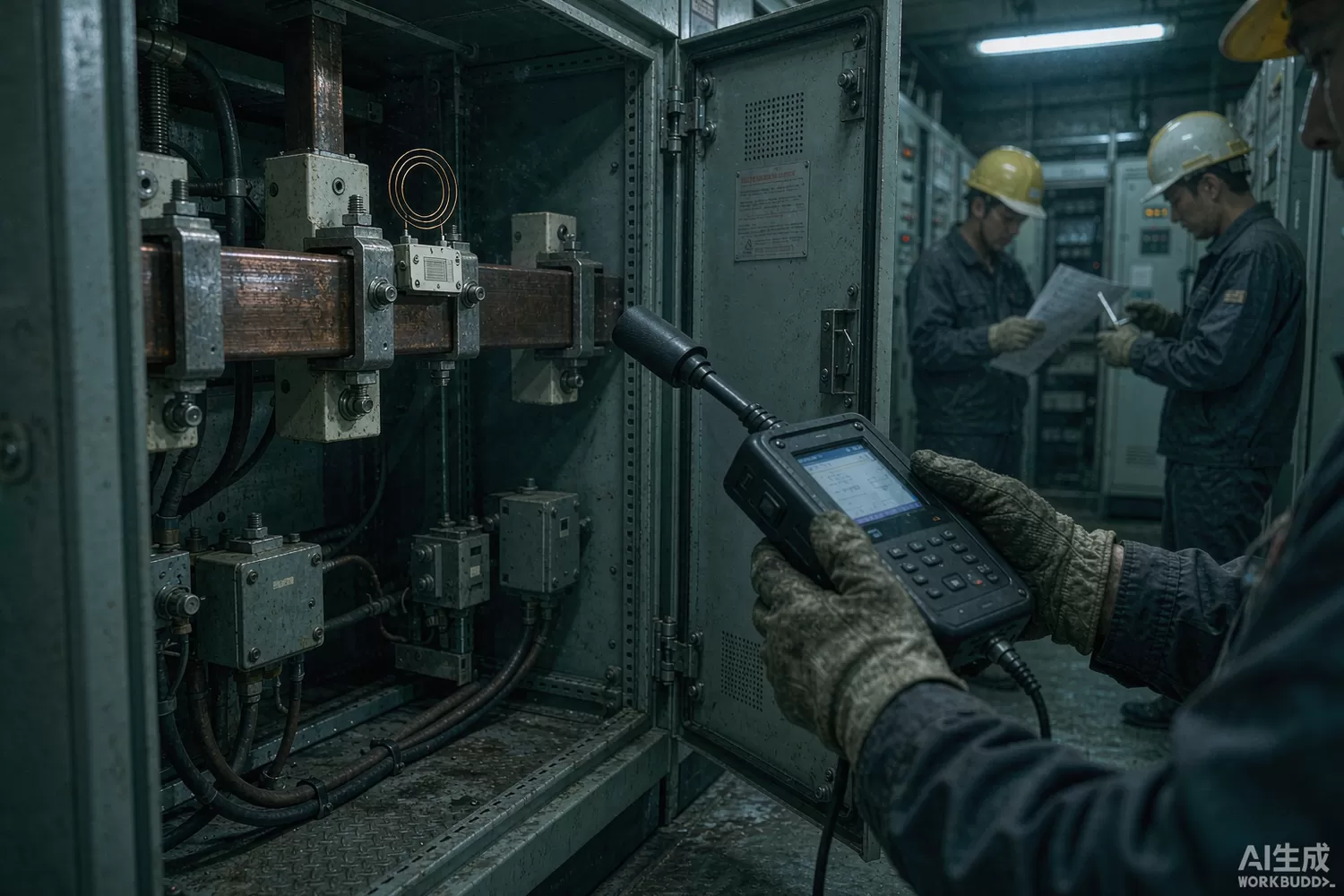
The most maintenance-free sensor in industry is one with no power supply at all. A surface-acoustic-wave (SAW) sensor is a piezoelectric chip that answers an incoming radio burst with its own resonant echo, powered entirely by the interrogating signal — the same energy-harvesting principle as an RFID tag, but answering with a frequency instead of an ID, and doing it inside a running motor, on a 25 kV busbar, or on a rotating turbine blade where wires and batteries simply cannot go. This article explains how the sensing physics maps to real measurements, the interrogation architectures and their trade-offs, what is new in the field, and the domestic supply picture. For the SAW device as a fixed-frequency component, see our SAW resonator article; for the general UHF reader side, our UHF RFID and energy-harvesting guide.

Application logic: the resonant frequency is the measurement
The principle is elegant. An interdigital transducer on lithium niobate or quartz converts an incoming RF burst into a surface acoustic wave; the wave reflects between grating structures and is re-radiated back. The chip's resonant frequency shifts with whatever strains or heats it — temperature moves the wave velocity by tens of kilohertz per degree, applied strain moves it further — so the interrogator measures the returned resonance and reads a physical quantity with no calibration drift from electronics, because there are no electronics. Four measurement families dominate:
- Temperature — switchgear busbars, motor end-windings, medium-voltage contacts: the sensor tolerates hundreds of degrees and total electrical isolation, which is the whole point in high-voltage environments.
- Pressure — a diaphragm couples strain into the SAW die for tyre-pressure-class and industrial process sensing without any sealed electronics cavity.
- Torque and strain — sensors bonded to rotating shafts report torque wirelessly for drivetrain and rig testing, replacing slip rings.
- Identity plus sensing — multiple resonators on one substrate encode both an ID and a measurement, letting one interrogator track many points.
Interrogation comes in two architectures, and the choice drives system cost. Pulse-based systems send a short burst and listen to the time-domain echo train — simple, and immune to multipath by time-gating, but range- and resolution-limited by the echo window. FMCW and chirp-interrogation systems sweep the transmit frequency and read the beat of the returned resonance — finer resolution and longer range, at the cost of a more complex synthesiser in the reader, the kind of frequency-generation chain covered in our DDS article. The 433 MHz ISM band suits metal-rich industrial plants; 915 MHz and 2.4 GHz give smaller antennas for shafts and rotating parts.
Parameters that decide whether the echo is readable
- Loaded Q and insertion loss — a higher-Q resonator returns a sharper, longer-lived echo and finer frequency resolution, but a narrower capture window; the interrogator bandwidth must match.
- Temperature coefficient by design — substrate choice sets sensitivity: lithium niobate for high temperature slope, quartz for stability-critical identity apps; know which you are buying.
- Reading range with the real antenna and metal — a sensor bolted to a busbar works with a different range than the datasheet's free-air figure; demand application-conditioned data.
- Update rate versus echo decay — high-Q sensors ring for microseconds, setting the fastest readable update rate; thermal time constants usually forgive this, vibration monitoring may not.
- Multiple-sensor collision handling — time- and frequency-gating must separate resonators on one busbar; ask how many sensors the reader resolves per sweep.
- Package survival — hermetic metal-cap packages for outdoor and washdown service; the die survives, the package corrosion does not.
- Mounting strain transfer — the adhesive or clamp is part of the sensor; a poorly coupled mount reads a different machine than a well-coupled one.
- Interrogator phase noise and spur content — at −120 dBm echo levels, reader phase noise sets the resolution floor, echoing the chain discipline in our reference-oscillator article.
What is new in passive SAW sensing
Three trends moved the category from niche to procurement lists. First, grid and heavy-industry adoption: switchgear and busbar temperature monitoring has become the anchor application, driven by predictive-maintenance mandates and the sheer economics of a sensor that never needs its battery changed in a 25-year installation. Second, higher-temperature materials and packages: newer die and hermetic packages survive 200–300 °C continuous, opening turbine, exhaust and mould monitoring where any electronic sensor dies. Third, interrogator integration: single-chip transceivers derived from the ISM-radio world have cut reader cost by an order of magnitude, turning point solutions into installable systems — the same cost curve described in our sub-GHz transceiver article. Standardisation for power-grid condition monitoring is progressing through industry consortiums, which matters because it converts proprietary sensors into a procurable commodity.
Domestic alternatives: suppliers and indicative cost
The domestic position is strong on the device tier and maturing on the system tier. The CETC 26th Institute (the SAW house within the state electronics group) supplies SAW resonator and sensing devices including high-temperature packages, and grid-oriented SAW sensor systems are offered by domestic integrators alongside the general SAW filter industry (Tai-Saw, site stock: TA0224A, TB0614A) that provides the process base. Imported anchors — SenGenuity (Kyocera AVX) SAW sensor families and European interrogation electronics — remain the documentation reference. The honest statement: at the device level domestic supply is proven; at the complete-system level (sensor + interrogator + software) evaluate domestic offerings case by case against your plant's communication and asset-management requirements.
An interrogator front end is standard RF engineering: a Mini-Circuits PHA-13LN+ as receive LNA, a Tai-Saw TA0224A SAW for band definition, a Titan Micro TS2502PN at the antenna port, and an Artery AT32F403ACGT7 for sweep control and peak extraction.
Price figures below are indicative public-market reference ranges for moderate volumes, compiled from publicly observable listings. They fluctuate with the spot market, package option, grade (industrial, automotive, screened) and order quantity, and must not be read as a quotation. Ask us for a firm price on your exact part numbers and quantities.
| Function (imported anchor) | Example import part / class | Indicative import price (USD) | Domestic candidate | Indicative domestic price (USD) |
|---|---|---|---|---|
| SAW temperature sensor, hermetic, to 200 °C | SenGenuity sensor families (family level) | 6 – 15 | CETC 26th Institute device families (family level) | 2.5 – 7 |
| SAW pressure / torque sensor element | Import sensor-die classes | 10 – 25 | Domestic die suppliers (family level, project basis) | 5 – 14 |
| Handheld interrogator, 433/915 MHz | Import reader electronics | 400 – 1,200 | Domestic integrated interrogators | 200 – 600 |
| Interrogator receive LNA | Mini-Circuits PHA-13LN+ class | 1.2 – 3.5 | Vanchip / Maxscend LNA families | 0.4 – 1.5 |
| Band-definition SAW filter | Murata / Tai-Saw classes | 0.25 – 0.9 | Tai-Saw SAW (site stock: TA0224A) | 0.08 – 0.3 |
| Antenna-port ESD array | Typical TVF/ESD classes | 0.1 – 0.4 | Titan Micro TS-series (site stock: TS2502PN) | 0.04 – 0.15 |
| Sweep & control MCU | STM32F103-class | 1.2 – 3.0 | AT32F403ACGT7 (Artery) | 0.4 – 0.9 |
Read the table as a screening tool, not a quotation. The economics that decide projects are rarely the sensor price: a battery-free sensor eliminates the battery replacement visit, and in a substation with hundreds of monitoring points that maintenance line item dwarfs the hardware delta. Evaluate total cost of ownership across the installation's life, and weight the domestic system integrators' local support — grid protocol compatibility, installation tooling, and Chinese-language engineering support are real differentiators that the imported device price does not capture.
Validation flow before you commit
Validate in the environment, not on the bench. Mount sensors on a live conductor or a rotating shaft representative of your plant and measure reading rate and range across a full duty cycle — switchgear doors closed, busbars loaded, machinery vibrating. Cross-check SAW readings against a reference thermocouple or torque flange over the full operating envelope, and record the mounting method: re-peel and remount the same sensor to quantify installation scatter, which typically exceeds the die's intrinsic accuracy. Exercise multi-sensor discrimination with your real sensor count per busbar, not the vendor's demo kit. For outdoor service, run humidity and thermal-cycling exposure, then re-verify Q and range, because package degradation shows up as a slow reading-range decay long before outright failure.
Frequently asked questions
How does a sensor with no battery survive for decades?
There is no chemistry to age: the die is a passive piezoelectric resonator and the only wear-out mechanisms are package corrosion and mounting degradation. That is exactly why heavy industry adopts it for 20-year assets.
SAW sensing or conventional RFID temperature tags?
RFID tags are digital and ID-centric with modest measurement accuracy; SAW sensors are analogue instruments with fine frequency resolution and much higher temperature capability. Choose by whether you need traceability or measurement.
Can one interrogator handle many sensors on one busbar?
Yes - sensors are separated by resonant frequency and echo timing, and modern readers resolve dozens per sweep. Verify discrimination with your actual sensor count and spacing before committing.
What limits reading range in metal-rich plants?
Reflections, conductor proximity and antenna polarisation. Demand range data with sensors mounted on your busbar geometry, and plan antenna placement as part of the installation design.
About us & trademarks: JTDZ Tech (Shenzhen Jingteng Electronics Technology Co., Ltd.) is an independent distributor of electronic components. We are not an authorised distributor or representative of the imported manufacturers named in this article. Manufacturer, brand and part names are used for identification purposes only; all trademarks remain the property of their respective owners. Cross-reference information in this article is based on publicly available sources, is subject to change, and is not a substitute for your own engineering validation. Always verify specifications against the manufacturer's datasheet before design-in or purchase.
